
Why did my foot suddenly start catching on stairs?
Catching your shoe on the edge of one step does not, by itself, mean your foot is weak.
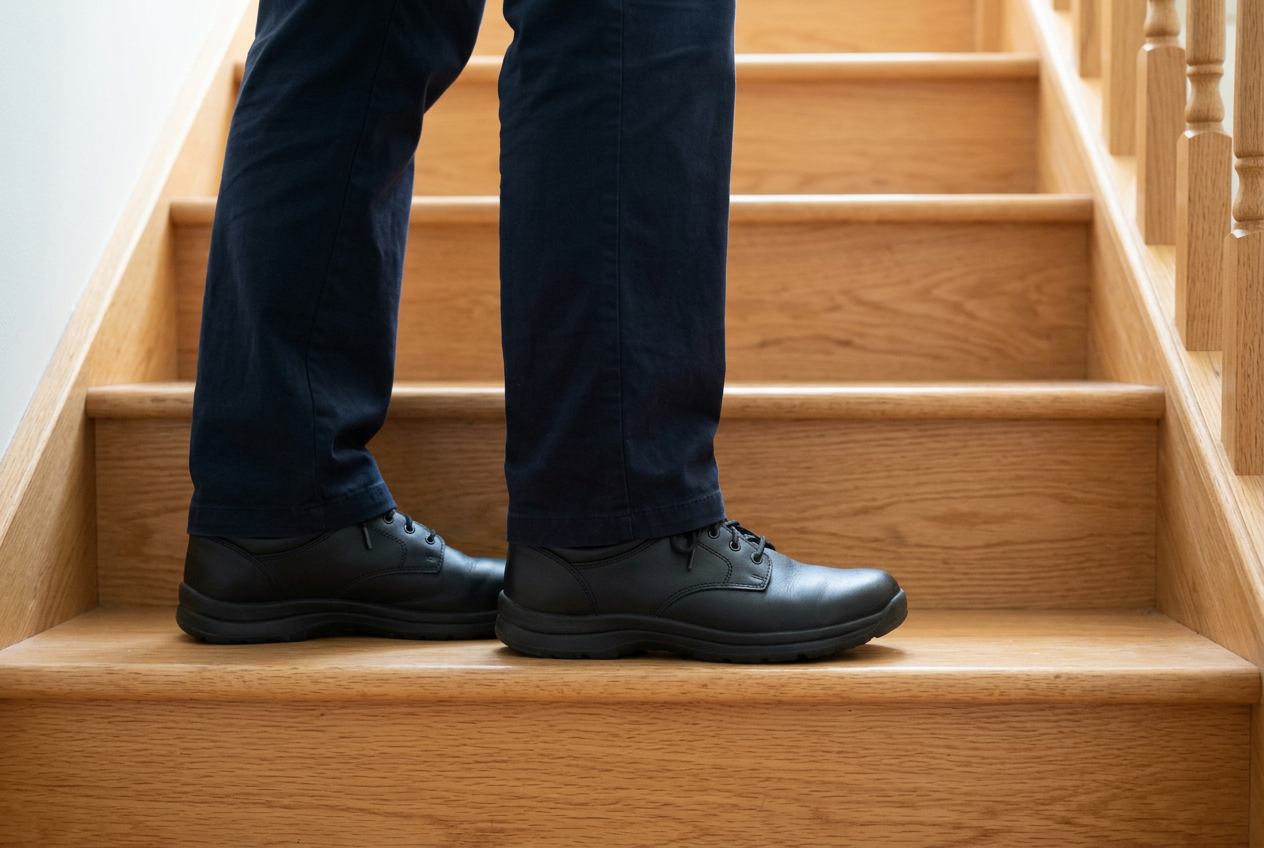
Why you might notice it on stairs
When you take a step, muscles lift the front of your foot so your toes clear the ground. If those muscles are weak, your shoe may scrape the next stair. “When foot drop is mild, patients may notice weakness only when walking up stairs or stepping onto a curb or stool,” says neurologist Peter D. Donofrio, MD. [6] On a level floor, you might hear one foot slap down or notice yourself lifting one knee higher to keep your toes from dragging. Foot drop is the name for difficulty lifting the front of the foot. It has several possible causes. [1]
How to stay safe and describe what happened
Use the handrail on stairs, keep stairways well lit, wear shoes that fit securely, and clear loose rugs and cords from your path. [7]
For your visit, make a short note from memory. Include when the change began, which foot caught, whether the weakness has changed since then, and whether you noticed it on stairs, on level ground or both. Mention any fall or near fall, pain or numbness, and any recent injury, operation or tight cast. You do not need to recreate the stumble. [1][8]
Where can the weakness start?
The peroneal nerve, also called the fibular nerve, wraps around the outside of the knee. It carries signals to muscles that lift the foot and toes. A knee injury or prolonged pressure there can weaken that movement. The top of the foot may also feel numb or tingly. [1][8]
A nerve root in the lower back supplies some of the same muscles. A herniated disc can press on a root such as L5 and make the foot harder to lift. Conditions affecting muscles, the brain or the spinal cord can also cause foot drop. The way your shoe catches cannot pinpoint the cause. [1][6]
What can the exam and tests tell me?
A clinician may watch you walk if it is safe, compare strength on each side, and check feeling and reflexes. The pattern of strong and weak movements helps them decide where to look next. [1][6]
A nerve conduction study measures how well signals travel along selected nerves. An EMG records electrical activity in selected muscles. Together they can help distinguish a problem near the knee from one at a nerve root. An EMG can look normal with an early or mild root problem. If your clinician orders testing, read what to expect during an EMG and nerve conduction study. [1][9][10]
Imaging may help identify a structural cause, such as a herniated disc pressing on a nerve root. Ask how the finding on the image matches the weakness on your exam. See when to get urgent help. [1][2][11]
Care depends on the cause. A brace and physical therapy may help with walking. [7][11]
What should I ask my physician?
- Which movements were weak on my exam, and what does that tell you about the cause?
- What is the safest way for me to manage the stairs at home?
- Would a nerve test or scan change what we do next?
- When should my strength be checked again?
If your clinician recommends routine spine follow-up after urgent causes have been assessed, you can reach our spine care team through our general line at 310-437-7921, see our locations, or request a visit. If a disc is involved, these questions about a herniated disc and sciatica can help you prepare. [12]
When to get help for new foot weakness
If you suddenly lose strength in even one foot or leg, call 911 now. Call even if the only change is that you can no longer lift the front of one foot as well as before, and even if your strength has already returned. Sudden weakness can be a sign of a stroke or transient ischemic attack (TIA). Do not wait for facial drooping, arm weakness or trouble speaking. Ask for an ambulance. Do not drive yourself or have someone drive you. Tell the dispatcher which side changed and when the weakness began. [2][3][4]
Go to an emergency department now if, along with new weakness, you cannot urinate, lose bladder or bowel control, or develop numbness around your genitals, anus or buttocks. Do not wait for severe back pain. Also go now if severe low back pain travels down a leg and you develop a change in bladder, bowel or sexual function, or numbness in that same saddle area. These can be signs of cauda equina syndrome, pressure on nerves in the lower back. Do not wait for an office callback. If you cannot get there safely, call 911. [2][5]
If leg weakness is noticeably worsening over hours or days, get an urgent medical assessment now, even if it began gradually. Go to an emergency department now if weakness is worsening in both legs or if worsening weakness comes with new trouble swallowing. Call 911 if you have trouble breathing or cannot get there safely. If you suddenly lose more strength at any point, call 911 for possible stroke. [2]
Do not wait for an outpatient test if you have any of the urgent symptoms. [1][2][11]
If weakness came on gradually, is stable and you have none of the warning signs above, contact a clinician promptly for an exam. Repeated unexplained tripping deserves attention, even without pain. [1]
For a possible life-threatening emergency, call 911.
This article is for general educational purposes. It does not provide medical advice or create a physician–patient relationship.
Learn More
- Stony Brook Medicine: Foot drop and its possible sources
- NICE: Suspected neurological conditions, recommendations 1.7.1–1.7.4 (PDF)
- MedlinePlus: Transient ischemic attack and why resolved symptoms still need emergency care
- National Heart, Lung, and Blood Institute: Stroke symptoms and emergency action
- American Association of Neurological Surgeons: Cauda equina syndrome
- Peter D. Donofrio, MD: Foot Drop, The Communicator, printed page 9 (PDF)
- NHS: Foot drop and fall prevention
- MedlinePlus: Common peroneal nerve dysfunction
- MedlinePlus: EMG and nerve conduction studies
- American Academy of Physical Medicine and Rehabilitation: What electrical tests can show about nerve-root problems
- MedlinePlus: Herniated disk exam and imaging
- Commons Clinic: Conditions treated in spine care
Related guides
Questions about a herniated disc and sciatica
Find questions about leg symptoms and how a clinician evaluates their cause.
What happens during an EMG and nerve conduction study?
See what the two parts of nerve testing can help your clinician learn.






 (562) 348-4588