
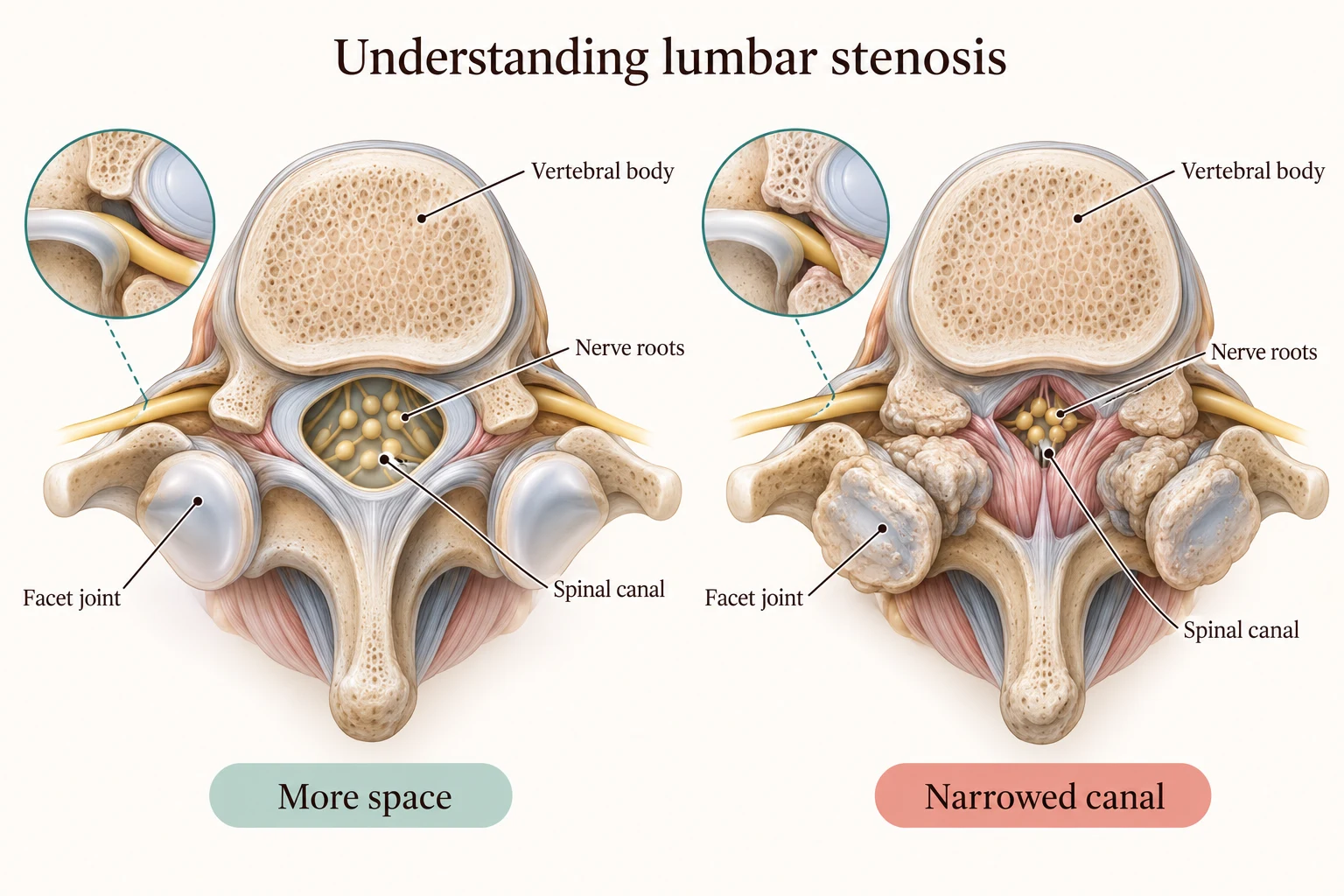
Original educational illustration. Two schematic cross-sections compare more space and a narrowed lumbar spinal canal.
The lower lumbar canal contains nerve roots. A picture of narrowing does not establish the cause of a person's symptoms; the examination and imaging need to be considered together.
Illustration references: Reference 1 · Reference 2 · Reference 3
1. Track where the symptoms travel
A herniated disc can irritate a nerve, but an image does not explain every episode of back or leg pain. In the low back, nerve-related symptoms may include pain into a leg, tingling, or weakness. Ask which part of your examination matches the disc finding before treating it as the source of every symptom.
For follow-up, describe the location and spread in ordinary language. Is the discomfort staying in the same area, reaching farther, or occurring in a new place? Note which leg is involved and whether the back and leg symptoms change together. A simple sketch or short note can help you explain the pattern. It cannot confirm that a disc has healed, but it gives the clinician something useful to assess.
Sources: Herniated Disc
2. Record what you can do more comfortably
Choose one or two necessary activities that you can describe consistently: a usual walk, getting through a work meeting, or preparing a meal. Notice how often symptoms make you stop and what helps you resume. Avoid repeatedly testing your maximum tolerance just to produce a number.
Tell the clinician whether an apparent improvement reflects feeling better, doing less, or taking a medicine that changes symptoms. Each can matter, but they tell different stories. Bring the practical result you value most into the discussion. If you can do a little more with manageable symptoms, ask how that should inform the next step. If function is shrinking, explain it even when the pain rating has not changed.
Sources: Herniated Disc
3. Treat changes in strength or sensation as their own conversation
Pain, numbness, and weakness are different symptoms. Ask how the clinician will monitor each and which changes should be reported before the next visit. A home symptom diary is useful background; it does not replace examination of muscle strength, reflexes, or sensation.
Contact a clinician promptly about new or progressive weakness. New loss of bowel or bladder control or numbness around the groin or saddle region needs emergency assessment. Do not label these changes as an ordinary recovery flare. Before leaving a visit, ask which contact route to use for a change in symptoms and which situations require emergency care. Knowing the distinction is more useful than trying to interpret a nerve symptom on your own.
Sources: Herniated Disc
4. Explain how symptoms affect sleep and the rest of your day
Notice whether the problem interrupts sleep, limits concentration, or changes how much help you need. Ask how to discuss these concerns alongside the physical examination. They can clarify why a modest change in a familiar task would be meaningful, or why the current plan is becoming difficult to maintain.
If the medicine plan has changed, record the name and effect, including unwanted effects, and bring the list to your clinician. Do not infer healing only because medication makes pain less noticeable. Ask which symptom changes the team hopes to see and how they want to balance comfort with the ability to participate in care. Your lived experience belongs in the assessment, including fatigue and worry about returning to responsibilities.
Sources: Herniated Disc
5. Separate symptom progress from what a scan shows
MRI gives detailed information about discs, nerves, and other soft tissues. A radiologist interprets the images, and the treating clinician connects that information with the clinical picture. Feeling better does not, by itself, prove that a disc has returned to a particular shape. An unchanged phrase on a report does not describe your entire recovery either.
Ask whether another image would answer an important new question and how the result might change care. Bring prior images when the team requests them, rather than only the report. If pain and imaging seem to tell different stories, ask what remains uncertain. You should not have to commission repeat scans to reassure yourself before someone explains the purpose of the test.
Sources: Spine MRI · Low Back Pain: Appropriateness Criteria
6. Describe what each treatment actually changed
Keep a brief timeline of medicines, therapy, injections, and other care. Include what you could complete and why something stopped. Saying a treatment “failed” may overlook a useful distinction between no benefit, short-lived benefit, side effects, or a plan you could not follow.
For epidural injections, the AAN’s evidence review distinguishes diagnosis, outcome, and duration of benefit. Ask whether a proposed injection is intended to create useful time for activity or rehabilitation and how its result would affect the next decision. If you already had surgery, make that clear when discussing recovery: postoperative instructions and follow-up should come from the team that knows the operation. Another person’s experience cannot supply your restrictions or predict your outcome.
Sources: Epidural steroid injections for chronic back pain: An AAN systematic review
7. Agree on what a plateau or setback should trigger
Many disc-related symptoms improve without an operation, while some situations need a surgical assessment. The decision depends on the cause, examination, effect on daily life, and treatment course. Ask the clinician what progress would support staying with the current plan and what would lead to reconsideration.
Leave with a review date and a short list of questions for the next visit. If an elective operation is proposed, ask which symptom it targets, which may remain, and what waiting would mean for your own situation. If a second opinion would help, bring the images and the existing recommendation. Tracking recovery should help you make a clearer decision, not turn every symptom fluctuation into a verdict on whether you are healing.
Our team includes spine surgeons Dr. Amandeep Bhalla and Dr. Sanjay Khurana, as well as pain physicians Dr. Michael Port and Dr. Evish Kamrava. Bring a short timeline and the activity you most want to regain. Relevant reviews can help you explore how patients describe explanations and follow-up while you prepare for your own assessment.
Sources: 5 Questions to Answer Before Considering Sciatica Surgery
Make the most of your visit
Questions to bring to your consultation
Choose the questions that matter most to you. Bring them along, and ask us to explain anything that is unclear.
- Which disc finding fits the symptoms I am tracking?
- What daily activity would be a useful measure of progress?
- Which change in strength or sensation should prompt earlier contact?
- How should we interpret improvement that depends on medication or reduced activity?
- Would another scan answer a question that changes care?
- What did the response to earlier treatment tell us?
- When should a plateau lead to reassessment or another opinion?
- What could a proposed operation improve, and what may remain?
Sources & further reading
- Herniated DiscAmerican Association of Neurological Surgeons
- Spine MRIACR / RSNA RadiologyInfo
- Low Back Pain: Appropriateness CriteriaAmerican College of Radiology and Radiological Society of North America
- Epidural steroid injections for chronic back pain: An AAN systematic reviewAmerican Academy of Neurology
- 5 Questions to Answer Before Considering Sciatica SurgeryJohns Hopkins Medicine
- Read our related clinical guide on Commons Clinic ↗
We use these medical sources to help explain your options and prepare you for a conversation with our team. Our guides feature our own clinicians; patient reviews describe individual experiences.









 (310) 595-1030