

Original educational illustration. Four illustrated stages show protection, movement, strength and return to activity after hip arthroscopy.
These are conversation stages, not a calendar. The procedure, tissue healing and your surgeon's and therapist's assessment determine progression. The people shown are fictional illustrations.
Illustration references: Reference 1 · Reference 2
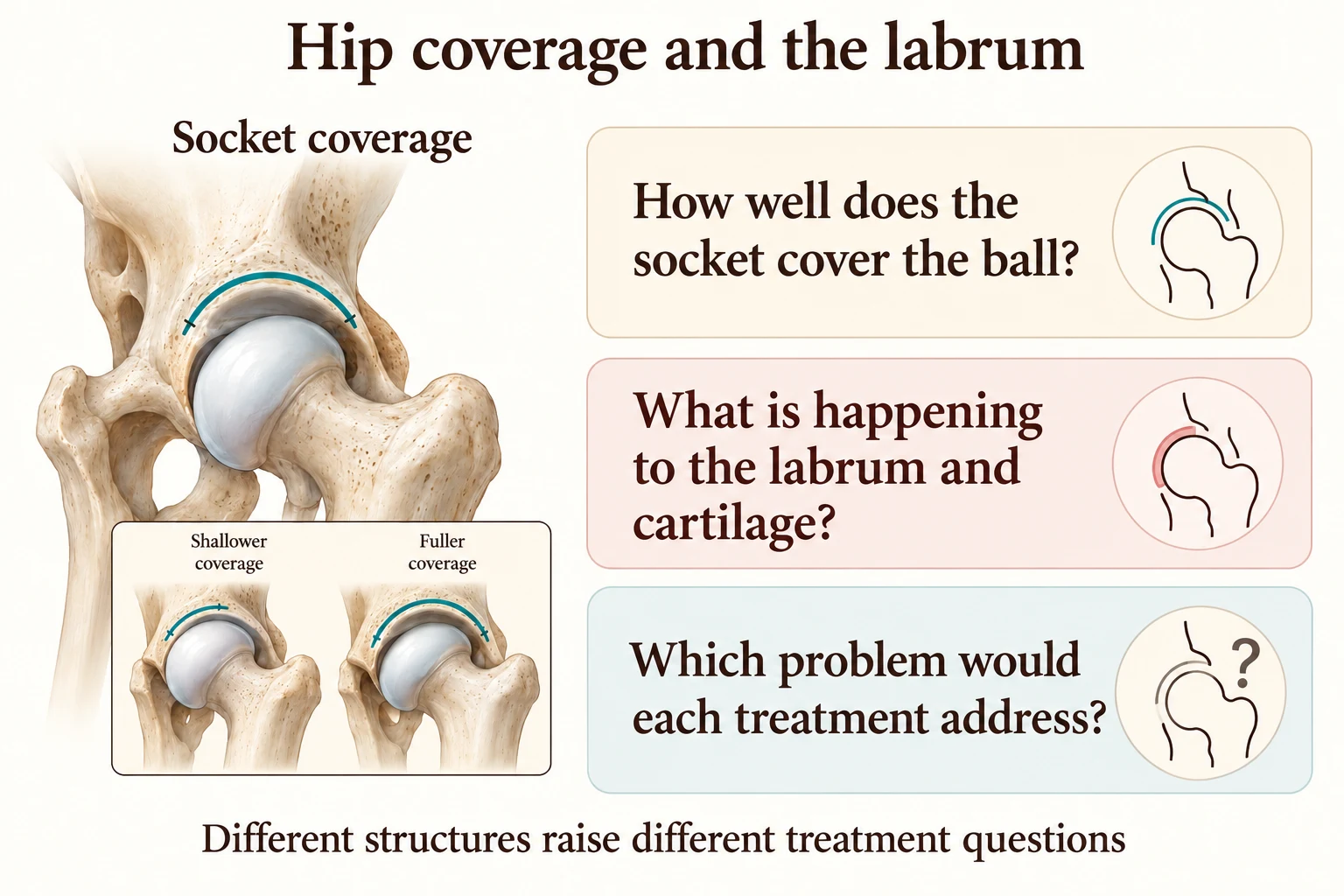
Original educational illustration. A hip socket-coverage schematic sits beside questions about coverage, labrum, cartilage and treatment purpose.
Ask how well the socket covers the ball, what is happening to the labrum and cartilage, and which problem each proposed treatment addresses. The drawings are conceptual, not a plan for an individual operation.
Illustration references: Reference 1 · Reference 2
1. Connect the scan to the symptoms
Hip impingement syndrome is more than a description of bone shape. The Warwick consensus defines it through a combination of symptoms, clinical signs and relevant imaging. That distinction matters when an MRI reports a labral tear or X-rays show a cam or pincer shape.
Tell the clinician which positions reproduce your familiar pain—deep sitting, turning, squatting or a particular sport movement. Ask whether the examination supports a problem inside the joint and whether another source of hip or groin pain should be assessed.
Sources: Warwick Agreement on FAI Syndrome: International Consensus
2. Understand what each finding means
The labrum is a ring of tissue around the socket. Impingement can create abnormal contact between the ball and socket and contribute to labral or cartilage damage. Ask the physician to distinguish the bony shape, the labral injury and any arthritis; they are connected but separate parts of the decision.
A helpful explanation should identify what would be treated and what would remain. If the report uses several unfamiliar terms, ask which one is most important for the next step rather than trying to solve every line independently.
Sources: Femoroacetabular Impingement
3. Make a rehabilitation trial purposeful
Ask what a structured nonsurgical plan would target, how it would fit your activities and what improvement is realistic. A plan might change provocative positions while working on relevant strength and movement. It should also include a review point so you know when to reassess.
Describe the therapy you have already tried in practical terms: exercises, progression, duration and response. If an injection is discussed, ask whether its purpose is temporary relief, helping clarify the pain source, or both. Ask how the response would influence the decision.
Sources: Femoroacetabular Impingement
4. Ask what arthroscopy can and cannot address
Arthroscopy may be considered for selected persistent symptoms after nonsurgical care. Depending on the problem, it may involve treating the labrum and reshaping impinging bone. It does not make every painful hip a suitable surgical candidate.
Socket coverage and stability deserve attention too. In a dysplastic hip, treating a tear without understanding the underlying structure can create different concerns. Ask whether preservation surgery, arthroscopy or a replacement discussion is most relevant to the overall condition of your joint, and why.
Sources: Hip Arthroscopy
5. Compare recovery with your actual goals
Before deciding, ask for the proposed rehabilitation outline, including crutches, motion precautions, therapy and staged return to activity. The plan depends on what is treated; “a scope” is not a complete description of recovery. Ask what would change if more cartilage damage is found.
Bring your sport, work and travel calendar. Discuss the goal separately for comfortable sitting, normal walking and demanding exercise. Ask how the team will judge readiness and what happens if pain improves but strength or confidence lags. You should leave with a next step that makes sense even if you are not ready to schedule surgery.
Sources: Hip Arthroscopy
6. Ask what a diagnostic injection would tell you
Mayo Clinic explains that a local anesthetic injection can help distinguish pain arising inside the hip joint from pain outside it. If an injection is suggested, ask whether its main purpose is diagnosis, short-term relief or both. Those are different questions, even when the same appointment serves both.
Beforehand, describe a familiar activity that brings on your symptoms and ask how the team wants you to report the response. Discuss how much improvement would be meaningful and what an incomplete response might mean. An injection result should be interpreted with the examination and images, rather than treated as a stand-alone verdict.
7. Understand what would change the recommendation
Ask what finding would make arthroscopy a poor choice for your hip. A painful labral tear, a shallow socket, and established arthritis can appear together, but they do not all respond to the same operation. Have the clinician explain which problem leads the decision and which uncertainty remains. If you obtain another opinion, bring the actual images and the proposed procedure list so the comparison is meaningful. You can ask our team to organize the discussion around a task that matters to you, such as sitting through work, returning to dance, or walking comfortably. A decision should explain both the expected improvement and what the operation may leave unchanged.
Sources: Femoroacetabular Impingement
Make the most of your visit
Questions to bring to your consultation
Choose the questions that matter most to you. Bring them along, and ask us to explain anything that is unclear.
- Do my symptoms, examination and imaging point to the same problem?
- Which finding is most likely to explain my familiar pain?
- How much arthritis or cartilage damage is present?
- Have we assessed socket coverage and hip stability?
- What would a useful rehabilitation trial target?
- What exactly would you repair or reshape during arthroscopy?
- How would unexpected cartilage findings change the plan?
- Which milestones guide walking, work and return to my sport?
Sources & further reading
- Warwick Agreement on FAI Syndrome: International ConsensusWarwick Agreement on FAI Syndrome
- Femoroacetabular ImpingementAmerican Academy of Orthopaedic Surgeons
- Hip ArthroscopyAmerican Academy of Orthopaedic Surgeons
- Hip labral tear: Diagnosis and treatmentMayo Clinic · Page date February 1, 2024
We use these medical sources to help explain your options and prepare you for a conversation with our team. Our guides feature our own clinicians; patient reviews describe individual experiences.







 (310) 595-1030