
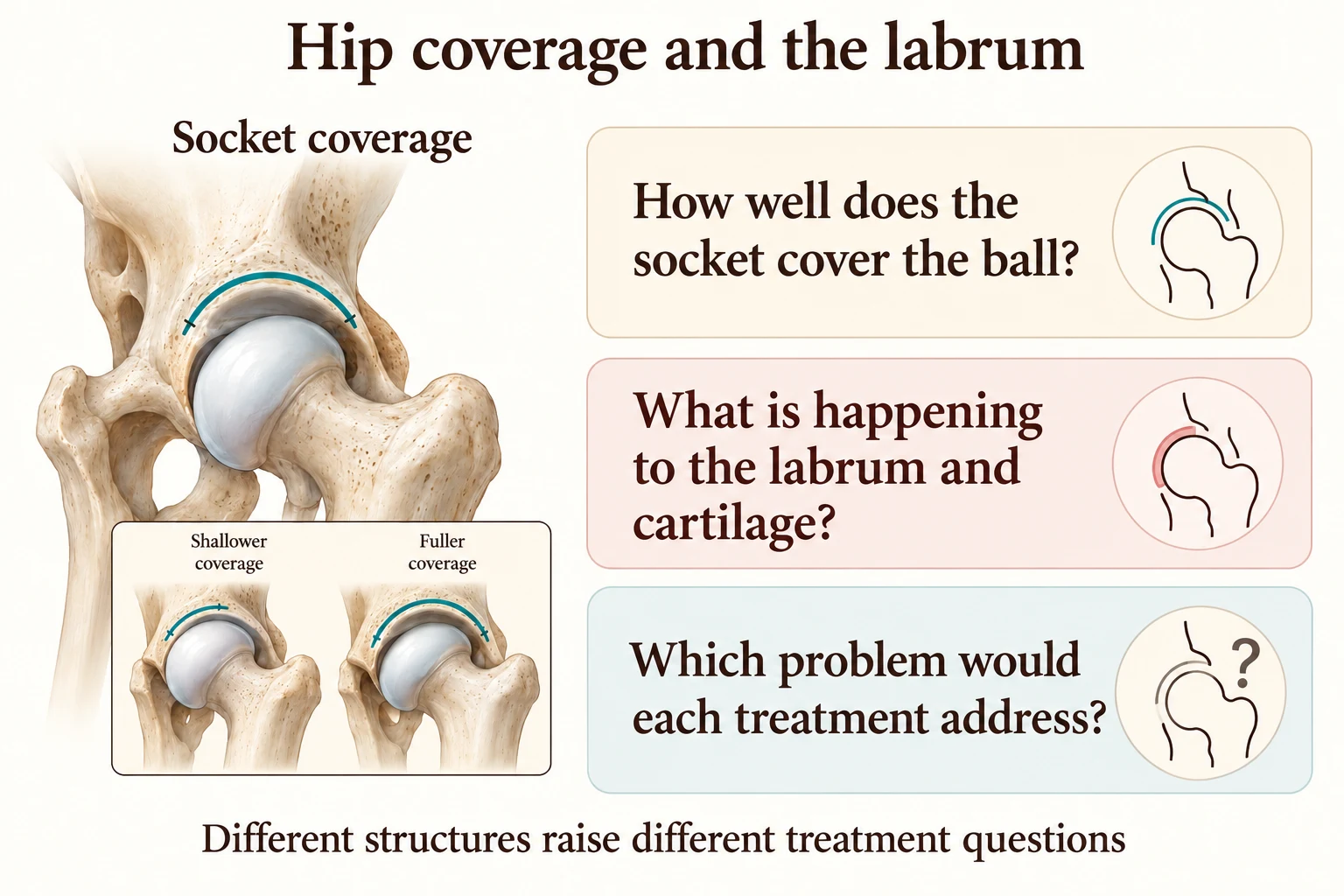
Original educational illustration. A hip socket-coverage schematic sits beside questions about coverage, labrum, cartilage and treatment purpose.
Ask how well the socket covers the ball, what is happening to the labrum and cartilage, and which problem each proposed treatment addresses. The drawings are conceptual, not a plan for an individual operation.
Illustration references: Reference 1 · Reference 2

Original educational illustration. Illustrated scenes show device fitting, home access, stairs and transport planning, and discussion with a care team.
Choose and practice a plan that matches your weight-bearing instructions, balance and home. Discuss the device, doorways, stairs and travel before discharge. The people shown are fictional; no walking or stair technique is prescribed.
Illustration references: Reference 1 · Reference 2
1. What is causing my symptoms, and how does dysplasia fit?
Hip dysplasia involves an abnormally developed hip socket and can become symptomatic in adolescence or adulthood. A shallow socket may leave the ball insufficiently supported; it is a structural diagnosis that requires interpretation alongside symptoms and examination.
Ask your surgeon to show you the relevant findings on your images. Explain where you feel pain, which activities bring it on, and what earlier treatments changed. If you also have a labral tear, ask how the two findings relate. The useful question is not simply whether dysplasia appears on a scan, but why the team believes the proposed treatment addresses the problem affecting your life.
Sources: Hip Dysplasia
2. What would PAO change in my hip?
In periacetabular osteotomy, or PAO, the surgeon cuts and repositions the socket portion of the pelvis to improve coverage of the femoral head. It aims to preserve the natural hip rather than replace it with an artificial joint.
Ask for an explanation of the planned correction and how it relates to your anatomy. Does the recommendation include work on the femur or treatment inside the joint? Which part is essential, and which part depends on findings during evaluation or surgery? A diagram can make this discussion easier to remember. Ask for the procedure names in writing so you can compare opinions about the same proposed operation.
3. What makes preserving this particular joint reasonable?
The condition of the joint surface matters in a preservation decision. The International Hip Dysplasia Institute describes cartilage damage, arthritis, joint congruence, and other individual factors as relevant when considering PAO versus replacement.
Ask what the images show about your cartilage and how confident the team is in that assessment. Ask what benefit seems realistic for someone with your findings and what limits that expectation. Avoid reducing the discussion to an age cutoff or a single measurement found online. If two surgeons interpret the joint differently, ask each to explain the finding that changes the recommendation and what additional information might settle the question.
Sources: Treatment Overview
4. Which alternatives deserve a fair discussion?
Hospital and specialty-institute resources describe nonsurgical care, preservation procedures, and hip replacement as different options for different situations. Arthroscopy can address selected tissue problems, but it does not by itself reposition a shallow socket.
Ask what each reasonable option would seek to improve in your case. If therapy, activity changes, or medication have already been tried, describe the duration and response rather than saying only that treatment “failed.” If arthroscopy is proposed, ask how the socket support has been evaluated. If replacement is proposed, ask why preservation is less suitable. A fair comparison includes the burden and uncertainty of every option, including continued observation.
Sources: PAO Surgery (Periacetabular Osteotomy) · Treatment Overview
5. What does “worth it” mean for the activities I care about?
AAOS describes preservation treatment as an effort to reduce symptoms and retain the native hip. That is a broad treatment aim, and your consultation should translate it into priorities that matter to you.
Choose two or three examples: walking through the workday, sitting comfortably in class, sleeping, or participating in a particular activity. Ask which are likely to change, which may remain difficult, and what evidence the surgeon uses to form that judgment. Ask about the possibility of future surgery without assuming PAO permanently eliminates that possibility. It is reasonable to want a clear benefit while also asking what remains uncertain.
Sources: Adolescent Hip Dysplasia
6. What are the risks and the demands of bone healing?
PAO involves bone cuts that must heal, and HSS describes a period of protected weightbearing and rehabilitation after surgery. It should be planned as a substantial recovery commitment rather than treated as interchangeable with a smaller hip procedure.
Ask the surgeon to explain the complications most relevant to your health and anatomy and how they are detected and managed. Discuss any medicines, smoking or nicotine use, previous operations, and problems with bone healing. Request the actual plan for walking support, follow-up imaging, and changes in protection. You should understand who makes those decisions and how to reach the team if recovery does not follow the expected course.
7. What support would I need at home, school, or work?
The practical burden of recovery belongs in the decision before you choose a date. A plan can look manageable in a clinic and still be difficult in a home with stairs, a long commute, or limited help.
Describe where you sleep, who lives with you, and which responsibilities cannot simply pause. Ask about transportation to follow-up and therapy, work or school accommodations, and equipment assessment. If you need paid help, leave from work, or insurance approval, ask for the contact person who can clarify those details. Write down the assumptions behind the recovery plan so that your family and clinical team are preparing for the same situation.
8. How should I use research, second opinions, and patient reviews?
Published outcomes need context: the patients studied, their joint condition, the follow-up period, and the definition of success. Ask which research is most applicable to your findings and whether a second preservation opinion could help with an unresolved decision.
Patient stories may describe early recovery or a caregiver’s perspective rather than a final result. Those accounts may help you think about explanations, support, and practical questions, but they do not establish typical pain relief, recovery time, or the chance that you will avoid replacement. When reading an account, ask how far along the writer was and whether their operation and situation resemble the one you are considering.
Sources: Treatment Overview
Make the most of your visit
Questions to bring to your consultation
Choose the questions that matter most to you. Bring them along, and ask us to explain anything that is unclear.
- Which findings explain my symptoms and support the diagnosis?
- What would you reposition, and would any other procedure be involved?
- How much arthritis or cartilage damage is present?
- Why does PAO, arthroscopy, replacement, or continued nonsurgical care fit my case?
- Which of my activity goals are realistic, and what remains uncertain?
- Which complications matter most for my health and anatomy?
- What walking support, home help, and follow-up would recovery require?
- Which outcome studies or second opinion would help me make the decision?
Sources & further reading
- Hip DysplasiaJohns Hopkins Medicine
- PAO Surgery (Periacetabular Osteotomy)Hospital for Special Surgery
- Treatment OverviewInternational Hip Dysplasia Institute
- Adolescent Hip DysplasiaAmerican Academy of Orthopaedic Surgeons
- Read our related clinical guide on Commons Clinic ↗
We use these medical sources to help explain your options and prepare you for a conversation with our team. Our guides feature our own clinicians; patient reviews describe individual experiences.





 (310) 595-1030