
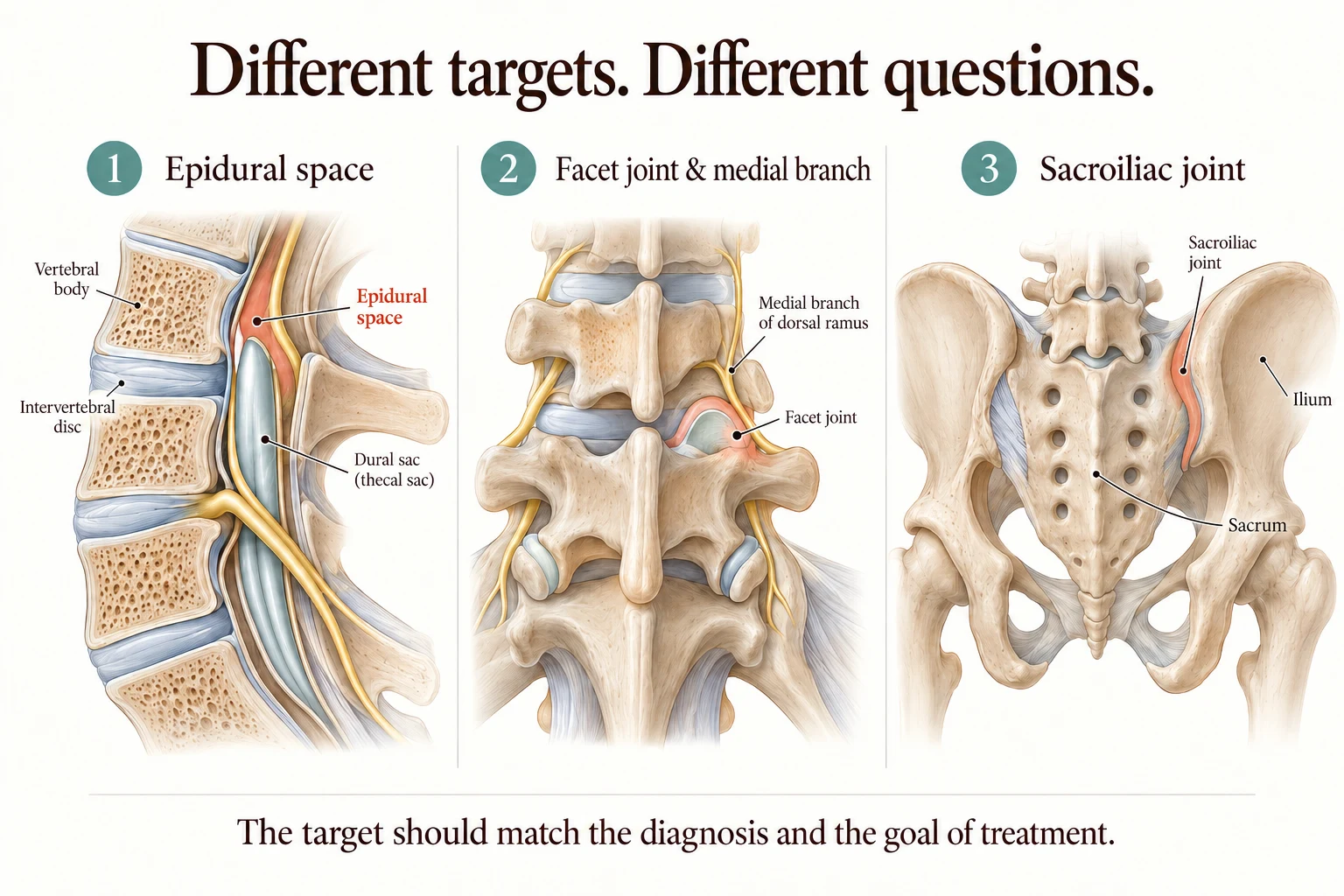
Original educational illustration. Three schematics locate the epidural space, facet joint with a medial branch, and sacroiliac joint.
The epidural space lies outside the dural sac; facet and sacroiliac procedures address different targets. Ask how the target was identified and what outcome would justify treatment. This is an orientation graphic, not an injection technique.
Illustration references: Reference 1 · Reference 2 · Reference 3
1. Start with the symptom you want to change
An epidural injection delivers medicine into the space around spinal nerves. It may be offered for selected problems involving nerve irritation; it is not a universal treatment for every kind of back pain. Ask your physician to connect the proposed target with your symptoms and examination, rather than stopping at a finding on an MRI.
Describe the problem in everyday terms: pain down your right leg, a commute you cannot tolerate, or sleep interrupted by arm pain. If several symptoms overlap, ask which one the injection is expected to address and which may need a different plan.
Sources: Epidural Injections
2. Know the procedure and its limits
Before you agree, have the team name the spinal level, side, approach, and medicines. Ask whether the main aim is symptom relief, information about the pain source, or both. Those goals require different conversations about how to interpret a response.
A useful explanation includes the possibility of little benefit. Ask what would count as worthwhile improvement for your situation, what the clinician cannot predict, and whether the hoped-for improvement would make rehabilitation or daily activity easier. Being pain-free for a short period and being able to function better over time are different outcomes.
Sources: Epidural Injections
3. Compare the next step with the alternatives
Ask why an injection makes sense now compared with continuing the current plan, changing rehabilitation, reviewing medication, or obtaining a surgical opinion. The answer should reflect your diagnosis and priorities. NICE guidance distinguishes selected use for acute, severe sciatica from using spinal injections routinely for nonspecific low-back pain. Recommendations and coverage also vary by setting.
If you have already had injections, bring their dates and results. Describe what changed and for how long. Ask what would justify another attempt rather than assuming that a preset series is necessary regardless of response.
The 2025 AAN review describes limited benefits that differ by diagnosis and by whether pain or disability is measured. A separate 2025 BMJ guideline recommends against the injections it evaluated for chronic non-cancer spine pain. Ask which population and treatment goal best match your situation, and how your physician weighs benefit, uncertainty and burden. A report of relief from another patient cannot resolve that question for you.
Sources: Low back pain and sciatica in over 16s: assessment and management — recommendations · Epidural steroid injections for chronic back pain: An AAN systematic review · Epidural steroid injections for chronic back pain: An AAN systematic review · Commonly used interventional procedures for non-cancer chronic spine pain: a clinical practice guideline
4. Prepare with instructions written for you
Share a complete medicine and supplement list, allergies, previous reactions, diabetes, infection concerns, and possible pregnancy. Ask for personalized instructions about medicines, eating and drinking, transportation, and activity afterward. Do not alter prescribed medicines using a general web checklist.
Make time for the practical questions. Will sedation be used? Who performs the procedure? What imaging guidance is planned? Which risks matter most with this particular approach? Ask who to call if the instructions from the prescribing clinician and procedural team seem inconsistent. Resolve that before procedure day.
Sources: Epidural Injections
5. Make the safety conversation personal
Johns Hopkins highlights diabetes, contrast allergy, and other health conditions as reasons to discuss preparation individually. An injection also has risks beyond temporary soreness, including bleeding, infection, and nerve injury. Bring your complete medicine list and details of earlier reactions. Ask which risks change with the proposed approach and how the team will address them. You should receive clear instructions from the clinicians responsible for your care, including whom to contact if your glucose, symptoms, or medicines raise a concern before the procedure.
Sources: Epidural Corticosteroid Injections
6. Make the follow-up useful
Before leaving the consultation, agree on what to record after treatment. A simple note about the treated pain, a familiar activity, and any unwanted effects may help you describe the response accurately. Ask how medicines used during the procedure could affect the first few hours and when the physician wants to assess the longer response.
Schedule or clarify the follow-up. Ask what happens if relief is brief, incomplete, or absent; whether the diagnosis will be reconsidered; and how the team handles a new symptom. You should know the contact route even if everything goes smoothly.
Sources: Epidural Injections
7. Find a clinician who can explain the whole plan
At Commons Clinic, Dr. Michael Port offers epidural steroid injections within his pain-management practice, and Dr. Evish Kamrava focuses on interventional spine care and functional recovery. Their profiles can help you explore the care each offers and prepare for a discussion about your own symptoms.
Bring the images and records you already have, along with a short list of treatments and responses. Tell the physician which activity you most want to improve and what worries you about an injection. Before leaving, ask for a summary of the target, the reason to proceed, and the follow-up plan. It should be clear enough that you could explain the next step to a family member without needing to translate medical terms.
Sources: Epidural Injections
Make the most of your visit
Questions to bring to your consultation
Choose the questions that matter most to you. Bring them along, and ask us to explain anything that is unclear.
- Which symptom and nerve target are we trying to treat?
- Why do you favor this level, side, and approach?
- What benefit would make the injection worthwhile for me?
- How does it compare with continuing nonsurgical care or seeking a surgical opinion?
- What personal risks or medication issues should we address?
- Will I need sedation, a driver, or time away from work?
- What should I record, and when will you assess the response?
- What would you recommend if it helps briefly or does not help?
Sources & further reading
- Epidural InjectionsACR / RSNA RadiologyInfo
- Low back pain and sciatica in over 16s: assessment and management — recommendationsNICE
- Epidural steroid injections for chronic back pain: An AAN systematic reviewAmerican Academy of Neurology
- Commonly used interventional procedures for non-cancer chronic spine pain: a clinical practice guidelineBMJ / international guideline panel
- Epidural Corticosteroid InjectionsJohns Hopkins Medicine
We use these medical sources to help explain your options and prepare you for a conversation with our team. Our guides feature our own clinicians; patient reviews describe individual experiences.








 (310) 595-1030