
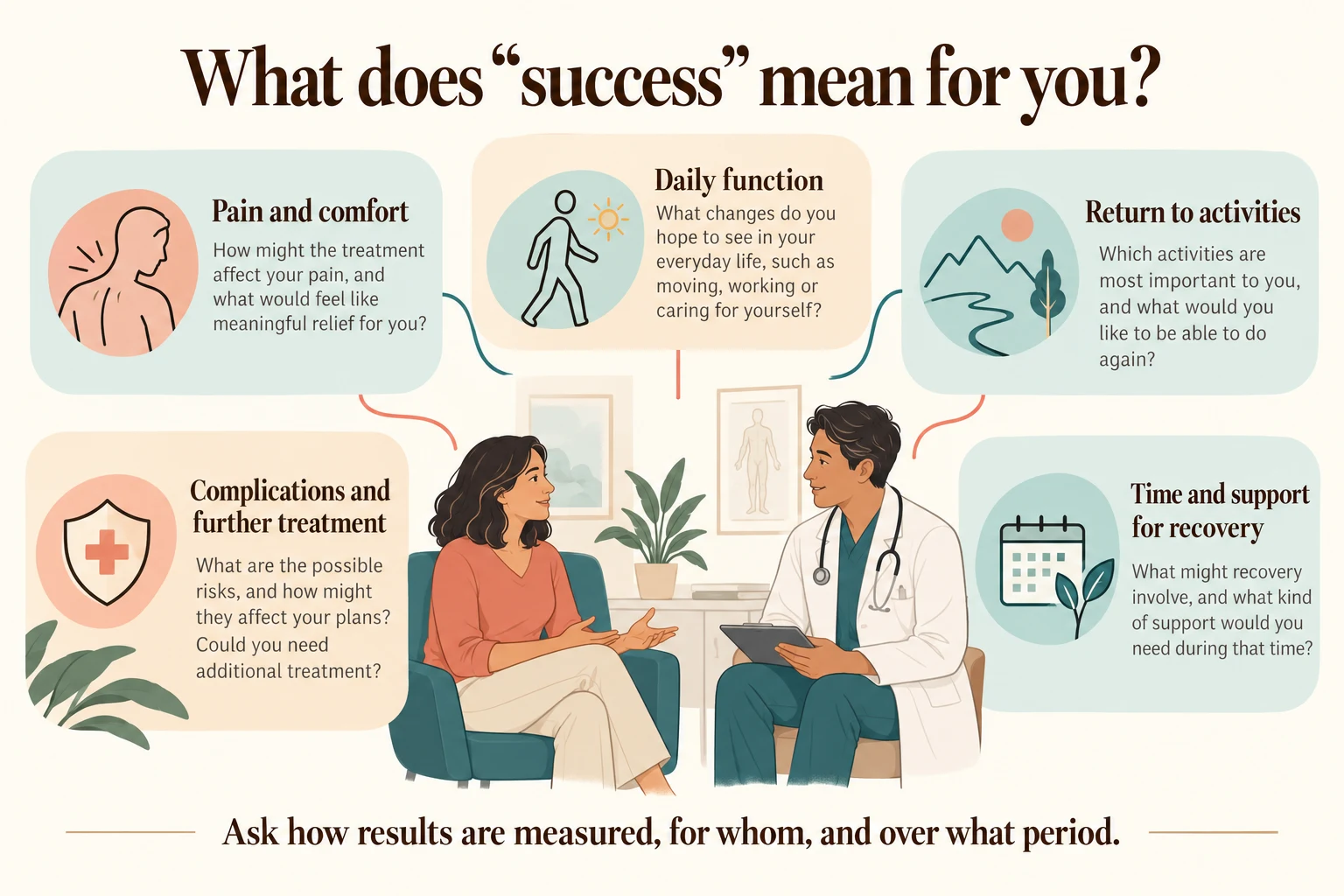
Original educational illustration. Five discussion areas surround an illustrated patient-clinician conversation: comfort, function, activities, complications and recovery support.
Ask how results are measured, in which patients and over what period. Pain relief, daily function, returning to activities, further treatment and time or support needs are separate outcomes. Patient reviews alone cannot establish their probabilities.
Illustration references: Reference 1 · Reference 2
1. Tell the physician what a better day would look like
Pain relief may be one goal, but it is rarely the whole goal. Perhaps you want to sleep through the night, stand for a work shift, walk to a café, or return to a sport. Describe the specific task and what limits it now. Also mention what you are unwilling or unable to take on at the moment. A recommendation is easier to assess when both you and the clinician know what change would make the treatment worthwhile.
NIH decision guidance asks patients to consider a treatment’s effect on everyday life. Bring one ordinary week into the discussion: work hours, travel, caregiving, sleep, and help at home. Identify the commitment you can make and the task you most want back. Ask which tradeoff is likely to matter most for you and whether there is time to arrange support before deciding. If a recommendation feels difficult to carry out, describe the obstacle plainly so the conversation can address it rather than leaving you with a plan that only works on paper.
2. Ask to see the reasonable choices together
AHRQ’s SHARE approach asks clinicians to compare options, discuss benefits and harms, understand preferences, reach a decision together, and revisit it. NICE similarly recommends discussing consequences and uncertainty in the context of the person’s life. Ask which options apply to your situation, including whether monitoring or continuing the current approach is reasonable. A decision aid, when available and relevant, can support that conversation; it cannot replace an assessment of your symptoms, health history, and goals.
Sources: AHRQ: Essential Steps of Shared Decision Making · NICE NG197: Shared decision making recommendations
3. Compare benefit, burden, and uncertainty
For each option, write down three things: what it is intended to improve, what you would have to do, and what remains uncertain. Ask whether the benefit is mainly expected in pain, movement, endurance, or another area. Then ask what would count as a limited response. If numbers are discussed, ask for the same time period and a comparable group of patients across the options. You can ask for a plain explanation of which parts of a prediction are known and which are an estimate.
AMA consent guidance includes the burdens, risks, benefits, and alternatives to a proposed treatment, including forgoing it. Compare reasonable options using the same headings rather than giving one a detailed discussion and another only a name. Ask which symptom each option targets, what uncertainty remains, and what participation it requires from you. Include the possibility of observation when your clinician considers it appropriate. Write down why our physician favors an option for your particular findings; that reasoning matters more than a general description of the procedure.
Sources: Informed Consent — AMA Code of Medical Ethics, Opinion 2.1.1
4. Make personal risks part of the comparison
Your medical history, previous treatment, current medicines, and practical support can affect the discussion. Ask which factors matter in your case and whether anything should be addressed before moving forward. Do not stop or change medicines on your own to prepare for a possible treatment. Ask the responsible clinician for instructions. It is also reasonable to discuss a concern that is hard to quantify, such as managing recovery while caring for a family member or being away from work.
5. Agree on a review point rather than an open-ended trial
If you choose a nonsurgical approach, ask what the plan involves, how you will carry it out, and when it will be reassessed. If you choose an operation, ask what milestones and restrictions will shape recovery. Either way, decide which changes should prompt earlier contact. A decision can be thoughtful without being permanent. Knowing what would lead the team to reconsider helps you recognize when the original plan still fits and when another discussion is needed.
6. Record your choice and reasons to reconsider
A workable decision includes what you are choosing now, why it fits, and what might lead you to reconsider. You can ask for time to talk with someone you trust when the decision is not urgent. You can also ask the physician to identify the part that is time-sensitive. Bring practical constraints into the same discussion as the medical options. Work, caregiving, travel, and the help available at home can change which reasonable plan you can actually carry out.
Make the most of your visit
Questions to bring to your consultation
Choose the questions that matter most to you. Bring them along, and ask us to explain anything that is unclear.
- Which choices are reasonable for my diagnosis and circumstances?
- What is each option most likely to help me do?
- What are the main drawbacks or burdens of each choice?
- How does my health history change the risks?
- What happens if I wait or continue the current plan?
- How certain are the expected benefits?
- What would make us change course?
- Can I take time to review the options or discuss them with someone I trust?
Sources & further reading
- AHRQ: Essential Steps of Shared Decision Makingahrq.gov · Published September 2020
- NICE NG197: Shared decision making recommendationsNational Institute for Health and Care Excellence
- Informed Consent — AMA Code of Medical Ethics, Opinion 2.1.1code-medical-ethics.ama-assn.org
- Discussing Health Decisions with Your DoctorAuthoritative clinical resource
We use these medical sources to help explain your options and prepare you for a conversation with our team. Our guides feature our own clinicians; patient reviews describe individual experiences.









 (310) 595-1030