
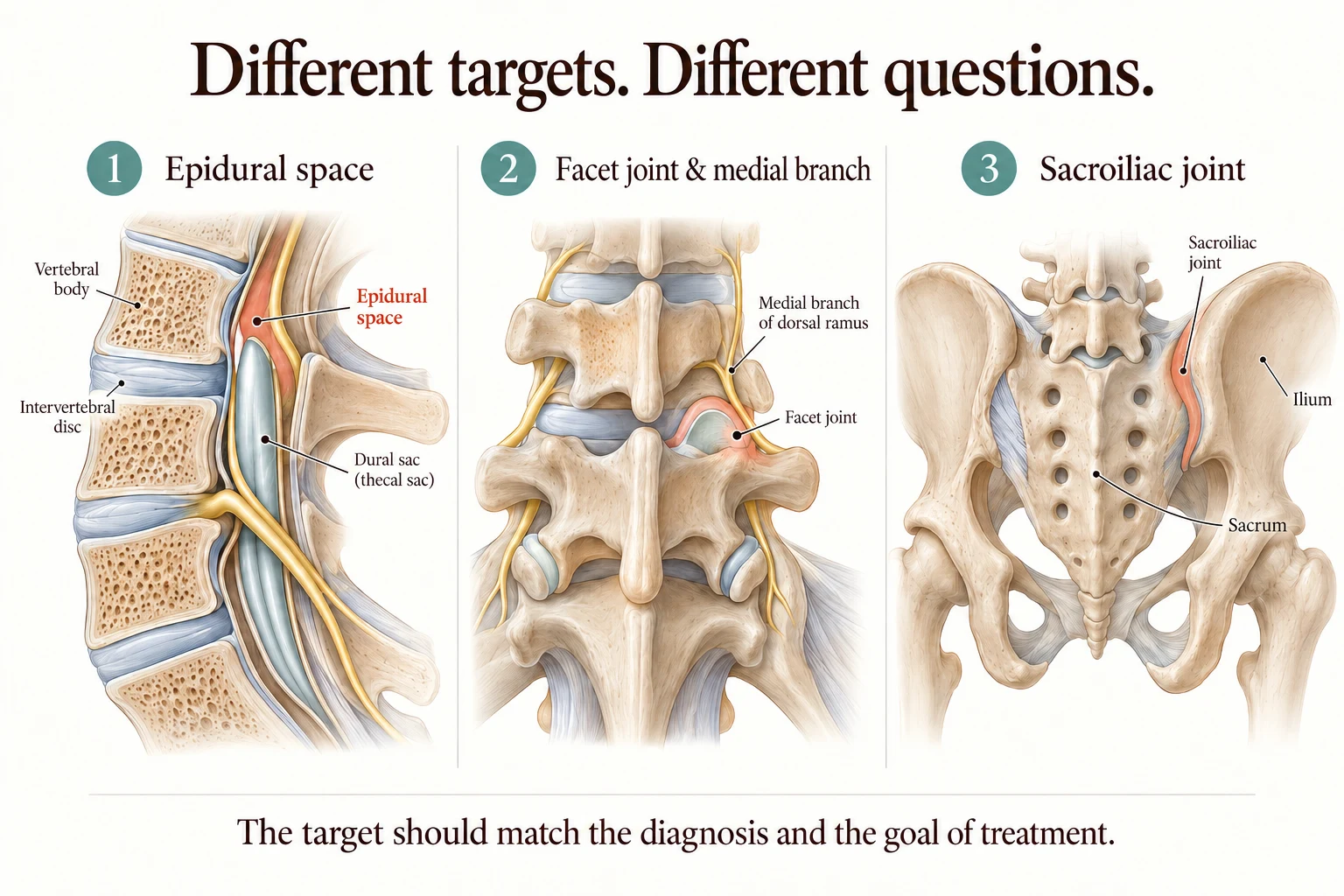
Original educational illustration. Three schematics locate the epidural space, facet joint with a medial branch, and sacroiliac joint.
The epidural space lies outside the dural sac; facet and sacroiliac procedures address different targets. Ask how the target was identified and what outcome would justify treatment. This is an orientation graphic, not an injection technique.
Illustration references: Reference 1 · Reference 2 · Reference 3
1. Clarify what the clinician suspects
Facet joints connect the small bones at the back of the spine. A physician may consider whether structures around these joints contribute to localized spinal pain. Ask what in your history and examination supports that possibility, and what competing explanations remain.
Pain in the same region can come from different structures. A scan describing arthritis does not, by itself, explain the purpose of the proposed procedure. Bring examples of the movements and tasks that bother you so the conversation begins with your experience rather than with the name of an intervention.
Sources: Facet Joint Block
2. Have the exact injection named
A facet-joint injection places medicine at the joint; a medial branch block targets small nerves that supply it. Ask which is proposed and whether it is intended mainly for relief or to help decide about another treatment. These are not interchangeable labels.
If a diagnostic block is proposed, ask for clear instructions before the day arrives. Which familiar activities should you assess? When should you record pain and function? What effect might sedation or other medicines have on the interpretation? You should understand how the result will be used before you try to describe it afterward.
Sources: Facet Joint Block
3. Understand what makes an ablation reasonable
Radiofrequency ablation uses heat near selected nerves to alter pain signaling. It does not repair an arthritic joint or guarantee lasting relief. NICE guidance for selected chronic localized low-back pain links radiofrequency denervation to a positive diagnostic medial branch block. That recommendation is not a promise that everyone with back arthritis should have ablation.
Ask your physician what counts as a meaningful block response in your situation, whether another block is needed, and why. Insurance criteria and clinical reasoning are worth discussing separately so you understand both the care decision and the scheduling requirements.
ASRA’s multispecialty lumbar facet guidance describes medial branch blocks as more useful for predicting radiofrequency ablation response than injections placed inside the facet joint. That distinction is worth understanding before a test is scheduled. Ask exactly which structure is being tested, why that test fits the suspected pain source, and what could make the result misleading. Have the clinician explain how your ordinary activity and symptom record will influence the decision, including what an unclear result would mean.
Recommendations differ. The 2025 BMJ guideline recommends against joint radiofrequency ablation for the chronic spine-pain population it evaluated. Ask your physician to explain any different specialty recommendation, the patients it applies to, and the uncertainty that remains for you. A positive test block should be discussed in that evidence context, not presented as a guarantee of lasting benefit.
Sources: UCLA Health: Radiofrequency Ablation · Low back pain and sciatica in over 16s: assessment and management — recommendations · Multispecialty International Group Develops Consensus Practice Guidelines on Interventions for Lumbar Facet Joint Pain · Commonly used interventional procedures for non-cancer chronic spine pain: a clinical practice guideline
4. Compare a procedure with your wider goals
You may be hoping to stand through dinner preparation, return to exercise, or sit comfortably at work. Tell the clinician which change would matter most. Ask how an ablation, if successful, would help you pursue that goal and what other care would continue.
Discuss alternatives, including revisiting rehabilitation or the pain assessment. If you have had several procedures without useful change, ask how that history affects the recommendation. There should be room to pause and reconsider. A different result from the one you hoped for can still provide information that changes the next decision.
Sources: Facet Joint Block
5. Plan for the day and the reassessment
Ask about imaging guidance, medicines, sedation, transportation, and the specific risks of the proposed location and technique. Provide a current medication list and relevant medical history. Get instructions directly from the procedural team and prescribing clinicians rather than changing treatment yourself.
Before scheduling, clarify who answers concerns after discharge, when the response will be reviewed, and what symptoms need urgent attention. If benefit wears off, ask what the team reassesses before offering another treatment. A repeat procedure deserves a fresh explanation of benefit, burden, and alternatives.
Cleveland Clinic explains that the amount and duration of relief after ablation vary and that treated nerves can regrow. This makes reassessment part of the treatment, rather than a formality after it. Ask how we will compare pain, function, and unwanted effects with your starting point. If benefit fades, discuss whether the same pain has returned or a new problem needs evaluation. A repeat procedure should come with an updated explanation of the target, alternatives, and likely value for you.
6. Bring your questions to our pain team
Our pain specialists offer different services within a nonsurgical care plan. Dr. Evish Kamrava offers spine and joint radiofrequency ablation; Dr. Michael Port offers facet-joint injections and nerve blocks. Their profiles give you a place to start when matching a consultation to your question.
Bring previous procedure reports and any response diary if you have them. Tell the physician what you most want treatment to make possible, whether that is standing at work or spending more time with family. Ask for the proposed sequence in plain language: what happens first, what the result would mean, and which choices remain afterward. You can take that explanation home and return with questions before scheduling the next step.
Sources: Facet Joint Block
Make the most of your visit
Questions to bring to your consultation
Choose the questions that matter most to you. Bring them along, and ask us to explain anything that is unclear.
- Are you proposing a joint injection or a medial branch block?
- What makes facet-related pain a reasonable working explanation?
- What other causes still need consideration?
- How should I record the block response and which activities should I assess?
- What result would support ablation, and why?
- What are the risks for this spinal location and technique?
- How will treatment support my movement and functional goals?
- When will we reassess, and what happens if relief is incomplete or wears off?
Sources & further reading
- Facet Joint BlockACR / RSNA RadiologyInfo
- UCLA Health: Radiofrequency AblationUCLA Health
- Low back pain and sciatica in over 16s: assessment and management — recommendationsNICE
- Multispecialty International Group Develops Consensus Practice Guidelines on Interventions for Lumbar Facet Joint PainASRA Pain Medicine
- Commonly used interventional procedures for non-cancer chronic spine pain: a clinical practice guidelineBMJ / international guideline panel
- Radiofrequency Ablation for Pain ManagementCleveland Clinic
We use these medical sources to help explain your options and prepare you for a conversation with our team. Our guides feature our own clinicians; patient reviews describe individual experiences.







 (310) 595-1030