
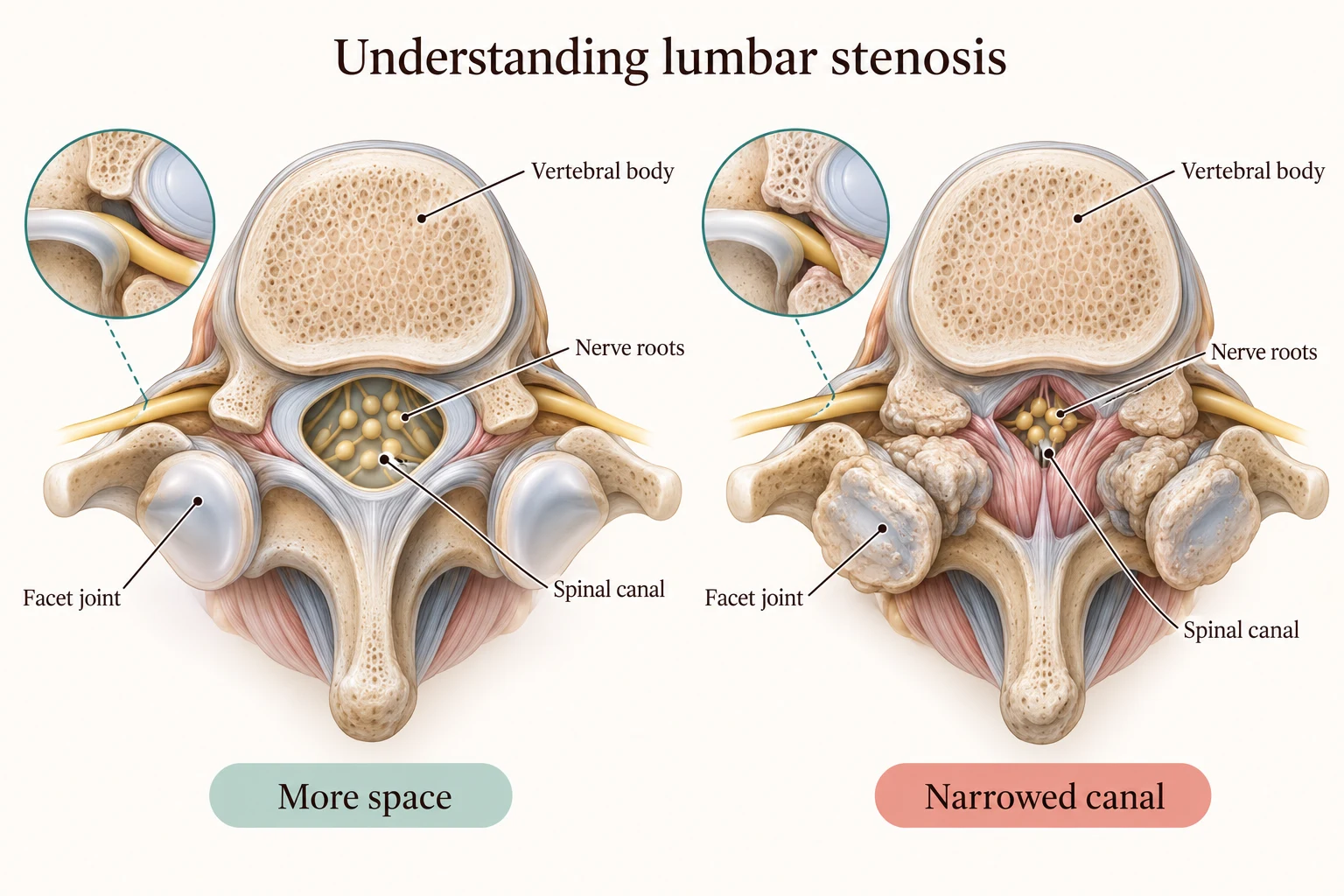
Original educational illustration. Two schematic cross-sections compare more space and a narrowed lumbar spinal canal.
The lower lumbar canal contains nerve roots. A picture of narrowing does not establish the cause of a person's symptoms; the examination and imaging need to be considered together.
Illustration references: Reference 1 · Reference 2 · Reference 3
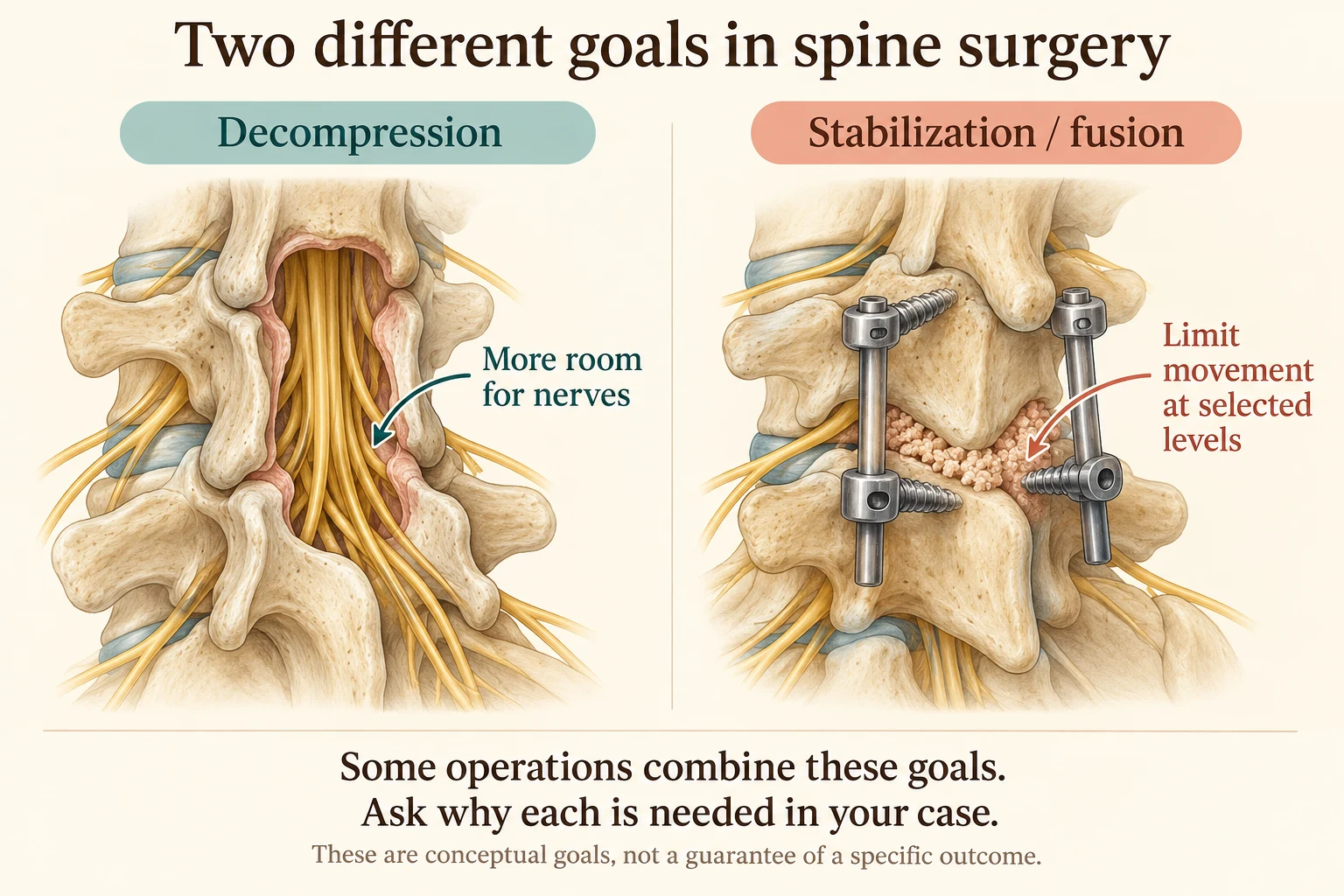
Original educational illustration. Schematic lumbar diagrams contrast making room for nerves and limiting movement at selected levels.
Decompression and stabilization address different goals and may be combined. Ask why each is proposed in your case, what alternatives exist, and what recovery involves. Hardware placement is schematic.
Illustration references: Reference 1 · Reference 2
1. What is causing my leg symptoms?
Sciatica can arise from more than one problem, including a herniated disc or spinal narrowing. The useful starting point is why the clinician thinks a particular structure is responsible for your symptoms. Ask how the history, examination, and images fit together and what does not fit.
Bring the actual images, previous reports, and a short account of the symptom pattern. Ask the surgeon to point to the level and side being considered. If several levels look abnormal, find out which are clinically relevant. A treatment called “sciatica surgery” should be translated into a specific problem and operation before you compare its benefits with recovery and risk.
Sources: 5 Questions to Answer Before Considering Sciatica Surgery
2. What would the operation remove or change?
Decompression is a broad term for relieving pressure. A discectomy removes disc material; a laminectomy removes part or all of the lamina, a bony structure at the back of a vertebra. Some operations combine steps. Ask for a drawing or a plain-language explanation of the tissue involved.
Then ask what stays in place. Will only the herniated portion be removed, or is another procedure planned? If the consent form uses different terms from the consultation, have the team reconcile them. You should be able to describe the operation in your own words, including which step addresses the nerve and whether stabilization is also part of the plan.
Sources: Minimally Invasive Lumbar Discectomy · Laminectomy
3. Which symptoms should we discuss separately?
List leg pain, back pain, altered sensation, and weakness as separate concerns. Ask which the surgeon expects to address and which may be slower to change or may persist. Also describe the practical obstacle: sitting through a commute, walking at work, or sleeping without repeated interruption.
If your main goal differs from the surgeon’s main goal, discuss that before scheduling. Ask how the team assesses the result and when they would consider further evaluation. An operation can accomplish its technical purpose without meeting every hope you bring to it. A clear conversation should make room for the benefit you value, the limits of the proposal, and uncertainty about the remaining symptoms.
Sources: 5 Questions to Answer Before Considering Sciatica Surgery
4. Why is surgery appropriate at this point?
Ask how the recommendation relates to what has already been tried and to any neurologic findings. Bring the dates, practical limitations, and effects of earlier treatment. If nonsurgical care remains reasonable, ask what the plan would be and how progress would be reviewed.
Timing deserves its own explanation. Is this an elective choice because symptoms remain limiting, or is a changing examination making the decision more urgent? Ask what would happen if you waited and what monitoring would be needed. New bowel or bladder control problems, saddle-area numbness, or major new weakness require urgent assessment rather than a routine debate about elective options.
Sources: Herniated Disc
5. Why this approach, and why this number of levels?
Microscopic, tubular, endoscopic, and open approaches describe how a surgeon reaches the target. Ask what makes the proposed route suitable for your disc location, narrowing, or prior surgery. AAOS notes that endoscopic diskectomy is not appropriate for every herniation or complex multilevel problem.
Compare realistic approaches using the same questions: can each adequately address the cause, what risks differ, and what evidence supports the expected benefit? Ask about the surgeon’s experience with similar anatomy and what could require a change in approach. If more than one level is proposed, ask why each is included. The size of an incision cannot answer those questions by itself.
Sources: Endoscopic Diskectomy
6. Is there a separate reason to add fusion?
Fusion joins selected vertebrae and addresses stabilization. It serves a different purpose from removing pressure on a nerve. If it is included, ask the surgeon to show the finding that makes it relevant and whether decompression alone is a reasonable alternative in your situation.
If different surgeons recommend different amounts of surgery, ask where their reasoning diverges. Is there a disagreement about instability, alignment, a previous operation, or the source of pain? Bring both plans to a focused discussion. You do not need to choose the smallest or largest proposal by instinct; you need an explanation of what each step contributes and which tradeoff it introduces.
Sources: Lumbar Spinal Stenosis
7. What personal risks and future-treatment possibilities matter?
Discuss nerve injury, bleeding, infection, persistent or recurrent symptoms, and the possibility of another procedure with the treating surgeon. Ask which concerns are most relevant to your health and surgical history. Tell the team about prior surgery, medication use, and conditions another specialist manages.
Ask what the next assessment would involve if the operation does not meet its goals. How would the team distinguish expected recovery from a new problem? Who would explain the findings? This is a practical question about follow-up, not an expectation that something will go wrong. It also helps you understand why an individual review cannot define your likely result or substitute for a personal risk discussion.
Sources: Minimally Invasive Lumbar Discectomy
8. What needs to be arranged before I go home?
Ask about transport, help with ordinary tasks, the medicine plan, wound instructions, and the first follow-up. Describe your actual job and commute rather than asking only when people “usually” return to work. Clarify who decides when driving, lifting, and exercise can resume.
Get an office and after-hours contact route and know which symptoms need emergency help. If a therapist will be involved, ask how restrictions and progress will be communicated between clinicians. At Commons Clinic, Dr. Leonel Hunt and Dr. Sanjay Khurana are among our spine surgeons whose interests include decompression approaches. Bring the written recommendation and the question you most need answered to your consultation.
Sources: 5 Questions to Answer Before Considering Sciatica Surgery
Make the most of your visit
Questions to bring to your consultation
Choose the questions that matter most to you. Bring them along, and ask us to explain anything that is unclear.
- What is the cause, level, and side of my sciatica?
- What tissue would you remove or change during this operation?
- Which symptoms might remain after the nerve is decompressed?
- What makes surgery appropriate now, and what would waiting mean?
- Why is the proposed approach suitable for my anatomy?
- Why is fusion included, if it is part of the recommendation?
- How would you assess persistent or recurrent symptoms?
- Who coordinates my recovery instructions and activity clearance?
Sources & further reading
- 5 Questions to Answer Before Considering Sciatica SurgeryJohns Hopkins Medicine
- Minimally Invasive Lumbar DiscectomyJohns Hopkins Medicine
- LaminectomyJohns Hopkins Medicine
- Herniated DiscAmerican Association of Neurological Surgeons
- Endoscopic DiskectomyAAOS OrthoInfo
- Lumbar Spinal StenosisAmerican Association of Neurological Surgeons
- Read our related clinical guide on Commons Clinic ↗
We use these medical sources to help explain your options and prepare you for a conversation with our team. Our guides feature our own clinicians; patient reviews describe individual experiences.







 (310) 595-1030