
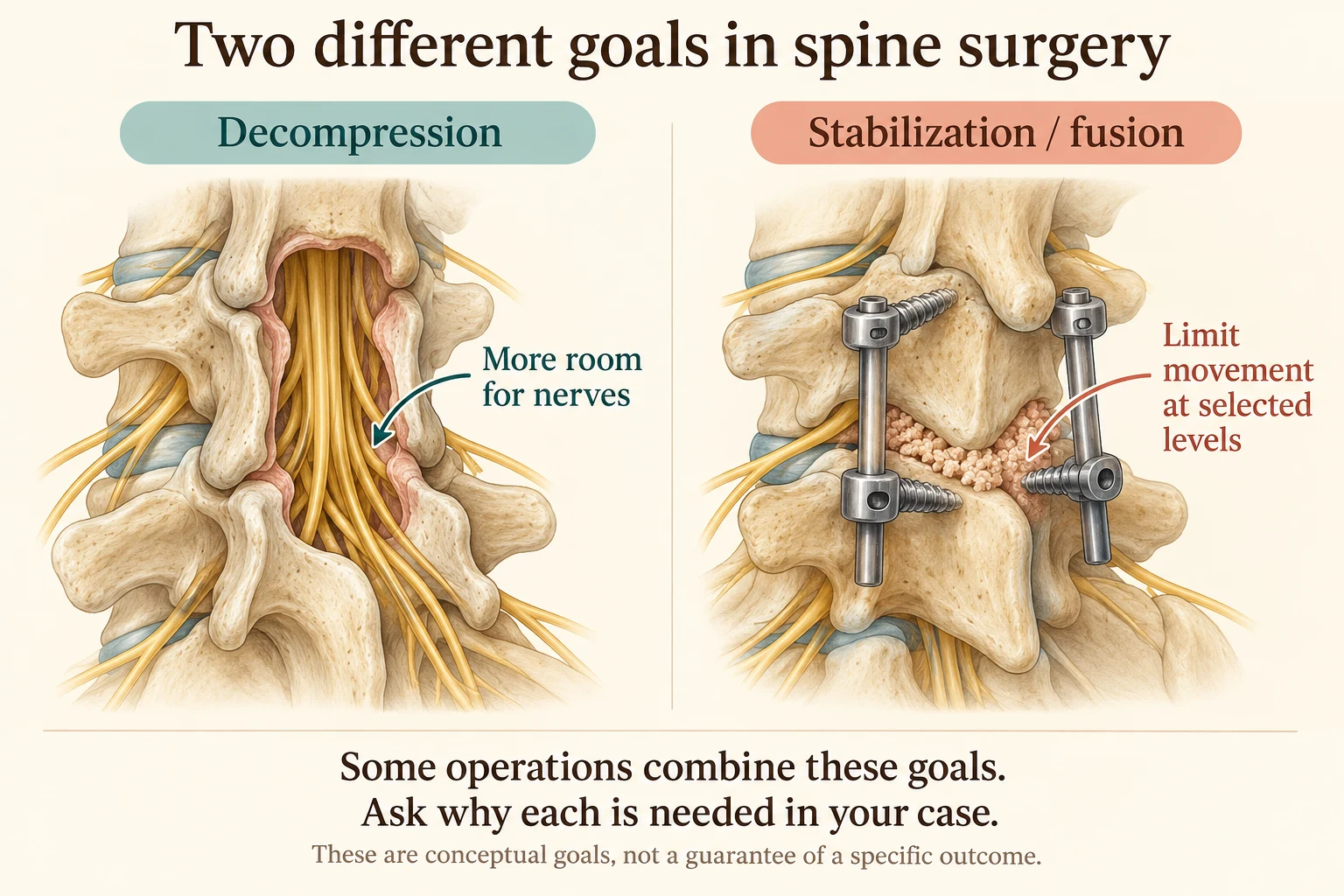
Original educational illustration. Schematic lumbar diagrams contrast making room for nerves and limiting movement at selected levels.
Decompression and stabilization address different goals and may be combined. Ask why each is proposed in your case, what alternatives exist, and what recovery involves. Hardware placement is schematic.
Illustration references: Reference 1 · Reference 2
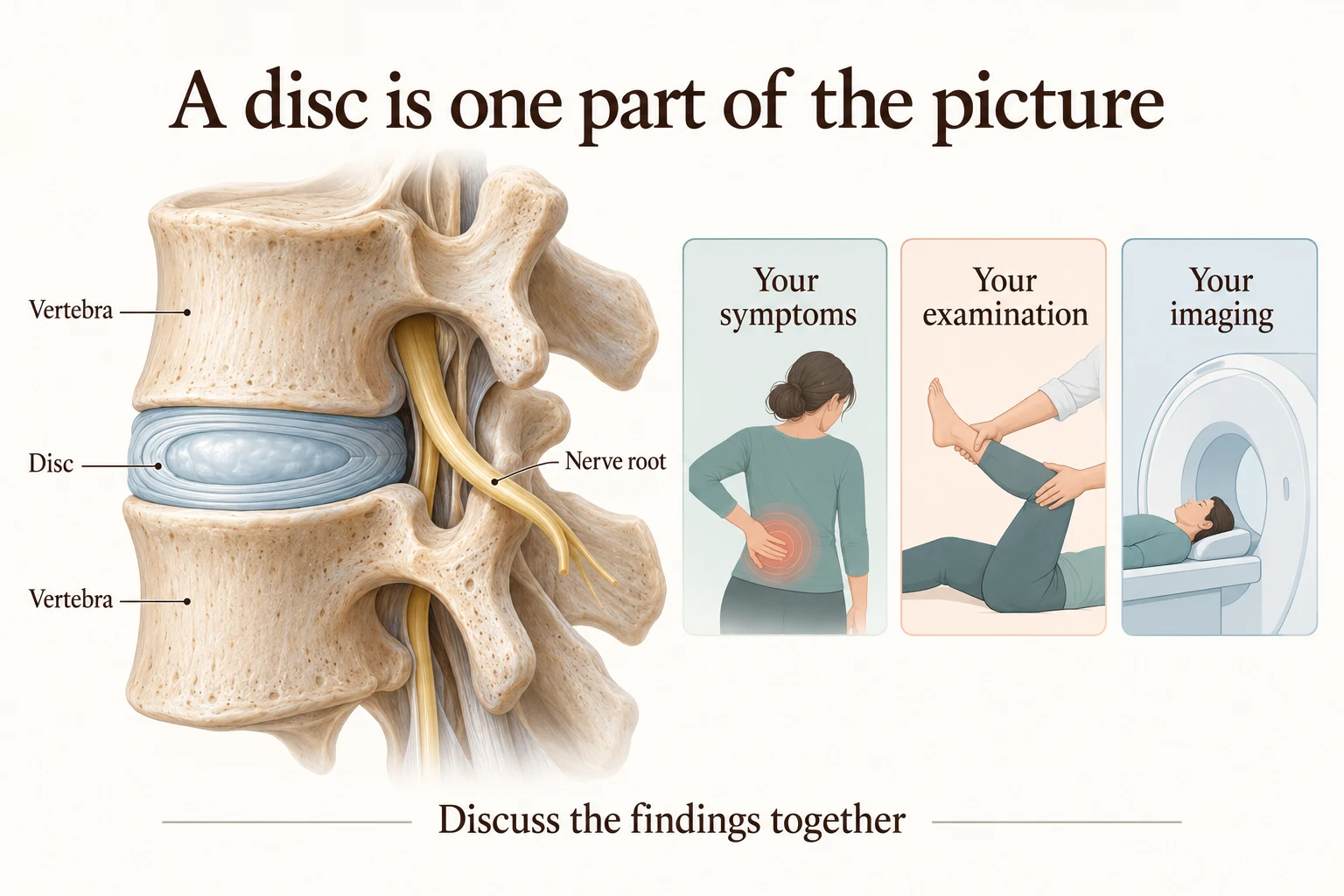
Original educational illustration. A simplified vertebra, disc and nerve illustration alongside symptoms, examination and imaging.
Disc findings are one part of the assessment. Ask which findings fit your symptoms and which activities you want the treatment plan to help you regain.
Illustration references: Reference 1 · Reference 2
1. What problem requires stabilization in addition to decompression?
Decompression creates space around nerves; fusion joins selected vertebrae so they heal together. These are different purposes within a surgical plan. For lumbar stenosis, ask the surgeon to distinguish what is causing pressure from what may require stabilization. The presence of narrowing alone is not the complete explanation for a fusion recommendation.
Have the relevant finding shown on your images and translated into ordinary language. Is the concern instability, a slip, deformity, the effect of the planned bone removal, or another issue? If several steps are proposed, ask what each contributes. You should be able to explain why fusion is part of your particular plan, rather than treating screws, rods, or a cage as the diagnosis.
Sources: Spinal Fusion · Lumbar Spinal Stenosis
2. Could decompression alone address the symptoms I most want changed?
AANS describes lumbar decompression with or without fusion, depending on the case. Ask whether decompression alone belongs among your realistic choices and what would make it unsuitable. If it is reasonable, ask how the expected benefits, risks, and possibility of further treatment compare with adding fusion.
Bring your goals into the comparison. Leg pain, back pain, weakness, and walking limitations may not all respond in the same way. Ask which would be targeted by removing pressure and which are part of the reason for stabilization. If one symptom is particularly uncertain, discuss whether the expected overall benefit still meets your priorities. The useful question is why the proposed plan fits the problem, not whether one operation has a more reassuring name.
Sources: Lumbar Spinal Stenosis
3. Which other choices are actually relevant to my diagnosis?
Ask about continued nonsurgical care, a different extent of decompression, or another surgical approach when appropriate. Motion-preserving procedures are not interchangeable substitutes for every fusion. If a suggested alternative would address a different condition, ask the surgeon to explain that distinction rather than leaving you to compare unrelated treatments.
For each realistic choice, discuss what waiting could mean and how the team would monitor your course. If a trial of further treatment is reasonable, give it a defined goal and reassessment point. Bring details of prior therapy, medicines, or injections, including what was impractical or short-lived. If no reasonable alternative is identified, ask why. Understanding a limitation can be as useful as hearing an additional option.
Sources: Spinal Fusion
4. Why are these levels included, and how do two opinions differ?
Confirm the exact levels and ask why each needs treatment. If one opinion recommends fewer levels, ask whether the difference concerns instability, alignment, nerve compression, or the source of pain. Request the reasoning in terms that connect to your examination and images, rather than simply comparing the length of the procedure.
Keck Medicine of USC encourages patients who are uncertain about a plan to raise their concerns and seek additional information or another opinion. Make the unresolved point the focus of that visit. Bring the earlier recommendation, images, and relevant operative history. A second consultation is most useful when it explains the disagreement and its implications, including which assumptions would make one plan more appropriate than the other.
5. How do the risks and healing demands compare for me?
A fusion needs biological bone healing after the operation; implants support the treated area while that process occurs. Ask about bone health, nicotine use, medical conditions, and preparation that may affect the plan. Discuss whether another clinician should help evaluate a concern before the procedure is scheduled.
Mayo Clinic and MedlinePlus describe risks including nerve or blood-vessel injury, infection, blood clots, persistent symptoms, and problems with the intended result. Ask which are most relevant to the actual operation and your health. Also ask what would happen if the bones did not unite or symptoms remained. A healed fusion and relief of every symptom are different outcomes. You deserve a discussion of both before weighing the recovery burden against the expected benefit.
Sources: Spinal Fusion · Spinal fusion · Spinal fusion
6. What would recovery and follow-up require from my household?
Ask about the expected care setting after discharge and the help you may need. Explain stairs, your commute, caregiving, and the physical demands of your job. Ask how driving, lifting, rehabilitation, and work decisions will be made. An early improvement in comfort does not by itself define readiness for every activity.
Confirm who handles medications, questions between visits, and unexpected symptoms. Ask how healing and progress will be followed and what would prompt an earlier assessment. Leave the decision visit knowing the role of decompression, the separate reason for fusion, the alternatives considered, and the uncertainty that remains. If you cannot explain a part of the recommendation, bring that question back before making an elective commitment.
Our spine surgeons include Dr. Sanjay Khurana, Dr. Amandeep Bhalla, and Dr. Hyun Bae. Bring the images and written plan you have been given, along with the activity you most hope to regain. Their profiles can help you explore relevant clinical interests, while patient reviews offer individual perspectives on explanations and support during care.
Sources: Spinal fusion
Hardware supports the plan; bone healing completes a different part
Ask the surgeon to distinguish three parts of the operation: relieving pressure on a nerve, supporting the treated segment with implants, and creating the conditions for bone fusion. They are related but not identical. A reassuring image of screws does not answer every question about symptoms or healing, and feeling better does not automatically mean all restrictions have ended. Request an explanation of what each follow-up assessment is intended to establish.
Have the team show where graft material and implants will be placed and why those choices fit your case. Ask how they will assess progress, what uncertainty can remain on imaging, and what would lead to another test. If you are told that healing is incomplete, ask what that finding means for activity and whether it changes the plan now. Avoid interpreting a report without the clinical explanation.
Bone health belongs in this discussion before surgery when possible. Ask whether your fracture history, prior bone-density results, or other health information suggests a need for assessment. If treatment is recommended, clarify which clinician manages it and how it connects with the operative timeline. Do not start supplements or osteoporosis medicines solely because fusion is planned; ask for advice that fits your medical history.
Finally, connect healing milestones with your own goals. Lifting at work, caring for a child, driving, and returning to exercise may require different assessments. Ask which activities depend on symptoms, which depend on strength or control, and which require the surgeon's clearance. A written explanation can help your therapist and other clinicians follow the same plan without treating an online recovery calendar as a deadline.
Sources: Spinal Fusion · Preoperative Osteoporosis Assessment · Spine surgery — discharge
Make the most of your visit
Questions to bring to your consultation
Choose the questions that matter most to you. Bring them along, and ask us to explain anything that is unclear.
- What requires stabilization beyond relieving nerve pressure?
- Could decompression alone reasonably address my main concern?
- Which symptoms might persist even if the bones heal?
- What other options fit my diagnosis, and why are others unsuitable?
- Why does each proposed level need treatment?
- What explains the difference between the opinions I received?
- Does my bone health or medical history change preparation or timing?
- How will we follow healing, function, and the need for further treatment?
- How will you assess implant position, bone healing, and symptom improvement separately?
- Does my bone health need assessment or treatment before the operation?
- Which recovery milestones determine when my specific activities can resume?
Sources & further reading
- Spinal FusionAAOS OrthoInfo
- Lumbar Spinal StenosisAmerican Association of Neurological Surgeons
- How to Manage Uncertainty About a Treatment PlanKeck Medicine of USC
- Spinal fusionMayo Clinic
- Spinal fusionMedlinePlus, U.S. National Library of Medicine
- Preoperative Osteoporosis AssessmentCongress of Neurological Surgeons
- Spine surgery — dischargeNIH / MedlinePlus
We use these medical sources to help explain your options and prepare you for a conversation with our team. Our guides feature our own clinicians; patient reviews describe individual experiences.








 (310) 595-1030