
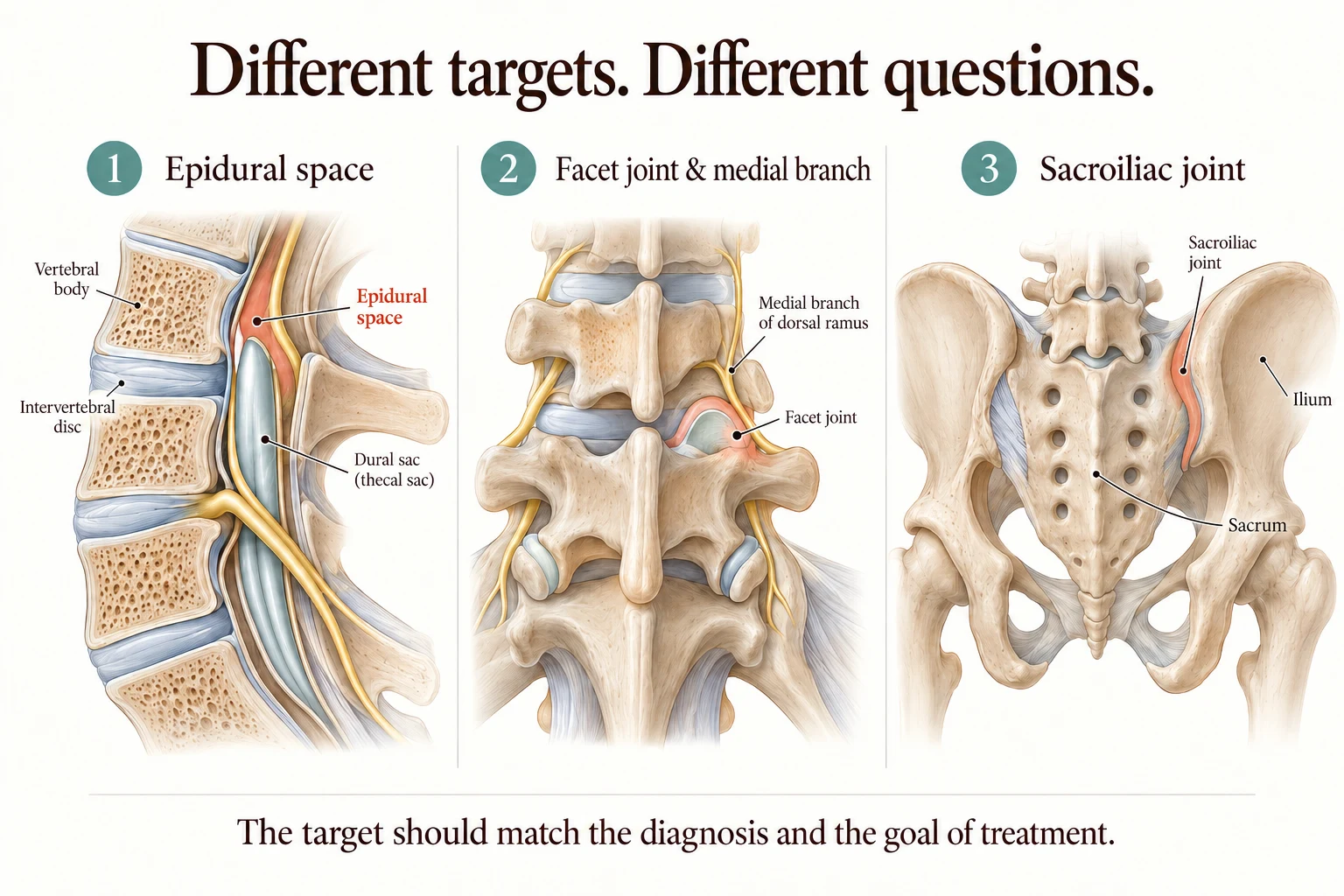
Original educational illustration. Three schematics locate the epidural space, facet joint with a medial branch, and sacroiliac joint.
The epidural space lies outside the dural sac; facet and sacroiliac procedures address different targets. Ask how the target was identified and what outcome would justify treatment. This is an orientation graphic, not an injection technique.
Illustration references: Reference 1 · Reference 2 · Reference 3
1. Begin with where and when it hurts
The sacroiliac, or SI, joints connect the sacrum at the base of the spine with the pelvis. Symptoms attributed to this area can overlap with pain from the low back or hip. Location helps start an assessment, but it does not settle the diagnosis.
Describe whether symptoms occur when turning in bed, climbing steps, walking, or moving from sitting to standing. Note which side is affected and whether pain travels. Bring a short account of an injury, pregnancy-related symptoms, previous spine surgery, or other events you think may be relevant, without assuming any one event explains everything.
Mayo Clinic describes a combination of examination, imaging, and sometimes a numbing injection when evaluating sacroiliitis. MRI may help assess an inflammatory cause in the appropriate setting. Ask whether your history suggests a mechanical problem, inflammation, or another source of pain, and whether an additional specialist should be involved. Bring the pattern of stiffness, activity-related symptoms, and prior treatments. Understanding the reason for a test helps you see how its result would change care, rather than treating the image as the diagnosis by itself.
Sources: APTA ChoosePT: Sacroiliac Joint Dysfunction · Sacroiliitis: Diagnosis and treatment
2. Ask how the examination narrows the possibilities
Ask what findings support an SI-joint source and which other problems the clinician is considering. You do not need to memorize examination tests. You do need to understand how the history, examination, and any imaging fit together.
If another test is proposed, ask what decision it could change. If an injection is discussed, clarify whether its purpose is relief, information about the suspected pain source, or both. Ask how an incomplete or short-lived response would be interpreted. A thoughtful assessment should make uncertainty easier to discuss rather than hide it behind a procedure name.
ASRA’s January 2026 summary emphasizes that sacroiliac joint complex pain can involve structures inside or outside the joint, with uncertainty in parts of the evidence. That helps explain why the same label can lead to different treatment discussions. Ask which structure your clinician suspects, what findings support that view, and what remains uncertain. If an injection or ablation is proposed, ask how its target relates to that explanation. A precise question is more useful than assuming every treatment called an SI procedure does the same thing.
3. Make rehabilitation specific to your activities
Rehabilitation may address movement, strength, and tasks that have become difficult. Ask the therapist which findings the program addresses and how the home activities connect to your goals. The useful question is not simply whether a muscle is weak; it is how the plan may help you move more comfortably and confidently.
Be clear about what you can manage between visits. Equipment, time, caregiving, work demands, and discomfort can affect follow-through. Ask for a demonstration and a way to check your technique. If something increases symptoms, know how to contact the team and how the program will be adapted.
4. Understand the role of an injection or other procedure
If an SI-joint injection is offered, ask why the team thinks it is appropriate at this point and what medicine and guidance technique will be used. Discuss risks in light of your medicines and health history. Preparation should come from the procedural team, with prescribing clinicians involved when needed.
If a more invasive option enters the conversation, ask for the specific diagnosis, alternatives, evidence, and expected recovery burden. There is a meaningful difference between an option being available and it being the right next step for you. Ask what information would make the physician recommend against it.
5. Set a reassessment point
Choose a few familiar tasks to discuss at follow-up, such as getting into the car or completing a grocery trip. Record enough detail to see whether the plan is changing function, rather than judging only one unusually good or difficult day.
Ask what would prompt reconsideration of the diagnosis. New symptoms, changes in walking, or a response that does not fit expectations deserve a conversation. MedlinePlus advises contacting a clinician for concerning changes such as new leg weakness or bowel or bladder problems. Get instructions for urgent concerns and a routine contact route before you leave.
6. Meet the relevant Commons team
Our clinicians bring several perspectives to pelvic-region and low-back symptoms. Dr. Evish Kamrava offers SI-joint injection and implant treatment within his practice. Dr. Amandeep Bhalla focuses on spine care, while Brett Pugh, PT, DPT, provides physical therapy. A consultation can help establish which expertise fits the problem you are trying to solve.
Bring your prior imaging and a brief account of treatment, then describe a task that consistently brings on the pain. Ask how the physician and therapist will share findings and decide when to adapt the plan. Before leaving, make sure you know the working explanation, the first goal, and when to return. You should have a clear route for questions without needing to coordinate several different recommendations on your own.
Make the most of your visit
Questions to bring to your consultation
Choose the questions that matter most to you. Bring them along, and ask us to explain anything that is unclear.
- What supports an SI-joint source rather than a hip or lumbar problem?
- Which findings make you less certain about the diagnosis?
- Would additional testing change the treatment decision?
- If you suggest an injection, what question is it meant to answer?
- Which activities will rehabilitation target?
- How should I adjust the plan if my symptoms increase?
- What would make us reconsider the diagnosis or treatment?
- Who coordinates the physician, procedural, and therapy recommendations?
Sources & further reading
- APTA ChoosePT: Sacroiliac Joint DysfunctionAmerican Physical Therapy Association
- Sacroiliitis: Diagnosis and treatmentMayo Clinic
- Consensus Practice Guidelines on Sacroiliac Joint Complex Pain from a Multispecialty, International Working GroupASRA Pain Medicine
- MedlinePlus: Sacroiliac joint pain—aftercareNational Library of Medicine — MedlinePlus
We use these medical sources to help explain your options and prepare you for a conversation with our team. Our guides feature our own clinicians; patient reviews describe individual experiences.








 (310) 595-1030