
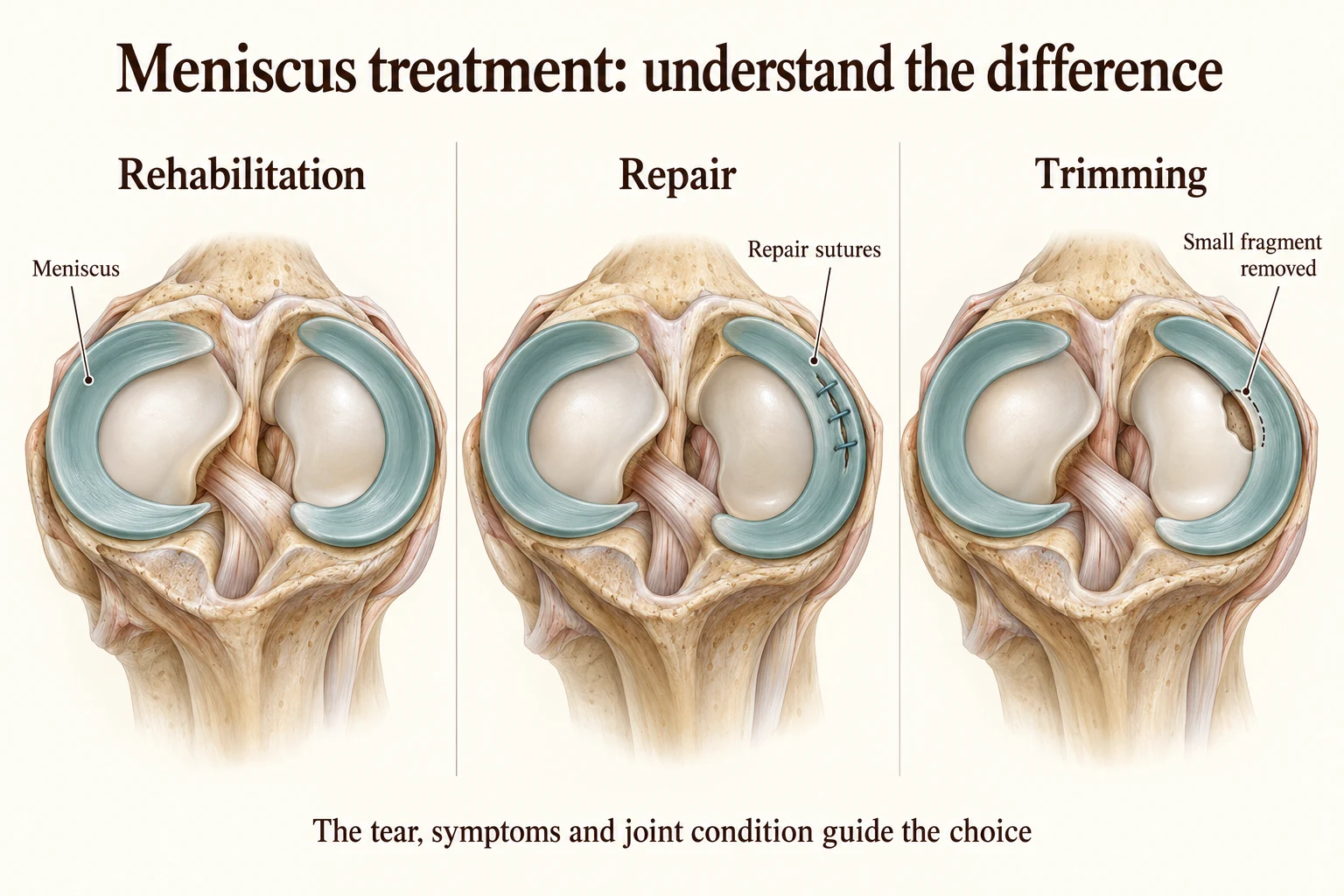
Original educational illustration. Three schematic panels introduce rehabilitation, meniscus repair and trimming.
Ask what each option is intended to accomplish, what tissue would be preserved or removed, and how rehabilitation would differ. Tear type, symptoms, arthritis and other findings influence the choice.
Illustration references: Reference 1 · Reference 2
1. Ask which kind of tear you have
A recent twisting injury and a gradually degenerating meniscus are different clinical situations. Tear location, pattern, tissue quality and associated arthritis can influence the recommendation. Ask the clinician to show the tear on the images and explain how well it fits the pain, swelling or catching you describe.
Mention whether the knee truly gets stuck and cannot straighten, rather than using “locking” for every click. Ask how urgently that symptom needs assessment. Bring the onset date and any prior knee operations, because the same MRI wording can mean different things in different histories.
Sources: AAOS OrthoInfo: Meniscus Tears
2. Give the rest of the knee a place in the conversation
The meniscus helps distribute load across the knee. It is not the only structure that can cause symptoms. Ask about the joint cartilage, ligament stability and alignment, especially if pain existed before the recent incident.
The 2024 AAOS guideline focuses on acute isolated tears. It does not cover every degenerative tear, root tear or meniscus injury associated with an ACL tear. Ask which evidence and treatment principles fit your type of injury rather than assuming one guideline resolves every knee problem.
Sources: AAOS: Management of Acute Isolated Meniscal Pathology Guideline
3. Understand what nonsurgical care is testing
Some tears can be managed with rehabilitation and symptom management. Ask what the program aims to improve—motion, strength, activity tolerance or confidence—and when it will be reassessed. Describe your previous exercise plan and its effect rather than simply saying you “tried PT.”
If the recommendation is to continue nonsurgical treatment, ask which symptoms would change that approach. If surgery is proposed, ask what makes it more likely to help than another period of rehabilitation. A thoughtful plan should account for your work and sport needs without promising that a scan finding must be removed.
Sources: AAOS OrthoInfo: Meniscus Tears
4. Compare repair with trimming in practical terms
Repair attempts to preserve torn tissue while it heals. Partial meniscectomy removes an unstable damaged portion. The possibility of repair depends on features of the tear and tissue, and the final decision may sometimes be clearer during arthroscopy.
Ask what the surgeon will try to preserve and what could lead to trimming instead. Repair may involve a longer period of protected weightbearing or motion than trimming; root repairs have their own demands. Ask how a change in the operation would change your home plan, therapy and time away from work.
Sources: AAOS OrthoInfo: Meniscus Repair
5. Bring the decisions that matter to you
Write down the tasks your knee needs to handle: kneeling at work, pivoting in sport, long shifts, carrying children or walking on uneven ground. Ask which choice best addresses those goals and which limitations may remain. Discuss possible persistent symptoms and the risk of another procedure.
Before surgery, ask how the actual findings and procedure will be explained afterward. Before nonsurgical care, ask who will reassess the knee if progress is limited. Either way, leave with a follow-up plan and a clear contact route, rather than just a list of exercises or an operation date.
6. Discuss what preserving tissue requires afterward
HSS distinguishes suturing a repairable meniscus from trimming an unsalvageable torn part. The repair’s need to heal can mean a more protective rehabilitation period. Ask about that tradeoff before an operation, especially if a fast return to work is driving your preference.
Have the surgeon explain the likely tear pattern and whether the final choice may depend on what is found during arthroscopy. Ask how much tissue they aim to preserve, what would prevent repair and whether you would receive different restrictions for each possible outcome. Arrange support for the more demanding plausible recovery rather than assuming the shortest one.
Sources: Meniscus Surgery: Meniscectomy, Transplant, and Repair
7. Ask what may change during arthroscopy
A scan can suggest a tear pattern, but the final tissue quality and repairability may become clearer during surgery. Ask which choices you are authorizing if the surgeon finds a different pattern from the one expected. If a root tear, ligament injury or substantial arthritis is present, those findings deserve their own discussion. Have the team explain how the final procedure will appear in your discharge instructions and therapy referral. You should leave knowing whether tissue was repaired or trimmed, which restrictions follow from that decision, and whom to contact if the written plans do not agree.
Sources: Meniscus Surgery: Meniscectomy, Transplant, and Repair
Make the most of your visit
Questions to bring to your consultation
Choose the questions that matter most to you. Bring them along, and ask us to explain anything that is unclear.
- Is this an acute tear, a degenerative tear, a root tear or another pattern?
- Does the tear explain my symptoms, or is arthritis contributing?
- What does my catching or locking mean clinically?
- What should a rehabilitation trial aim to change?
- How much tissue could be preserved with repair?
- What might make you choose trimming during surgery?
- How would each option change weightbearing, therapy and work?
- What will we do if the first treatment does not help enough?
Sources & further reading
- AAOS OrthoInfo: Meniscus TearsAmerican Academy of Orthopaedic Surgeons
- AAOS: Management of Acute Isolated Meniscal Pathology GuidelineAmerican Academy of Orthopaedic Surgeons
- AAOS OrthoInfo: Meniscus RepairAmerican Academy of Orthopaedic Surgeons
- Meniscus Surgery: Meniscectomy, Transplant, and RepairHospital for Special Surgery · Published September 17, 2023
We use these medical sources to help explain your options and prepare you for a conversation with our team. Our guides feature our own clinicians; patient reviews describe individual experiences.









 (310) 595-1030