
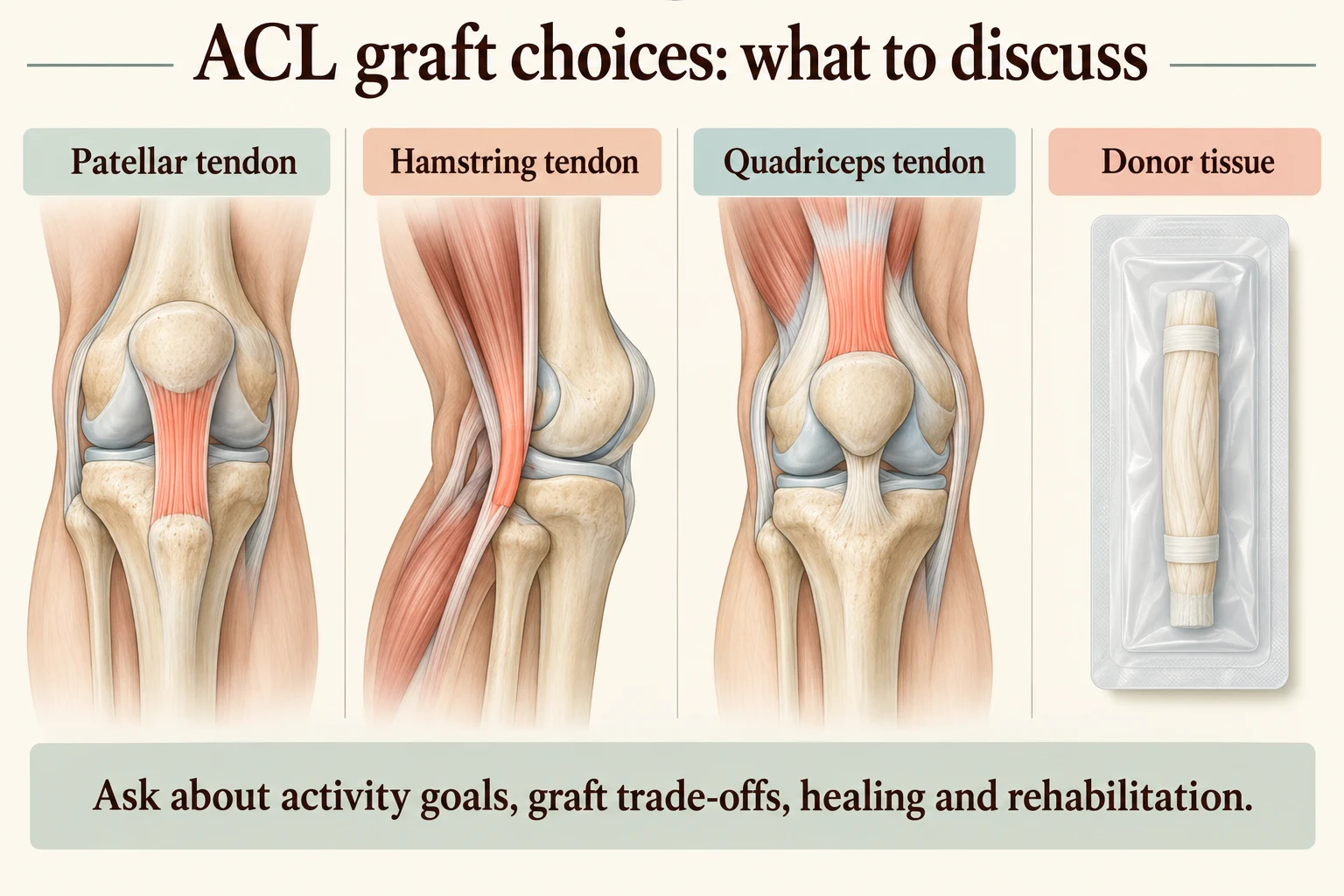
Original educational illustration. Knee schematics indicate patellar, hamstring and quadriceps tendon sources alongside a donor-tissue symbol.
Ask about activity goals, graft trade-offs, healing and rehabilitation. The drawings identify general tissue sources, not a graft-harvesting technique or a ranking of options.
Illustration references: Reference 1 · Reference 2
1. Describe what the knee can and cannot do
A torn ACL does not produce the same experience for everyone. Some people notice giving way during everyday movement; others mainly have difficulty with pivoting or cutting. Tell the clinician about swelling, motion, repeated instability and what you hope to return to.
The consultation should also assess the meniscus, cartilage and other ligaments. Ask which parts of the injury affect urgency, restrictions and the treatment recommendation. Bring the original MRI images if available, not only the written report. Mention whether instability occurs unexpectedly during ordinary walking or only during a specific sport movement.
Sources: AAOS OrthoInfo: ACL Injury—Does It Require Surgery?
2. Compare two complete care pathways
Structured rehabilitation can be an appropriate route for selected patients, particularly when instability and future demands allow it. Reconstruction may be recommended when instability, associated injury or demanding pivoting activities make it a better fit. Ask the clinician to explain the reasoning for your knee.
Compare what each route asks of you: therapy, activity changes, reassessment and the possibility of later surgery. If surgery is indicated, discuss timing rather than assuming that either immediate surgery or an indefinite delay suits everyone. The AAOS guideline considers associated injury and the risk of additional damage in that discussion.
Sources: AAOS OrthoInfo: ACL Injury—Does It Require Surgery? · AAOS Guideline Summary: Management of Anterior Cruciate Ligament Injuries
3. Give the meniscus its own discussion
An accompanying meniscus injury may change both the operation and the early recovery. Ask whether repair is possible, what preserving tissue would involve and what cannot be known until surgery. Protection after a repair may differ from the plan after isolated ACL reconstruction.
Have the surgeon explain any decision that could change during the operation. Ask how the final procedure will be communicated to your therapist so that the written rehabilitation plan matches what actually happened. This is especially helpful when several teams or facilities are involved.
Sources: AAOS Guideline Summary: Management of Anterior Cruciate Ligament Injuries
4. Define readiness beyond a return date
Ask how strength, movement control, symptoms and confidence will be assessed before demanding activity. Returning to jogging, team training and competition are different decisions. A calendar estimate helps planning, but it does not replace a functional assessment.
Be candid about school, therapy access, employment and the pressure of a season. Ask who has the final clearance role, how information reaches your coach when you consent, and what happens if progress stalls. If the knee locks or a new injury causes a major change, contact the treating team rather than waiting for the next sport milestone.
5. Prepare for rehabilitation on either route
Mayo Clinic’s August 2026 review includes rehabilitation in nonsurgical treatment and before and after reconstruction. It also describes stability, activity demands and associated injuries as reasons treatment choices differ. Choosing rehabilitation first should therefore still produce a defined plan and follow-up.
Ask which movements or giving-way episodes would mean the current strategy is not meeting your needs. If you choose surgery, ask what strength and motion work should happen beforehand and who will coordinate it. Your decision should include access to therapy and the time required to complete it, alongside the procedure itself.
Sources: ACL injury: Diagnosis and treatment
6. Compare grafts using your own priorities
The AAOS guideline favors autograft over donor allograft particularly in young or active patients. Among skeletally mature patients, patellar-tendon grafts and hamstring grafts carry different tradeoffs involving graft failure, front-of-knee discomfort and kneeling pain. Ask how those findings apply to your work and sport rather than treating them as a universal ranking. Quadriceps-tendon tissue may also be discussed. Request the surgeon's reasoning for the offered options, the harvest-site consequences, and the plan if the chosen tissue is unsuitable. Previous surgery, growth status and other injuries can change the comparison.
Sources: AAOS Updates Clinical Practice Guideline for Management of ACL Injuries
7. Plan for the week the decision becomes real
Before choosing a route, map the next few appointments, travel needs and responsibilities. Can you attend therapy, use the required walking aids, manage stairs and avoid the activities the clinician restricts? If not, say what will be difficult. Rehabilitation first and reconstruction both require follow-through; neither decision is complete when the visit ends. Ask our team which records your therapist needs, who adjusts restrictions, and how to report another giving-way episode. Keeping those responsibilities clear helps you evaluate whether the plan fits your actual circumstances, including school, work and family commitments.
Make the most of your visit
Questions to bring to your consultation
Choose the questions that matter most to you. Bring them along, and ask us to explain anything that is unclear.
- What instability have you found, and what does it mean for my goals?
- Which other structures are injured?
- What makes rehabilitation or reconstruction the better fit for me?
- If surgery is recommended, how does timing affect my knee?
- Why do you recommend this graft and any additional procedure?
- Can the meniscus be preserved, and how would repair change restrictions?
- What tests and criteria will guide training and competition?
- How will the surgeon, therapist and sports team coordinate decisions?
Sources & further reading
- AAOS OrthoInfo: ACL Injury—Does It Require Surgery?American Academy of Orthopaedic Surgeons
- AAOS Guideline Summary: Management of Anterior Cruciate Ligament InjuriesAAOS Guideline Summary
- ACL injury: Diagnosis and treatmentMayo Clinic · Page date August 14, 2026
- AAOS Updates Clinical Practice Guideline for Management of ACL InjuriesAmerican Academy of Orthopaedic Surgeons · Published September 7, 2022
- 2016 Consensus Statement on Return to Sport from the First World Congress in Sports Physical Therapy, BernBritish Journal of Sports Medicine · Published May 25, 2016
We use these medical sources to help explain your options and prepare you for a conversation with our team. Our guides feature our own clinicians; patient reviews describe individual experiences.







 (310) 595-1030