
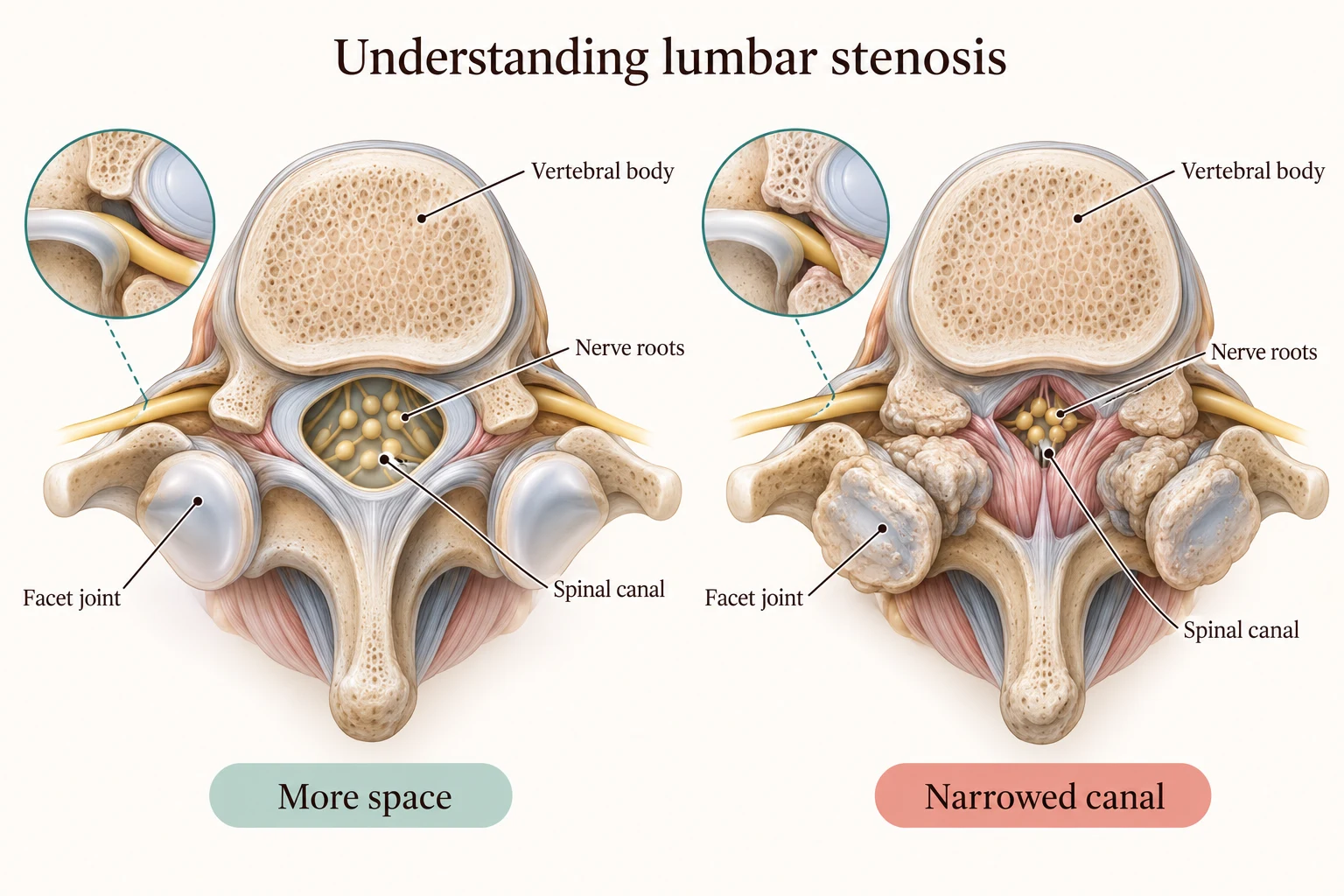
Original educational illustration. Two schematic cross-sections compare more space and a narrowed lumbar spinal canal.
The lower lumbar canal contains nerve roots. A picture of narrowing does not establish the cause of a person's symptoms; the examination and imaging need to be considered together.
Illustration references: Reference 1 · Reference 2 · Reference 3
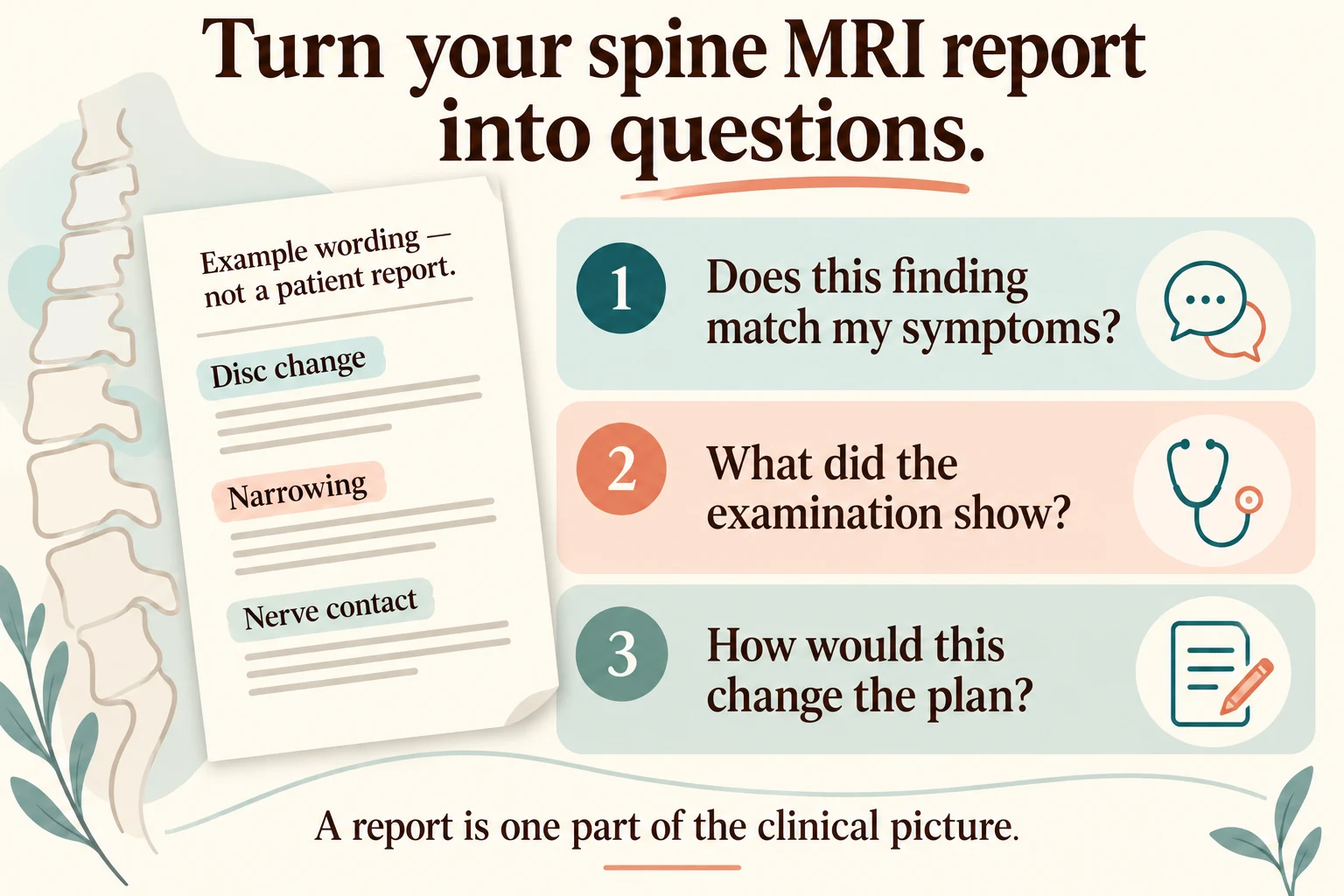
Original educational illustration. A clearly fictional report with disc change, narrowing and nerve-contact wording sits beside three consultation questions.
Ask whether a finding matches your symptoms, what the examination showed, and how it would change the plan. The example is not a patient report or a diagnostic image.
Illustration references: Reference 1 · Reference 2 · Reference 3
1. Does lumbar stenosis explain what limits my walking?
Lumbar stenosis is narrowing around nerves in the lower spine. It can cause leg discomfort, altered sensation, weakness, and difficulty standing or walking. Some people notice relief when sitting or leaning forward. The pattern matters alongside the images; narrowing on a scan alone does not establish that treatment is needed.
Tell the clinician what makes you stop during a familiar activity and what helps you restart. Is it pain, heaviness, fatigue, balance, or something else? Ask which examination findings support the explanation and whether another problem also contributes. The answer should connect your symptoms to the proposed treatment, rather than treating the word “severe” in a report as the whole decision.
Sources: Lumbar Spinal Stenosis · Spinal Stenosis: Diagnosis, Treatment, and Steps to Take
2. What improvement are we trying to achieve?
Set a goal you can recognize in daily life: reaching a nearby shop, standing to make a meal, or walking with fewer stops. Discuss leg pain, back pain, numbness, and weakness separately. Ask which are realistic treatment targets and which might remain even if the main goal improves.
Write down a baseline you can describe without repeatedly pushing yourself into symptoms. Ask when the team will review progress and what would count as a worthwhile benefit. If another health condition affects endurance or walking, include it in the conversation. A change in the scan, a technically completed operation, and greater independence are different measures; be clear about which result you value.
Sources: Lumbar Spinal Stenosis
3. Which nonsurgical choices still have a useful role?
NIAMS describes rehabilitation, symptom medicines, and selected injections among possible approaches. Ask which fit your examination and health history, what each is intended to do, and how long a trial should be reviewed before the next decision. The aim is to make the role of each treatment understandable.
Bring details of earlier care instead of only saying it failed. Was therapy limited by pain, transport, cost, or a plan that did not fit? Did medication help sleep but create unwanted effects? This information can change the next discussion. Ask whether a revised approach has a defined goal or merely repeats something that was already impractical. Do not change prescribed medicines without guidance.
Sources: Spinal Stenosis: Diagnosis, Treatment, and Steps to Take
4. If an injection is proposed, what should it accomplish?
The American Academy of Neurology’s 2025 evidence review found limited benefits from epidural steroids, with different findings for radiculopathy and spinal stenosis and for pain versus disability. Ask which evidence applies to your diagnosis and whether the intended benefit is symptom relief, improved activity, or information for another decision.
Agree on how to assess the result before having the procedure. If it gives only brief relief, what would the team learn, and what would happen next? Discuss your own medication and medical risks with the treating clinician. A positive experience in someone else’s review does not establish that an injection will work for you or determine how often it should be repeated.
Sources: Epidural steroid injections for chronic back pain: An AAN systematic review
5. What exactly does “minimally invasive” mean here?
The phrase describes an approach to an operation, not a complete diagnosis or treatment plan. AAOS describes endoscopic diskectomy as using a camera to reach and visualize the target through small incisions. Ask for the exact operation name and what tissue would be removed or changed.
If someone recommends an endoscopic or other smaller approach, ask why it can address your particular pattern of narrowing and what its limits are. Is the claim about the incision, early recovery, complications, or longer-term function? Ask for evidence relevant to that claim and the surgeon’s experience with comparable cases. Also ask what might require a different approach. A technology label should make the explanation more precise.
Sources: Endoscopic Diskectomy
6. Would decompression alone address the problem?
Decompression makes more room for nerves. Fusion adds stabilization and has a separate purpose; it is not an automatic part of every lumbar stenosis operation. AANS describes laminectomy with or without fusion depending on the situation. Ask the surgeon to identify the level, the structure causing pressure, and any reason stabilization is being considered.
If the proposed plan includes several levels or implants, have each part explained. When two opinions differ, ask whether they disagree about instability, the source of symptoms, or how much decompression is needed. The goal is to compare actual plans. A less extensive operation is only useful if it addresses the clinical problem, and a larger operation needs a reason you can understand.
Sources: Lumbar Spinal Stenosis
7. What are the tradeoffs for my health and household?
Ask about personal risks, including nerve injury, infection, persistent symptoms, and the possibility of more treatment. Tell the surgeon about prior operations, other medical conditions, and the help available at home. Discuss the expected care setting after surgery and how discharge readiness will be assessed.
Work backward from the demands of your life: stairs, driving, work, caregiving, and rehabilitation visits. Ask which milestones guide increasing activity rather than relying on another patient’s timetable. If you live alone or have limited transport, say so early. Planning these details helps you compare a proposed treatment’s potential benefit with what you will need to make recovery workable.
Sources: Lumbar Spinal Stenosis
8. What would make us change the plan or seek help sooner?
Arrange a review date and a clear contact route. Ask what change in walking, strength, or sensation should lead to earlier reassessment and what the team would reconsider if a treatment does not meet its goal. A plan for monitoring is part of treatment, including when continued observation is reasonable.
New loss of bowel or bladder control or increasing numbness around the groin or saddle area requires immediate assessment. Do not wait for a routine appointment to discuss it. For an elective decision, bring any unanswered question back to the team before scheduling. You should know the problem being treated, why the approach fits, and what benefit remains uncertain.
Our spine team includes Dr. Hyun Bae and Dr. Amandeep Bhalla. Bring your images, previous treatment records, and a walking goal that matters to you. Their profiles and the lumbar stenosis review collection can help you prepare questions about the consultation, explanations, and support you want from your care team.
Sources: Lumbar Spinal Stenosis
Make the most of your visit
Questions to bring to your consultation
Choose the questions that matter most to you. Bring them along, and ask us to explain anything that is unclear.
- How do the images and examination explain my walking symptoms?
- Which symptom is this treatment most and least likely to improve?
- What remains worth trying without surgery, and how will we assess it?
- What outcome should we use to judge an injection?
- What exact operation does the newer technique perform?
- Why would I need fusion in addition to decompression?
- What risks and recovery needs are specific to my situation?
- What changes should prompt earlier or emergency assessment?
Sources & further reading
- Lumbar Spinal StenosisJohns Hopkins Medicine
- Spinal Stenosis: Diagnosis, Treatment, and Steps to TakeNational Institute of Arthritis and Musculoskeletal and Skin Diseases
- Epidural steroid injections for chronic back pain: An AAN systematic reviewAmerican Academy of Neurology
- Endoscopic DiskectomyAAOS OrthoInfo
- Lumbar Spinal StenosisAmerican Association of Neurological Surgeons
- Read our related clinical guide on Commons Clinic ↗
We use these medical sources to help explain your options and prepare you for a conversation with our team. Our guides feature our own clinicians; patient reviews describe individual experiences.







 (310) 595-1030