
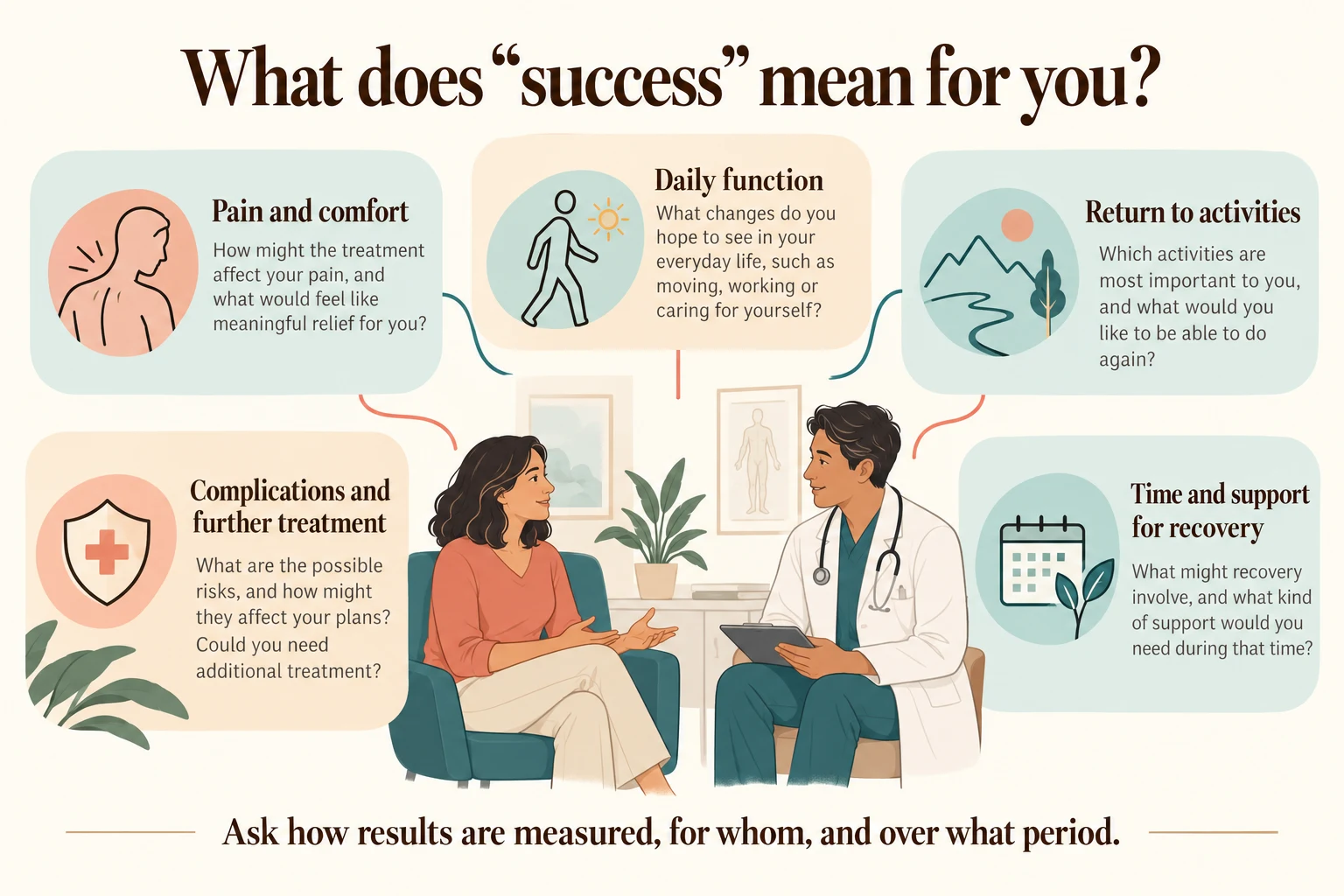
Original educational illustration. Five discussion areas surround an illustrated patient-clinician conversation: comfort, function, activities, complications and recovery support.
Ask how results are measured, in which patients and over what period. Pain relief, daily function, returning to activities, further treatment and time or support needs are separate outcomes. Patient reviews alone cannot establish their probabilities.
Illustration references: Reference 1 · Reference 2
1. Start with what the patient actually describes
A review saying a physician explained an image tells you something different from a review saying an office was easy to reach. Both can matter. Look for a clear account of what happened, which clinician or team was involved, and what the reviewer valued. Separate an observation from a conclusion: 'answered my questions' describes an interaction; 'best surgeon anywhere' expresses a personal judgment. The first gives you a useful process to ask about in your own care.
2. Keep experience and clinical results in perspective
AHRQ describes patient experience as the interactions people have with care, including communication, access, respect, and coordination. It is one part of healthcare quality and complements measures of effectiveness and safety. An online review may discuss those experiences, but it is not the same as a standardized clinical outcome measure. A patient’s report of feeling better is meaningful as their story; it does not tell you the chance that the same treatment will help your particular diagnosis.
AHRQ’s quality framework includes safety, effectiveness, timeliness, and the patient’s experience of care. An online comment usually offers only a small view of that wider picture. Read for observable details such as whether the reviewer understood the explanation or could arrange follow-up. Then write a consultation question about that detail. Comparing stories about the same process can help you identify priorities, but different diagnoses, expectations, and stages of recovery make star totals a poor substitute for a clinical discussion of your own situation.
Sources: AHRQ: What Is Patient Experience? · AHRQ: What Are Patient-Reported Measures? · Six Domains of Healthcare Quality
3. Check who and what the account concerns
A comment may refer to a physician, a therapist, an office team, or several people together. Read it with that context in mind. Notice whether the treatment is actually named or whether you are filling in the gap from the page around it. A kind comment about an unrelated visit can help you ask about bedside manner, but it should not be read as evidence about a specific operation. On this site, source links let you return to the platform context available for the record.
4. Read patterns without treating them as a guarantee
Several accounts describing clear explanations can make communication a useful topic to explore. A single unusually enthusiastic or disappointed account deserves context too. Consider dates and the details provided, and read lower-rated written accounts as well as positive ones. Different patients have different expectations and medical circumstances. Reviews do not reveal everyone who received care, so they cannot produce a fair league table of technical skill or complication rates across physicians.
5. Convert impressions into questions you can verify
Before a consultation, choose two or three qualities from the reviews that matter to you. Then ask how they work in practice. If coordination matters, ask who communicates with your outside therapist. If explanations matter, ask to compare the benefits and drawbacks of the available options. If a reviewer mentions getting back to an activity, describe your own activity and ask what treatment can realistically aim for. A direct answer about your situation is more valuable than trying to match another person’s recovery timeline.
Notice whether the account gives an example you can recognize in your own priorities. A detailed description of an explanation or follow-up call is easier to explore than a broad superlative.
6. Turn praise into a checkable expectation
AMA patient-rights guidance emphasizes participation, respect, and answers to questions. Use those expectations to make a review more useful. A comment about feeling reassured might prompt you to ask how uncertainty is explained. A comment about a second opinion might lead to a question about obtaining records. Look for a process you can discuss with our team, and distinguish it from a promise that you will have the same result. Record the answer you receive at your visit so your choice rests on your own conversation too.
Sources: Patient Rights — AMA Code of Medical Ethics, Opinion 1.1.3
7. Turn a useful review detail into a consultation question
We use patient accounts to help you explore the experience of care and the questions that matter to you. Read the source link whenever a detail influences your choice. Notice whether a statement concerns the initial visit, a procedure, rehabilitation, or an office interaction. Bring the useful detail into your appointment as a question. That approach respects the patient's account while leaving your own treatment decision grounded in an examination, an explanation of options, and your priorities.
Make the most of your visit
Questions to bring to your consultation
Choose the questions that matter most to you. Bring them along, and ask us to explain anything that is unclear.
- Does this review describe the physician, the team, or both?
- What specific experience does the reviewer explain?
- Is the procedure or diagnosis actually named?
- How recent is the account?
- Can I check the platform context through its source link?
- Which review detail should I ask about at my consultation?
- What evidence beyond reviews can explain my treatment choices?
- Can the physician discuss likely benefits and risks for someone with my circumstances?
Sources & further reading
- AHRQ: What Is Patient Experience?ahrq.gov
- AHRQ: What Are Patient-Reported Measures?ahrq.gov
- Six Domains of Healthcare QualityAgency for Healthcare Research and Quality
- Patient Rights — AMA Code of Medical Ethics, Opinion 1.1.3American Medical Association
We use these medical sources to help explain your options and prepare you for a conversation with our team. Our guides feature our own clinicians; patient reviews describe individual experiences.









 (310) 595-1030