
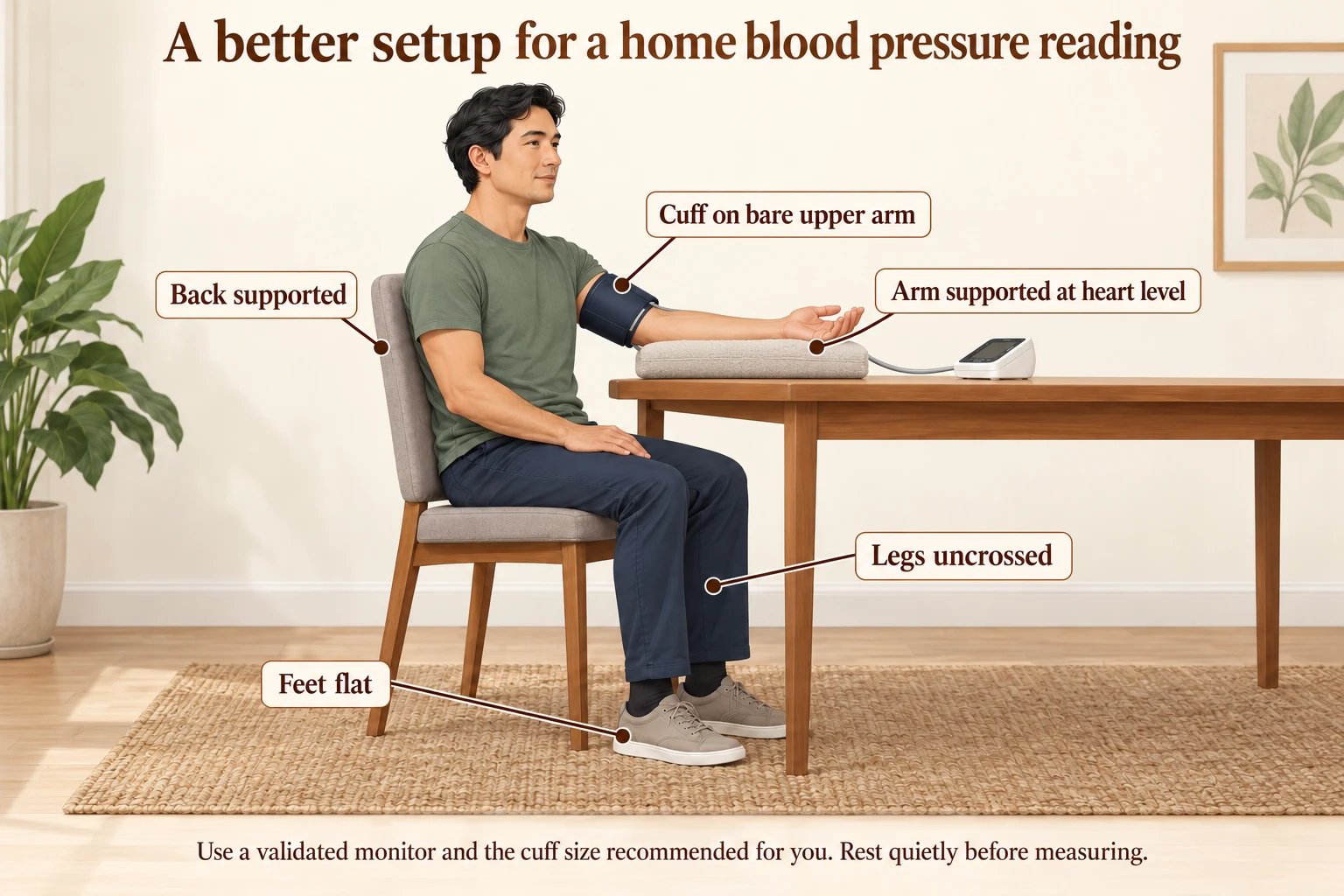
Original educational illustration. An illustrated seated person has back support, uncrossed legs, feet flat, and a bare upper-arm cuff with the arm supported.
Use a validated monitor and a cuff that fits. Rest quietly, support the arm so the cuff is at heart level, and follow the measurement instructions from your care team. This illustration addresses setup, not diagnosis or medication changes.
Illustration references: Reference 1
1. Ask what home monitoring is meant to answer
Home readings can help a clinician assess blood pressure outside the office and evaluate a treatment plan. They are most useful when you know why you are measuring and how the results will be reviewed. The 2025 AHA guideline emphasizes accurate measurement, home monitoring, and coordinated care.
Tell the clinician your main concern: high office readings, variable home results, a recent medicine change, or symptoms. Ask what question the monitoring period is intended to answer and whether another assessment is needed. A device supplies numbers; your care team should explain what those numbers mean in your situation.
Sources: American Heart Association: 2025 High Blood Pressure Guideline
2. Check the monitor and cuff
The American Heart Association recommends a validated automatic upper-arm monitor with a properly fitting cuff. Bring the device to a visit so the team can check fit, technique, and how its results compare with office equipment.
Before buying or replacing a monitor, ask whether it suits your arm size and circumstances. If you have trouble positioning the cuff, reading the screen, or using the controls, say so. The best plan is one you can carry out reliably. Ask whether a caregiver can learn the technique with you and how often the device should be checked.
Sources: Home Blood Pressure Monitoring
3. Build a repeatable measurement routine
AHA guidance includes quiet rest before measurement, supported sitting, a bare arm supported at heart level, and avoiding talking during readings. Caffeine, smoking, recent exercise, and an unsuitable cuff can interfere with consistency. Ask the team to demonstrate the setup and watch you repeat it.
Agree on when to measure, how many readings to take, and for how many days. Use the schedule your clinician recommends rather than measuring repeatedly whenever you feel worried. A manageable routine makes the record easier to interpret and reduces the chance that timing or technique obscures the pattern.
Sources: Home Blood Pressure Monitoring
4. Keep a record the clinician can review
Ask how to share readings: a dated paper log, a device memory, or a system the practice uses. Include the measurement time and any information the clinician requests about medicines or symptoms. Bring the full record rather than selecting only the highest or most reassuring numbers.
Make the next step explicit. Who reviews the results, when should you expect a response, and how will any treatment change be communicated? If the office and home results differ, ask how that difference will be assessed. You should not have to interpret an average alone or decide independently that a medicine is unnecessary.
Sources: Home Blood Pressure Monitoring
5. Know the urgent plan before you need it
Do not stop prescribed blood pressure medicine based on home readings without discussing it with your clinician. Ask for a plan covering both unexpectedly high and unusually low results, including symptoms that need urgent attention.
If a very high reading comes with chest pain, shortness of breath, weakness, vision change, or difficulty speaking, call 911 immediately; do not wait to repeat it. If there are no emergency symptoms, repeat a reading above 180 systolic and/or 120 diastolic after at least one minute; if it remains very high, contact a clinician immediately.
Sources: Home Blood Pressure Monitoring
6. Use the record in a prevention conversation
Dr. Jenica Ortega's work at Commons Clinic includes hypertension management and preventive cardiology. Bring your monitor, recent results, medication list, and questions to a visit so the discussion can connect your measurements with a broader plan.
Tell the team what is hard about the routine, whether that is shift work, travel, cost, side effects, or anxiety about a number. Ask which changes matter most and when they will be reassessed. Reliable monitoring should support a calmer, clearer conversation: what the pattern suggests, what needs action, and how the next decision will be made together.
The AMA explains how the U.S. Blood Pressure Validated Device Listing assesses evidence of clinical accuracy. Ask your team to check the exact model you own or plan to buy, along with the cuff sizes it supports. A familiar brand name is not enough to establish that every model has been validated for your circumstances. If an upper-arm cuff is difficult to fit or operate, ask for help before substituting another device. Bring the monitor to a visit so the team can assess your setup.
Sources: Why doctors and patients can count on these BP devices
7. Discuss office and home differences without guessing
Mayo Clinic describes white coat hypertension and masked hypertension as reasons home and office patterns may differ. Ask how your clinician will assess a discrepancy, including whether the device, technique, or timing needs review and whether ambulatory monitoring would add useful information. Share the full record, including ordinary readings, rather than sending only the numbers that worry you. Agree on the route and timing for feedback. Home measurements should help guide the discussion with your clinician; they should not become a reason to change prescribed medicines independently.
Make the most of your visit
Questions to bring to your consultation
Choose the questions that matter most to you. Bring them along, and ask us to explain anything that is unclear.
- What question are we trying to answer with home readings?
- Is this monitor validated and is the cuff the right size?
- Can you check my positioning and technique?
- When, how often, and for how many days should I measure?
- What information should I record with the numbers?
- Who reviews the log and when will I hear back?
- What should I do about unexpectedly high or low readings?
- How will we use the pattern to decide whether the care plan needs changing?
Sources & further reading
- American Heart Association: 2025 High Blood Pressure GuidelineAmerican Heart Association
- Home Blood Pressure MonitoringAmerican Heart Association
- Why doctors and patients can count on these BP devicesAmerican Medical Association
- Get the most out of home blood pressure monitoringMayo Clinic
We use these medical sources to help explain your options and prepare you for a conversation with our team. Our guides feature our own clinicians; patient reviews describe individual experiences.






 (310) 595-1030