
We consider removing an elbow bone spur when it seems to cause a specific problem that hasn't settled with nonsurgical care. That problem might be trouble straightening your arm, catching, or pain at the end of a movement that keeps you from work or activities you value. A spur that shows up on an X-ray is not a reason for surgery by itself. Elbow arthroscopy is one way to remove spurs. It may be recommended when a painful condition doesn't improve with nonsurgical treatment [1].
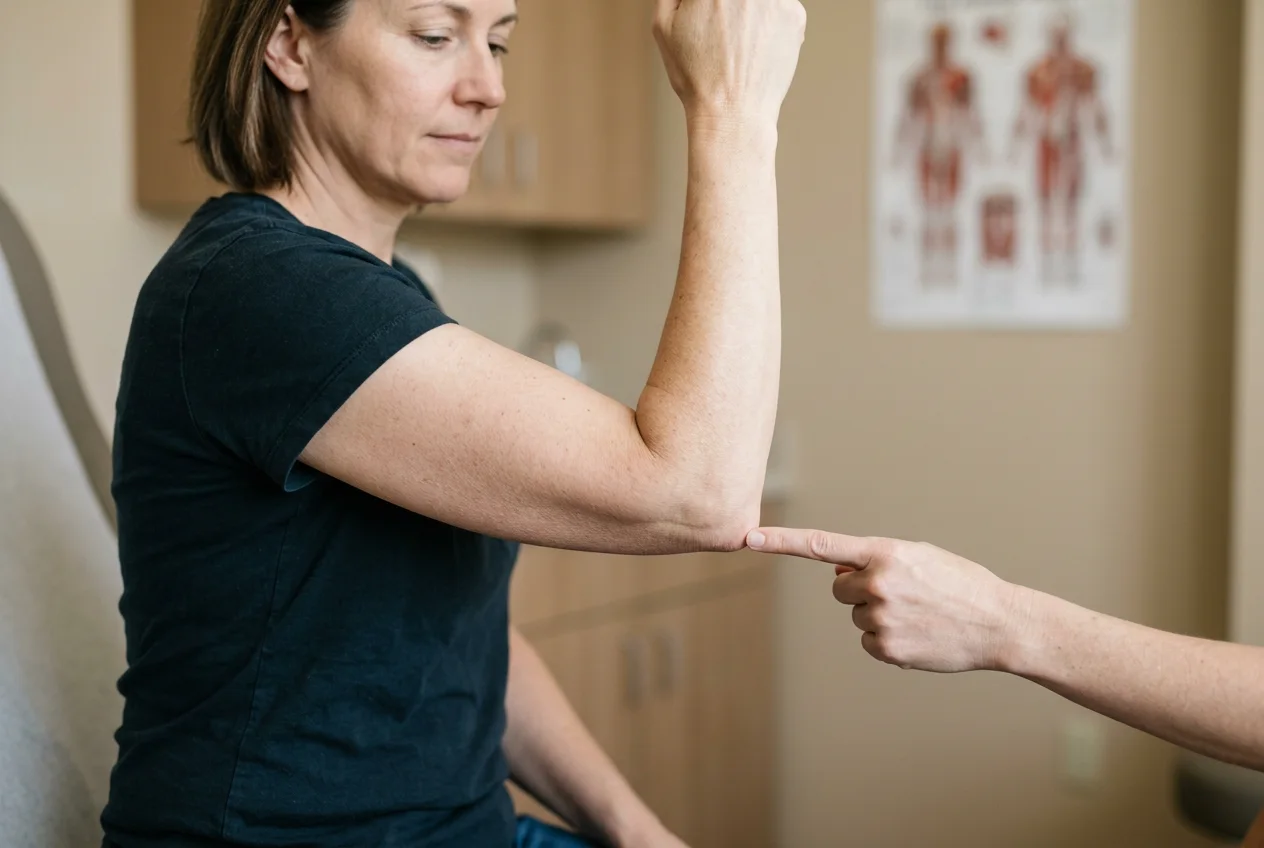
What an elbow bone spur is
A bone spur, or osteophyte, is extra bone that grows along the edge of a joint. In elbow osteoarthritis, the smooth cartilage wears down and becomes rough, and bone spurs may form [2]. These spurs often appear on the olecranon, the coronoid process and the radial head. Loose pieces of bone or cartilage are also common [3].
An olecranon traction spur is different. It grows at the back tip of the elbow, where the triceps tendon attaches. In one surgical case series, the spur sat in the outer fibers of the triceps tendon in every case [4]. It may cause pain by itself or together with triceps tendon irritation or olecranon bursitis [4]. Spurs on the olecranon are also a known problem in throwing athletes [5].
Why the X-ray is only part of the picture
Symptoms and X-ray findings often don't match in elbow arthritis [6]. That's why we pay close attention to how your elbow actually behaves.
- Grating or locking. Locking can happen when loose pieces of bone or cartilage get stuck between the moving joint surfaces [2].
- Less straightening or bending. Larger spurs have been strongly linked with reduced motion in primary elbow arthritis [3].
- Nerve symptoms. The ulnar nerve runs behind the inner elbow. Swelling in the joint can press on it and cause tingling or numbness in the ring and small fingers [2].
Care that doesn't remove bone
Nonsurgical care won't dissolve a spur, but it can ease symptoms and help you use your arm. We may discuss changes to your activities and medicines. If you have elbow arthritis, a corticosteroid injection in the joint may temporarily relieve pain in some cases [2] [3]. We choose options based on which tissue is contributing to your symptoms. Physical therapy is also part of nonsurgical treatment [1].
When removal makes sense, and how
If symptoms continue despite these steps, surgery may help [2]. Which approach fits depends on the cause and the tissues involved.
- Arthroscopic surgery uses a small camera and thin instruments passed through small cuts. Spurs can be removed along with loose cartilage pieces [1]. Even when wear and spurs are severe, arthroscopy can improve motion and reduce pain [2].
- Open surgery gives the surgeon access to the whole elbow at once. This may work better for complicated problems [7].
- Removing a traction spur at the triceps attachment is backed by limited evidence. In one small study, surgeons used an open incision to remove a spur near the triceps attachment in 11 men aged 27 to 62. Two had a spur grow back. This small study gives limited information about recovery for other groups [4].
- Advanced wear changes the discussion. If the joint surface is completely worn away, joint replacement may be the only option likely to help. It comes with long-term lifting limits [2].
We check the ulnar nerve carefully as part of planning spur surgery, especially if you have tingling or weakness and may be treated during the same surgery [3].
Risks to weigh
Most people don't have significant complications from elbow arthroscopy. Still, studies report a slightly higher risk of infection and nerve irritation than with knee or shoulder arthroscopy [1]. In a large review, stiffness was the most commonly reported complication [8].
Before and after a procedure
If you're generally healthy, elbow arthroscopy is usually done as an outpatient procedure, so you go home the same day. You'll talk about anesthesia beforehand. Antibiotics are typically given before surgery to lower the risk of infection [1]. Please tell us about your medicines, any past elbow surgery and any nerve symptoms.
There's no single recovery schedule. When you can drive, handle daily tasks and go back to work depends on the type of surgery you had [1].
Pain relief and progress aren't the same
Less pain doesn't always mean your elbow moves better. Better motion doesn't always mean less pain either. Removing a spur can clear a physical block, but it doesn't restore worn cartilage. We track pain, motion, nerve symptoms and function separately so you can see what's changing.
Questions to ask us
- If you do heavy manual work: Which tasks put the most strain on my elbow, and could surgery change them?
- If you throw or play overhead sports: Is my spur linked to ligament stress?
- If your daily demands are lighter: Could nonsurgical care be enough?
- If you use a cane, a walker or your arms to stand up: How would a period of limited arm use affect my safety at home?
- If your fingers tingle: Is my ulnar nerve involved?
- For everyone: Is my main problem pain or motion, and what result would count as success?
Getting back to what matters
We plan your return around what matters to you, whether that's gripping tools, lifting a grandchild or playing a sport. Progress is often uneven. We guide each step based on how your elbow responds.
At our Lakewood and Long Beach – Douglas Park offices, patients see Richard Ahn, MD, an orthopedic surgeon specializing in elbow, wrist and hand.
When to seek urgent care
Get urgent medical help for sudden severe joint pain, or joint pain with a fever or feeling generally unwell. These can be signs of a joint infection [9]. After surgery, contact your surgical team if you notice redness spreading from a wound, fluid leaking from the dressing, a fever or pain that keeps getting worse. Go to an emergency department if your hand or fingers turn cold or pale, or if numbness or weakness is new, worsening, or lasts longer than your care team told you to expect [10].
Related reading
- Elbow arthroscopy at Commons Clinic
- Wrist and elbow arthritis
- Cubital tunnel and ulnar nerve questions
Learn More
- Elbow Arthroscopy, OrthoInfo, American Academy of Orthopaedic Surgeons
- Osteoarthritis of the Elbow, OrthoInfo, American Academy of Orthopaedic Surgeons
- Primary Elbow Osteoarthritis: Evaluation and Management, PMC
- Surgical Management of Symptomatic Olecranon Traction Spurs, PMC
- Elbow Injuries in the Throwing Athlete, OrthoInfo
- An Overview of the Pathogenesis and Treatment of Elbow Osteoarthritis, Journal of Functional Morphology and Kinesiology
- Elbow Surgery, Cleveland Clinic
- Complications of Elbow Arthroscopic Surgery: A Systematic Review and Meta-analysis, PMC
- Septic Arthritis, NHS
- Elbow Arthroscopy, OrthoWiki patient information






 (310) 595-1030