
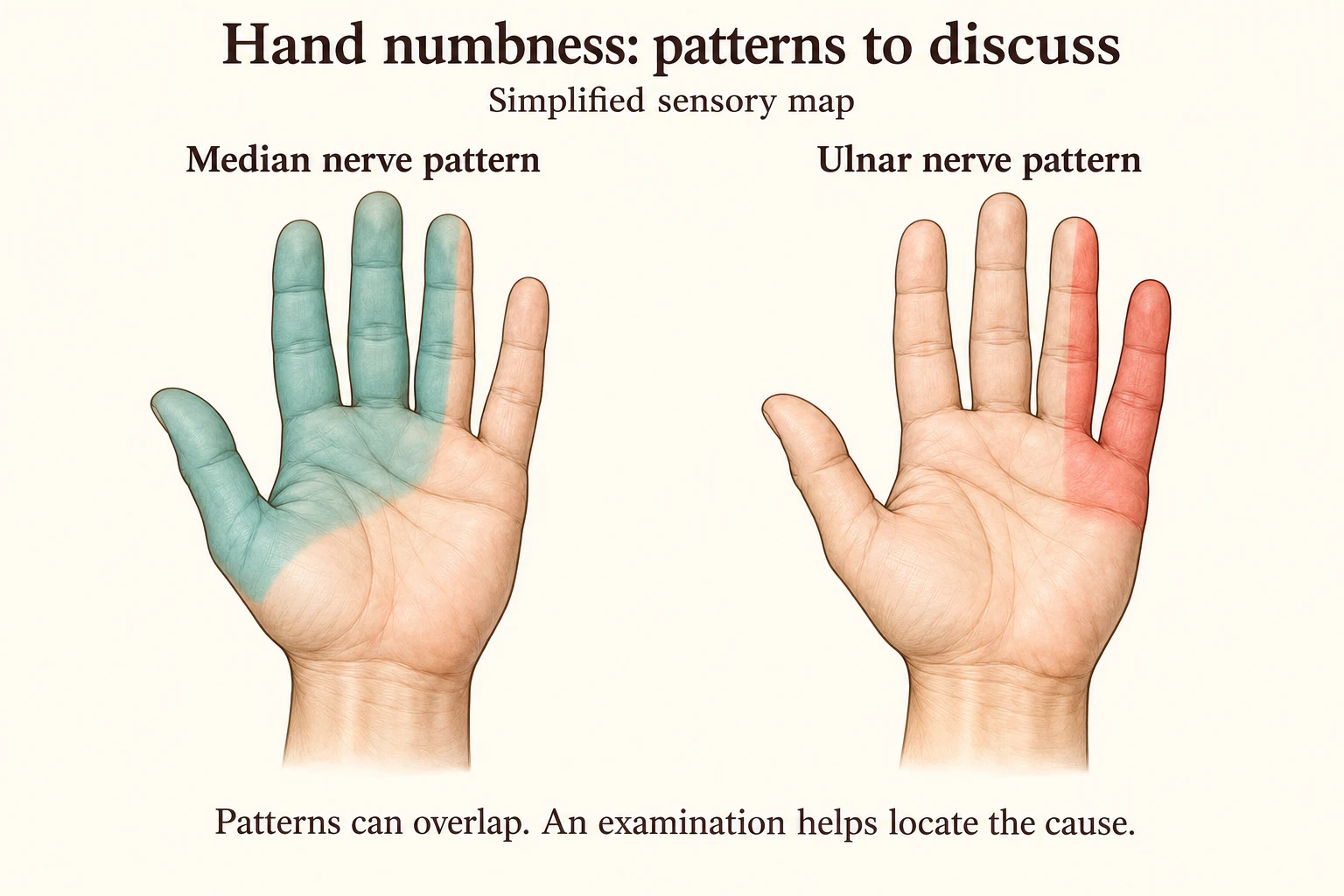
Original educational illustration. Simplified palm maps show common median-nerve and ulnar-nerve sensory areas.
The median pattern includes the thumb, index, middle and thumb-side portion of the ring finger; the ulnar pattern includes the little finger and adjacent portion of the ring finger. Patterns overlap and vary. An examination helps locate the cause.
Illustration references: Reference 1 · Reference 2
1. Connect the fingers, the elbow, and your daily routine
Cubital tunnel syndrome involves irritation or compression of the ulnar nerve near the inside of the elbow. Ring- and little-finger numbness or tingling are common features. AAOS notes that the nerve can also be affected elsewhere along its course. Describe what happens during sleep, phone use, desk work, or prolonged elbow bending, and whether moving the arm changes it. These observations help the clinician evaluate the pattern; they do not prove where the nerve is affected.
Johns Hopkins describes evaluation of cubital tunnel symptoms through history, examination, and sometimes nerve testing. Bring a clear account of where numbness occurs and whether it relates to elbow position. Mention difficulty with a key, buttons, or grip even when pain is limited. Ask how the clinician distinguishes irritation at the elbow from another location along the nerve’s path. If testing is proposed, ask what the result would change. This keeps the appointment focused on locating the problem and understanding its effect on your hand.
Sources: AAOS OrthoInfo: Ulnar Nerve Entrapment at the Elbow · Cubital Tunnel Syndrome
2. Mention strength and dexterity, not just tingling
Tell the clinician about difficulty opening a jar, controlling a key, spreading your fingers, or holding small items. North Tees and Hartlepool’s patient guidance describes severe symptoms that can include persistent numbness, weakness, and muscle loss. Ask whether the examination suggests a change that should affect timing. If function is getting worse, describe when you first noticed it and how quickly it changed rather than waiting for a routine review without telling the team.
If a task has become less reliable, describe the change without repeatedly challenging the hand. Your everyday example can guide a more focused examination.
Sources: North Tees and Hartlepool NHS: Hand Therapy — Cubital Tunnel Syndrome
3. Ask how the diagnosis will be confirmed
A good assessment should explain why the elbow is the suspected source and whether another nerve or another location could contribute. If nerve studies or imaging are proposed, ask what uncertainty they address. Bring previous reports and let the physician know if the symptoms have changed since testing. You can ask, 'If this test is normal, what would we do next?' Understanding the role and limits of a test is more useful than treating the result as the entire diagnosis.
4. Make activity changes workable
If your clinician recommends changing an elbow position, using a brace, or working with a therapist, ask for a demonstration and a plan that fits the day you actually have. A workstation, a long commute, and a job with sustained tool use raise different questions. Ask what to monitor and when to report back. Rather than trying several online nerve exercises at once, confirm which exercises, if any, are appropriate for your examination and how to respond if they reproduce symptoms.
ASHT’s patient resource describes a therapist’s role in identifying activities that increase symptoms. Look beyond a single exercise: ask about how you sit at a desk, hold a device, lean on an armrest, or sleep. Bring photographs of your workspace if they help explain the setup. If an orthosis or activity change is suggested, ask what it is intended to accomplish and how it fits your workday. Agree on how to report persistent symptoms, poor fit, or reduced dexterity without waiting for the next routine appointment.
Sources: Cubital Tunnel Syndrome — Patient Education Resource
5. Understand the reason for a proposed procedure
If an operation is being discussed, ask what problem it addresses, why that approach is proposed, and what improvement is realistic in sensation and strength separately. Clarify what might remain unchanged. You can also ask what makes a nonsurgical trial reasonable or less appropriate in your case. Practical recovery questions should include incision care, lifting, leaning on the elbow, driving, and your actual work duties. Request the treating surgeon’s instructions rather than borrowing a return-to-work date from another patient.
6. Track the hand function you want to preserve
Bring a concrete example of the lost function, such as trouble fastening a button or holding an object securely. Explain whether it is new, worsening, or intermittent, and mention any neck or other arm symptoms. Ask how the clinician will track sensation and hand function as treatment proceeds. If surgery is proposed, make sure the expected benefit and remaining uncertainty are clear. Planning around your actual hand use helps turn a technical nerve discussion into a useful care decision.
Make the most of your visit
Questions to bring to your consultation
Choose the questions that matter most to you. Bring them along, and ask us to explain anything that is unclear.
- Does the examination suggest compression at my elbow, wrist, or somewhere else?
- Is there weakness or muscle loss that affects the urgency of treatment?
- What will nerve testing tell us, and what can it miss?
- Which positions or work tasks should I modify?
- Would a brace or a therapist be useful for my situation?
- If surgery is proposed, why this approach?
- Which symptoms might improve, and which may remain?
- What changes should prompt an earlier call?
Sources & further reading
- AAOS OrthoInfo: Ulnar Nerve Entrapment at the ElbowAmerican Academy of Orthopaedic Surgeons
- North Tees and Hartlepool NHS: Hand Therapy — Cubital Tunnel SyndromeNHS
- Cubital Tunnel SyndromeJohns Hopkins Medicine
- Cubital Tunnel Syndrome — Patient Education ResourceAmerican Society of Hand Therapists
We use these medical sources to help explain your options and prepare you for a conversation with our team. Our guides feature our own clinicians; patient reviews describe individual experiences.






 (310) 595-1030