
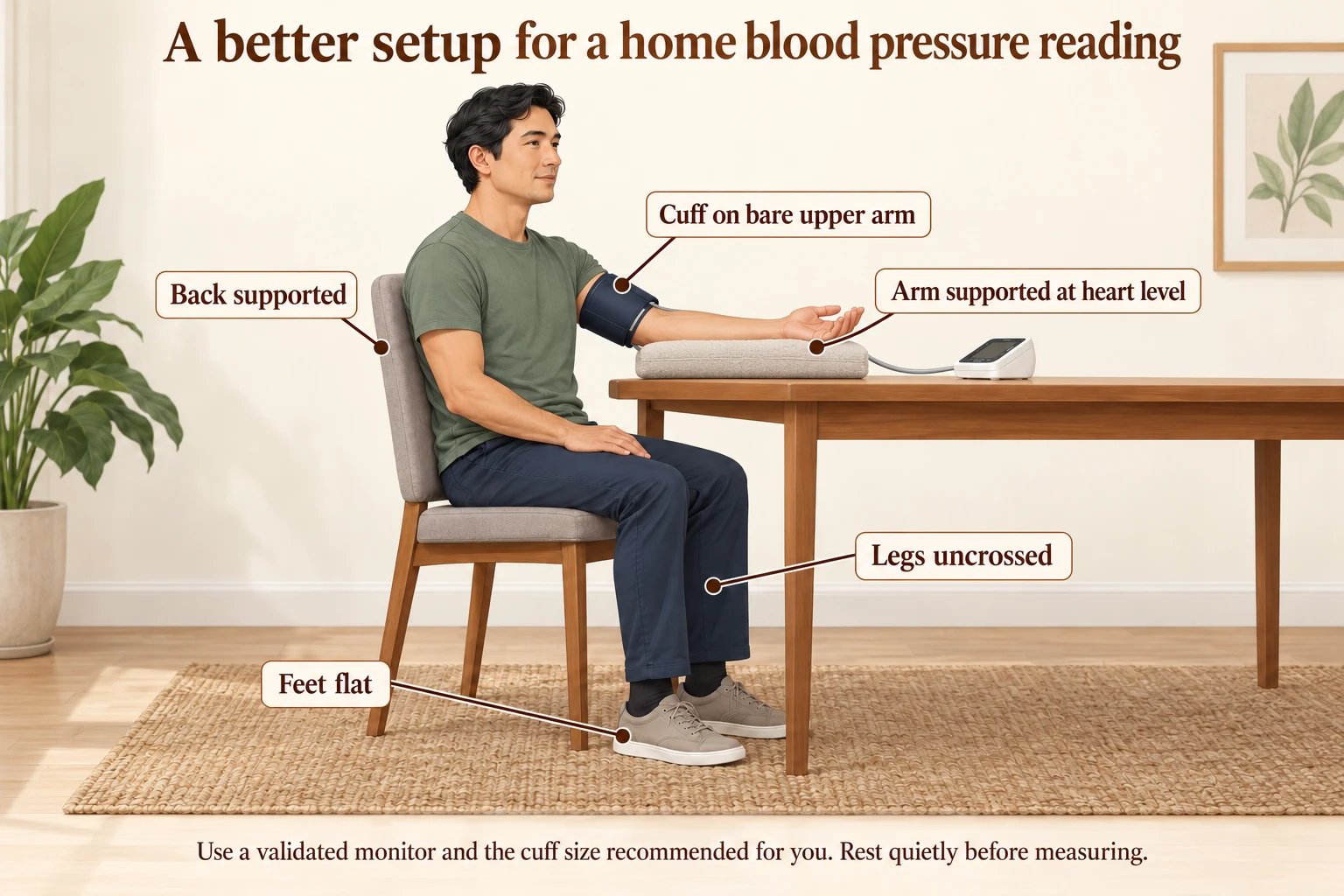
Original educational illustration. An illustrated seated person has back support, uncrossed legs, feet flat, and a bare upper-arm cuff with the arm supported.
Use a validated monitor and a cuff that fits. Rest quietly, support the arm so the cuff is at heart level, and follow the measurement instructions from your care team. This illustration addresses setup, not diagnosis or medication changes.
Illustration references: Reference 1
1. Start with why you are seeking care
You may feel well and want to understand a family history of early heart disease. You may have high blood pressure, cholesterol concerns, or questions about your long-term risk. Tell the cardiologist what brought you in and what you most want to leave knowing.
A focused opening helps: "My father had a heart attack young, and I want to understand what that means for me." Or, "My home blood pressure and office readings differ." Prevention is more useful when it addresses a real question than when it becomes a collection of tests without a clear purpose.
2. Put individual numbers in a larger picture
Blood pressure, cholesterol, blood sugar, tobacco exposure, sleep, and physical activity all contribute to a prevention conversation. Your health history also matters. Ask which factors are driving concern in your case and which can be changed.
Risk calculators can support that discussion. The American Heart Association's PREVENT equations estimate cardiovascular risk using health information, including kidney and metabolic factors, for appropriate adults without known cardiovascular disease. Ask whether a risk estimate applies to you, what period it describes, and what it leaves out. A number should help explain a recommendation, not replace the conversation.
The ACC’s March 2026 dyslipidemia summary describes PREVENT-ASCVD for an eligible primary prevention population and highlights risk factors that a score alone may miss. Ask whether the calculator applies to you and which personal details could change its interpretation, such as family history, kidney disease, or pregnancy-related cardiovascular history. The point is to understand why a recommendation fits your circumstances. Bring earlier lab results and treatment history so the conversation can consider your pattern over time rather than one isolated number.
Sources: American Heart Association: Heart-Health Screenings · American Heart Association: PREVENT cardiovascular risk assessment · ACC/AHA Issue Updated Guideline for Managing Lipids, Cholesterol
3. Bring the history that a lab report cannot tell
Prepare a family history with the type of cardiovascular problem, the relative affected, and their approximate age when it occurred. Bring prior cholesterol and blood pressure results, a medication and supplement list, and relevant pregnancy or menopause history. If you use a home monitor, bring its readings and ask whether the device and cuff fit are appropriate.
You do not need a perfect spreadsheet. A few dated results and an honest account of your routine are more useful than a polished record that leaves out barriers. Explain work schedules, caregiving, food access, exercise limitations, and previous medicine side effects.
4. Ask what a proposed test would change
Before another test, ask which uncertainty it is meant to resolve and how the result could alter the plan. A useful discussion covers what happens after a reassuring result, an uncertain result, or an abnormal one. It should also include costs and whether insurance coverage is clear.
Current AHA lipid guidance highlights more personalized risk assessment, including Lp(a) testing and selective additional measures. That does not mean every available test is needed at every visit. Ask the cardiologist which assessment is appropriate for your history and why it belongs before a particular decision.
Mayo Clinic explains that coronary calcium scanning may help when cardiovascular risk is uncertain; it is not a universal screening test. Ask what decision is unresolved and how a low, intermediate, or high result would influence treatment. Discuss radiation, cost, and whether information already available could answer the same question. If you proceed, agree on who will explain the result and connect it with your other risk factors. A test has the most value when both you and your clinician know what they will do with the answer.
Sources: American Heart Association: 2026 Guideline on the Management of Dyslipidemia · Coronary calcium scan
5. Leave with priorities and a review date
Ask for the two or three most useful next steps. If lifestyle changes are discussed, make them specific enough to fit your life and ask what support would help. If medicine is proposed, discuss the expected benefit, side effects, alternatives, and when the response will be checked.
Clarify who manages ongoing prescriptions and how recommendations will reach your primary care team. Agree on which results to repeat and when to return. The goal is a plan you can follow and revisit, with room to ask questions if it proves difficult or does not produce the expected change.
6. Leave with prevention priorities and follow-up
Bring your most recent laboratory reports, medication list, home readings if available, and the family history you know. You do not need a perfect record to begin the conversation. Ask which missing information would change the next decision and which can wait. Our preventive cardiology profile can help you prepare for a visit focused on your risk and priorities. Leave knowing the first actions, who coordinates them, and when you will review the response together.
Make the most of your visit
Questions to bring to your consultation
Choose the questions that matter most to you. Bring them along, and ask us to explain anything that is unclear.
- Which factors have the greatest effect on my cardiovascular risk?
- Does a risk calculator apply to me, and what does it miss?
- How does my family or pregnancy history change the discussion?
- Are my home blood pressure readings reliable and useful?
- What would each proposed test change about the plan?
- What benefit and unwanted effects should I understand before starting a medicine?
- Which two changes should I prioritize first?
- Who will coordinate follow-up, repeat tests, and prescriptions?
Sources & further reading
- American Heart Association: Heart-Health ScreeningsAmerican Heart Association
- American Heart Association: PREVENT cardiovascular risk assessmentAmerican Heart Association
- American Heart Association: 2026 Guideline on the Management of DyslipidemiaAmerican Heart Association
- ACC/AHA Issue Updated Guideline for Managing Lipids, CholesterolAmerican College of Cardiology
- Coronary calcium scanMayo Clinic
We use these medical sources to help explain your options and prepare you for a conversation with our team. Our guides feature our own clinicians; patient reviews describe individual experiences.






 (310) 595-1030