
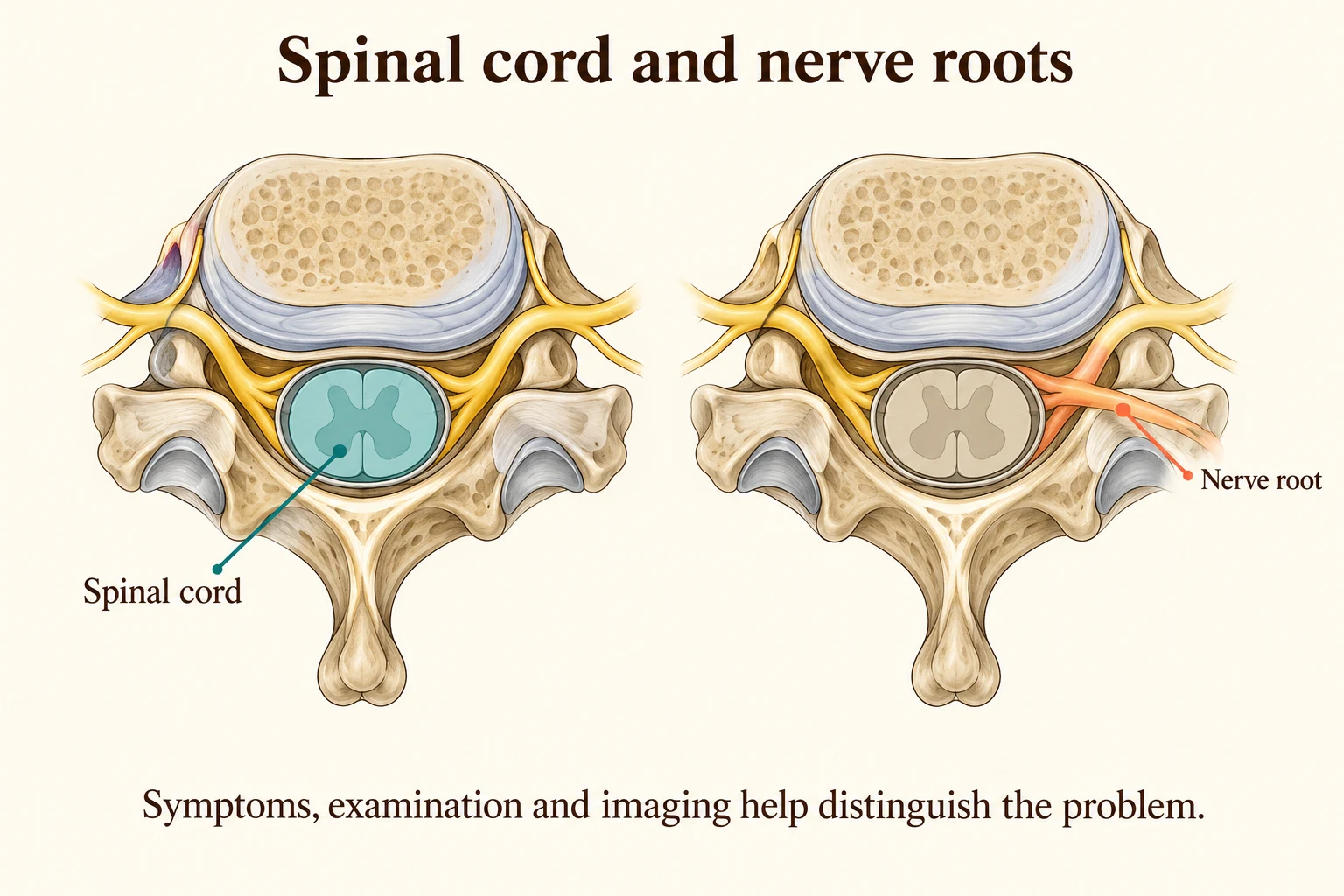
Original educational illustration. Matched cervical spine cross-sections highlight the central spinal cord and an exiting nerve root.
Cord and nerve-root problems can have different implications. Symptoms, examination and imaging are considered together; this orientation drawing cannot diagnose the source of numbness or weakness.
Illustration references: Reference 1 · Reference 2
1. Describe the pattern rather than choosing a label
Cervical radiculopathy occurs when a nerve root in the neck is irritated or compressed. It can cause pain into the shoulder or arm, altered sensation, or weakness. Similar symptoms can also arise from other problems, so the pattern and examination matter.
Before your visit, note where symptoms travel, which fingers feel different, and which tasks have changed. Explain whether symptoms began after an injury or appeared gradually. Avoid forcing your experience into a diagram you found online. A precise description of what you feel is more helpful than arriving certain which nerve is involved.
2. Ask what supports the diagnosis
The assessment may include strength, sensation, reflexes, and movements of the neck and arm. Ask how these findings fit your symptoms and whether a shoulder condition or a nerve problem elsewhere could contribute.
If imaging or a nerve study is suggested, ask what uncertainty it could resolve and how the result would change care. Bring existing images as well as their reports. A report can describe several changes, while the clinician may consider only one relevant. Ask the physician to explain that distinction and to identify any symptoms that remain unexplained.
HSS explains that a cervical radiculopathy diagnosis combines symptoms, physical examination, and imaging. Common age-related scan changes do not necessarily explain the pain. Ask your clinician to show which side, level, and nerve fit your symptoms and which findings appear incidental. If shoulder disease or a peripheral nerve problem remains possible, ask how that distinction will be investigated. Bringing a short description of the tasks that expose weakness can make the examination and subsequent conversation more useful than the MRI report alone.
Sources: Cervical Radiculopathy (Pinched Nerve) · Cervical Radiculopathy
3. Give nonsurgical care a clear purpose
Many people with cervical radiculopathy improve without surgery. Your clinician may discuss options such as a tailored rehabilitation plan or medication, depending on the assessment. Ask what each option is intended to change and how you will recognize useful progress.
Explain practical obstacles: sleep disruption, a long drive to work, screen time, lifting demands, or previous treatment side effects. Ask what can reasonably be adapted while you recover. A plan should include a reassessment date and a contact route for worsening symptoms, rather than an open-ended instruction to keep trying the same thing.
4. Keep weakness and function in the conversation
Pain, numbness, and weakness are related but different concerns. Tell the clinician if you are dropping a cup, struggling with a tool, or noticing reduced ability to lift. Ask whether the examination shows a strength change and how it will be followed.
New or worsening weakness, problems with walking or coordination, or other major neurologic changes deserve prompt clinical attention. Ask for instructions suited to your findings. If pain improves but strength remains reduced, ask how that affects the next decision rather than assuming the whole problem has resolved.
AANS notes that neck pain can arise from several tissues and may extend into the arms. The word pinched nerve should therefore lead to a specific explanation, rather than end the evaluation. Ask what kind of symptom change warrants a call before your next appointment and whether weakness or coordination changes alter the plan. If a treatment is intended mainly to ease pain, clarify how the team will also monitor strength and sensation. Keep a simple record of meaningful changes rather than repeatedly testing yourself throughout the day.
Sources: Neck Pain
5. Understand when a surgical discussion changes
If symptoms persist or worsen despite appropriate nonsurgical care, a surgeon may discuss decompression. Options for selected problems include anterior discectomy with fusion, disc replacement, or posterior decompression. The suitable choice depends on anatomy and the specific problem.
Ask which symptom is most likely to improve, what could remain, and why the proposed operation is favored over the alternatives. Discuss the risks, recovery demands, and the likely course if you continue observation. You should understand the reason for surgery before deciding between technique names or trying to compare incision size.
6. Bring your priorities to our cervical spine team
Our spine team includes Dr. Brandon Ortega, Dr. Hyun Bae, and Dr. Sanjay Khurana, whose practices include cervical spine care. Their profiles can help you explore relevant expertise and prepare questions about the options you have been offered.
Bring a treatment timeline and one or two functional goals, such as sleeping through the night or returning to a particular work task. If a previous clinician proposed a procedure, bring the name and written recommendation. Ask for a plan that distinguishes pain, sensation, and strength, with a date for reassessment. Use the visit to make sure your own priorities are part of the decision and that you know whom to contact with questions.
Make the most of your visit
Questions to bring to your consultation
Choose the questions that matter most to you. Bring them along, and ask us to explain anything that is unclear.
- Which findings point to a neck nerve root rather than another problem?
- Does my examination show weakness that needs closer follow-up?
- Which imaging finding actually matches my symptoms?
- What is each nonsurgical option meant to achieve?
- How and when should we reassess strength and function?
- What new symptoms should prompt urgent contact?
- If surgery becomes appropriate, why do you favor this procedure?
- Which symptoms may improve, and which may persist despite treatment?
Sources & further reading
- Cervical Radiculopathy (Pinched Nerve)AAOS OrthoInfo
- Cervical RadiculopathyHospital for Special Surgery
- Neck PainAmerican Association of Neurological Surgeons
- Surgical Treatment for Cervical RadiculopathyAmerican Academy of Orthopaedic Surgeons
We use these medical sources to help explain your options and prepare you for a conversation with our team. Our guides feature our own clinicians; patient reviews describe individual experiences.








 (310) 595-1030