
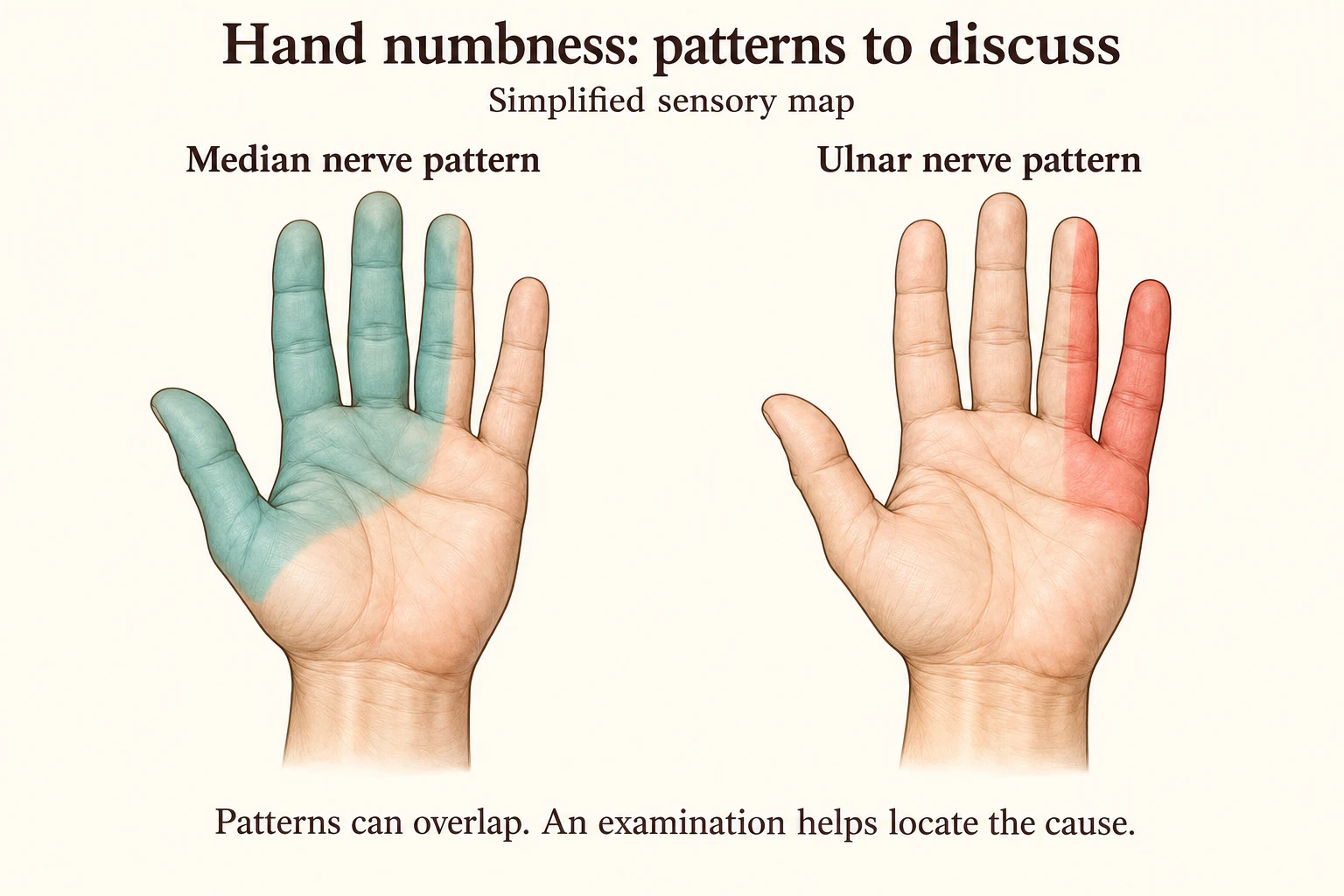
Original educational illustration. Simplified palm maps show common median-nerve and ulnar-nerve sensory areas.
The median pattern includes the thumb, index, middle and thumb-side portion of the ring finger; the ulnar pattern includes the little finger and adjacent portion of the ring finger. Patterns overlap and vary. An examination helps locate the cause.
Illustration references: Reference 1 · Reference 2
1. Describe the pattern before naming the problem
Write down which fingers feel numb or tingly, whether symptoms wake you, and whether they come and go or remain throughout the day. Mention changes in pinch, grip, or handling small objects. The Hand Society describes carpal tunnel syndrome as pressure on the median nerve at the wrist, often affecting the thumb, index, middle, and part of the ring finger. Similar-sounding hand complaints can have different causes, so let the clinician connect your pattern with the examination rather than choosing treatment from a symptom list.
Sources: American Society for Surgery of the Hand: Carpal Tunnel Syndrome
2. Ask what a test would change
AAOS notes that history and examination can sometimes establish the diagnosis without additional testing. Nerve conduction studies or other selected tests may help answer questions about severity, another compression site, or a different nerve problem. Ask which question a proposed test is meant to answer and how the result could change care. If you already have a test report, bring it with the date and the original symptoms that prompted it. An abnormal result needs interpretation alongside how your hand is functioning now.
The 2024 AAOS guideline supports a structured clinical assessment called CTS-6 instead of routine ultrasound or nerve testing in some circumstances. That makes a useful question for your consultation: what uncertainty would an additional test resolve in your case? Describe which fingers are affected, whether symptoms wake you, and whether fine hand tasks have changed. Ask how the examination fits the proposed explanation and whether another cause needs consideration. A recommendation for testing should come with a reason you can understand, rather than becoming a test you expect everyone to have.
Sources: AAOS OrthoInfo: Carpal Tunnel Syndrome · Management of Carpal Tunnel Syndrome: Evidence-Based Clinical Practice Guideline
3. Make the first treatment a clear trial
If a splint, an activity change, an injection, or another nonsurgical step is discussed, ask what it is intended to improve and how you will know whether it helped. Be specific about a task you want back, such as holding a steering wheel comfortably or fastening a button. Confirm how to use any prescribed splint and when the plan will be reassessed. Tell the team if the suggestion is difficult to follow during your work or caregiving day, so the conversation addresses the real obstacle.
4. Separate relief from recovery of nerve function
If release surgery is recommended, ask what the surgeon hopes it will do for your particular symptoms and what may remain uncertain. A question about night tingling is different from a question about established weakness. Ask whether delay could matter in your case, what alternatives remain, and how the plan accounts for the duration of your symptoms. New or worsening weakness deserves attention rather than an assumption that another patient’s improvement will predict yours.
5. Make bracing and hand use part of the plan
ASHT describes hand therapy support for brace use and activities that irritate the median nerve. If a brace or therapy is recommended, bring examples from your own day: typing, handling a tool, holding a phone, or sleeping with the wrist bent. Ask for a demonstration of the intended position and how to judge whether the fit is comfortable. Record what improves, what remains difficult, and any change in hand function. Agree on a review point so ongoing weakness or persistent symptoms have a route back to the treating clinician.
Sources: Carpal Tunnel Syndrome — Patient Education Resource
6. Plan around the way you use your hands
Tell the clinician which hand is dominant and whether your work requires lifting, gripping, fine control, or contact with water or tools. Ask about wound care, driving, work duties, and any help you might need if a procedure is chosen. If both hands are affected, ask how that changes timing and everyday tasks. Request instructions for your treatment rather than relying on a generic online recovery calendar. A practical discussion now can prevent uncertainty about ordinary tasks later.
7. Tie treatment to sleep and useful hand function
Describe the hand tasks that matter most: fastening clothing, holding a tool, typing, or sleeping without waking to tingling. Ask which symptom the proposed treatment is intended to improve and which recovery may be uncertain. A hand consultation is also a chance to discuss work adjustments and help at home. If a test is recommended, make sure you understand the question it will answer. An understandable plan should connect your symptom pattern, examination, and next decision.
Make the most of your visit
Questions to bring to your consultation
Choose the questions that matter most to you. Bring them along, and ask us to explain anything that is unclear.
- Which findings suggest carpal tunnel rather than another nerve problem?
- Do I need nerve testing, and what decision would it change?
- Is there weakness or another sign that affects timing?
- What is the goal of the first treatment trial?
- What improvement is realistic for my symptoms and their duration?
- What are the risks and alternatives if release is recommended?
- How would treatment affect work, driving, and use of my dominant hand?
- When should I contact you earlier than planned?
Sources & further reading
- American Society for Surgery of the Hand: Carpal Tunnel SyndromeAmerican Society for Surgery of the Hand (ASSH / The Hand Society)
- AAOS OrthoInfo: Carpal Tunnel SyndromeAmerican Academy of Orthopaedic Surgeons
- Management of Carpal Tunnel Syndrome: Evidence-Based Clinical Practice GuidelineAmerican Academy of Orthopaedic Surgeons
- Carpal Tunnel Syndrome — Patient Education ResourceAmerican Society of Hand Therapists
We use these medical sources to help explain your options and prepare you for a conversation with our team. Our guides feature our own clinicians; patient reviews describe individual experiences.






 (310) 595-1030