
A sore shoulder when you reach overhead, pain when you lie on one hip, or swelling where you rest your elbow can come from tissues close to the joint. We look at which activity brings on your pain, exactly where you feel it and how you move. Those details help us decide which tissue may be involved and what could help you get back to your usual activities [1] [2] [3].
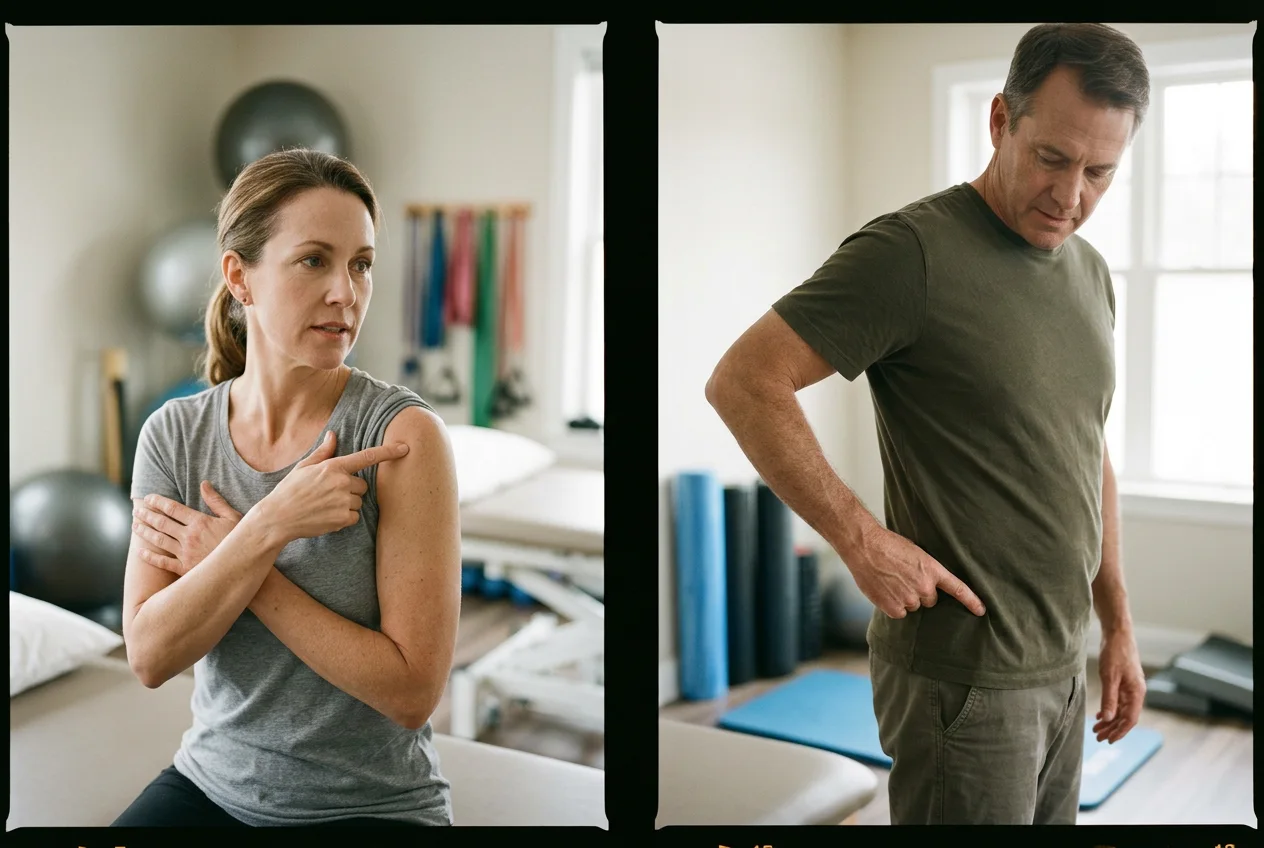
- A Outer shoulder region
- B Outer hip region
What tendons and bursae do
A tendon joins a muscle to a bone. When you reach, stand up or push off with your foot, tendons help transfer that muscle force. Repeated loading can make a tendon sore. You may hear this called tendonitis or tendinopathy. A bursa is a small sac of fluid that cushions places where tissues move over one another. Bursitis happens when that sac becomes irritated or inflamed [1] [2].
The two can overlap. At the shoulder, the rotator cuff tendons run beside a bursa. Both can contribute to pain when you reach overhead. On the outside of the hip, soft tissues near the bony point can hurt when you lie on that side, climb stairs or walk uphill. Swelling directly over the tip of the elbow may lead us to look at the elbow bursa [1] [2] [3].
Why it happens and what you can change
Tell us whether the symptoms began after more running, a new exercise, repeated overhead work, a fall or pressure on the area. Repeated load and direct pressure affect different tissues. Using a pad under your elbow at work, adjusting the volume of an overhead task or building up activity in smaller steps are examples of changes we might discuss. Your plan depends on the tissue involved and what you need to do [1] [2] [3].
Write down which movements hurt during the activity and which leave you sore later. That can help us find a level of activity you can tolerate as you regain strength and confidence.
How we help you recover
We start by asking what is harder now. Bring one concrete example, such as reaching a shelf, putting on a jacket, sleeping on your side or climbing the stairs at home. We examine motion, strength and where symptoms appear. When there is a reason to look for another cause, such as an injury to the bone or a torn tendon, we may discuss imaging. A hot, swollen bursa may need a different evaluation to check for infection [1] [2] [3].
For many overuse problems, we start with adjusting the activity and building a rehabilitation plan. The plan might target shoulder motion and strength or help you change how you use the area for work or sport. The right exercise depends on the body part and exam. If we discuss an injection or other procedure, ask which tissue it would address, what relief might look like and how follow-up would change [1] [2].
Feeling better and making progress
Less pain is one sign of progress. We also look at what you can do and whether symptoms return as you increase activity. If your goal is sleeping on one side, lifting a bag or returning to tennis, tell us. We can agree on smaller steps toward that activity and when to reassess.
When to seek care quickly
Get same-day medical assessment for a newly hot or painful swelling, especially if the skin changes color, fluid drains from it, or you have fever or chills. These can be signs of infection [3]. Hip pain after a fall needs prompt assessment, especially in older adults. Get emergency care if you have severe hip pain or cannot put weight on your leg after a fall [4]. Call 911 for symptoms that could be life-threatening.
Questions to ask us
- Which tissue is most likely causing the pain, and what findings support that?
- What would imaging or another test change in my plan?
- Which motions should I adjust for now? What can I keep doing?
- What will show that I’m ready to add more work, exercise or sport?
- When should I contact you if the plan is helping less than expected?
Explore our guides to hip bursitis, tennis elbow and Achilles tendon pain if one of those areas is where you need help.






 (310) 595-1030