
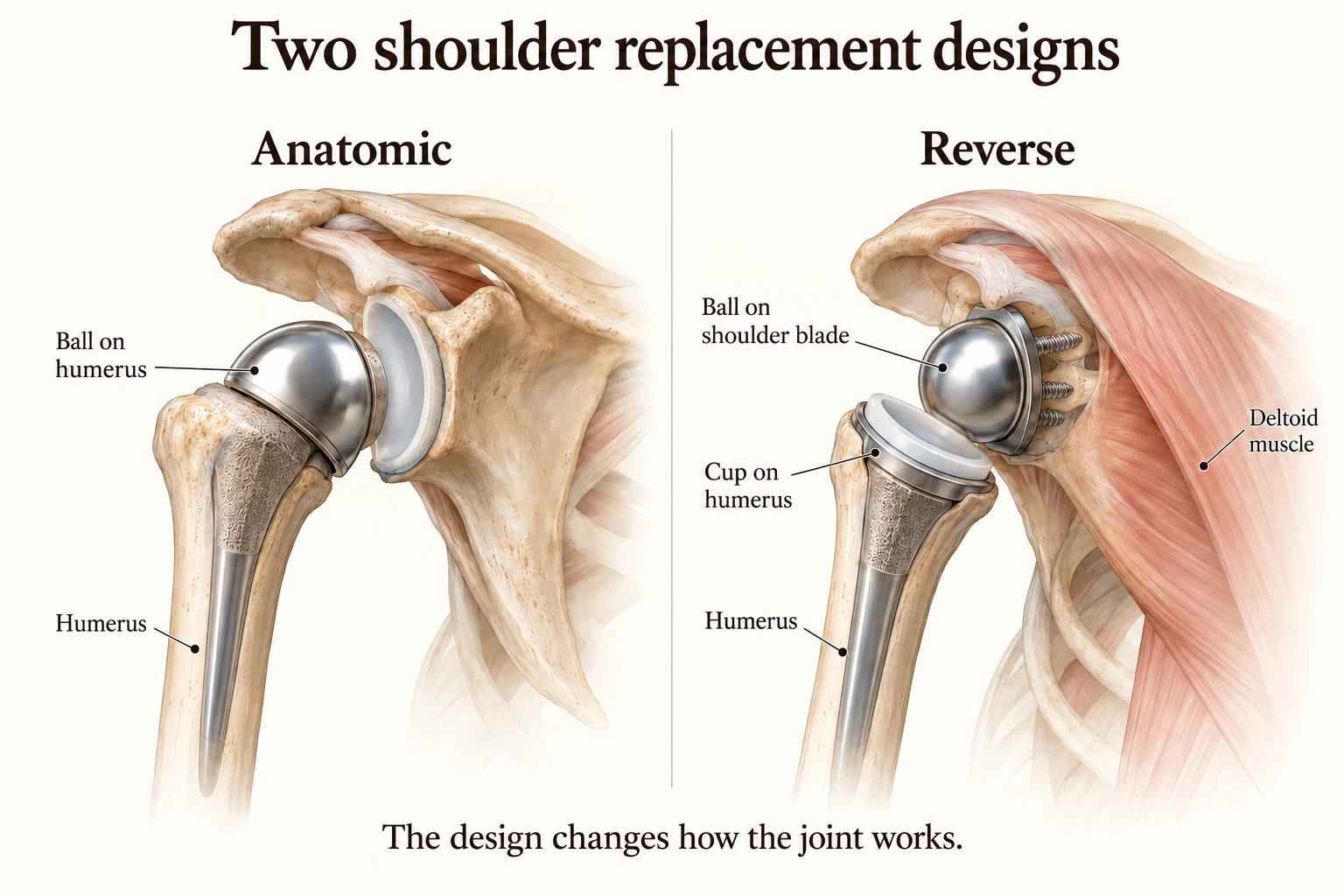
Original educational illustration. Anatomic replacement places the ball on the humerus; reverse replacement places the ball on the shoulder-blade side and the cup on the humerus.
The implant arrangement changes how the joint works. Discuss the rotator cuff, bone, deltoid function and goals that influence the choice; neither drawing identifies the right procedure for every patient.
Illustration references: Reference 1 · Reference 2
1. Why is a reverse replacement being recommended for me?
A reverse shoulder replacement switches the usual ball-and-socket arrangement and allows the deltoid muscle to play a larger role in moving the arm. It may be considered for several problems, including certain cuff-related conditions, fractures, and failed previous surgery.
Ask which diagnosis is driving your recommendation and why an anatomic replacement or another treatment is less suitable. Have the surgeon point out the important bone and tendon findings on your images. This is a decision about your anatomy and goals, not a contest between two implant names. A useful explanation should make clear what the proposed design is intended to solve.
Sources: Reverse Total Shoulder Replacement
2. What improvement is realistic for the tasks that matter to me?
Pain relief, raising the arm, reaching behind the back, strength, and endurance are different outcomes. HSS notes that some limitations may remain after reverse replacement, including restricted motion in certain directions.
Name the tasks you most want back: washing your hair, fastening clothes, preparing meals, gardening, or playing a particular sport. Ask the surgeon to discuss each rather than offering only a general promise of “better function.” Ask which limitations may be temporary and which may remain. Bringing a short written list helps keep a meaningful daily task from being lost in a conversation about X-rays and implants.
Sources: Reverse Shoulder Replacement
3. What needs attention in my health before surgery?
Johns Hopkins describes preparation as part of deciding whether the operation is appropriate and planning anesthesia and recovery. Your medical history belongs in the conversation alongside the condition of the shoulder.
Bring an accurate medication list and mention earlier anesthesia problems, infections, and previous shoulder operations. Ask who will coordinate any necessary medical assessment and whether another clinician needs to help plan your care. Request written instructions about medicines rather than stopping or changing them yourself. If surgery is being delayed, ask what specific issue the team is addressing and how you will know it is ready to proceed.
Sources: Reverse Total Shoulder Replacement
4. How will I manage daily life while the arm is protected?
The Royal National Orthopaedic Hospital describes occupational therapy as a way to plan personal care and household tasks while the operated arm is protected. The practical discussion is especially useful when it is your dominant arm.
Tell the team whether you live alone, use a walking aid, or support a family member. Walk through dressing, bathing, toileting, meal preparation, and getting out of a chair. Ask which tasks need assistance and whether equipment assessment would help. Plan transport and arrange a person who can hear the discharge instructions with you. It is easier to organize support before surgery than after you discover an essential task is difficult.
Sources: A Patient’s Guide to Reverse Type Total Shoulder Replacement
5. Which movement and lifting restrictions apply to my operation?
Reverse replacement recovery can include a sling and restrictions to protect healing tissues and reduce complications. The precise instructions vary with the operation and any additional repair, so a general online timetable is not your prescription.
Ask the team to show you how to use the sling and how to perform necessary movements within your restrictions. Ask whether leaning on the arm, reaching behind you, lifting an object, or pushing up from a chair is allowed. Request the limits in writing and find out who can change them. If the surgeon performs an additional procedure, ask how that changes the instructions given to your therapist.
Sources: A Patient’s Guide to Reverse Type Total Shoulder Replacement
6. What is the pain plan, and who helps if it is not working?
Johns Hopkins describes anesthesia, postoperative pain control, and follow-up as parts of the surgical pathway. The details should be clear enough that you and a helper can follow them at home.
Ask which medicines are scheduled and which are taken only when needed, who handles refills, and what to do about side effects or inadequate relief. If a nerve block is planned, ask what to expect as it wears off. You should also know whom to call at night or over a weekend. Keep the written plan near your medications and ask a pharmacist or your care team about any instruction you do not understand.
Sources: Reverse Total Shoulder Replacement
7. How will rehabilitation progress, and how will you assess it?
AAOS describes a rehabilitation program after reverse shoulder replacement. The plan needs to account for the operation performed and the surgeon’s protection instructions.
Ask when therapy should begin and who will provide the therapist with the operative details. Have the team explain how progress will be judged: comfortable daily function, movement, strength, or another measure. If an appointment is delayed or a movement feels different from what you expected, ask how to obtain advice. A review mentioning rapid progress may be encouraging, but it should not lead you to advance exercises or remove protection early.
Sources: Reverse Total Shoulder Replacement
8. What must happen before driving, work, or recreation?
HSS explains that recovery and restrictions depend on factors including health, shoulder damage, and rehabilitation. Driving and demanding activity require an individual conversation rather than a date borrowed from another patient.
Describe the job, vehicle, and leisure activities you want to return to. An office role, heavy lifting, and overhead work create different planning needs. Ask who provides clearance, what criteria they use, and when the decision will be reviewed. If an employer can offer modified duties, ask the team what limitations to document. Discuss the longer-term demands of your preferred activities before choosing surgery, while there is time to understand the tradeoffs.
Sources: Reverse Shoulder Replacement
9. Which problems should prompt a call, and what follow-up is needed?
Potential complications include infection, instability or dislocation, fracture, and implant-related problems. Some concerns arise early; others require longer-term follow-up. The surgeon should explain your individual risks and the plan for recognizing them.
Request written guidance for worsening pain, a wound concern, a new injury, or a sudden change in function, including where to obtain urgent assessment. Ask when follow-up visits and images are expected. Patient reviews can reveal how people experienced communication and access to help. Check whether an account describes reverse replacement or another shoulder procedure, and discuss your own expected motion and activity restrictions with the surgeon.
Sources: Reverse Total Shoulder Replacement · Reverse Shoulder Replacement
Make the most of your visit
Questions to bring to your consultation
Choose the questions that matter most to you. Bring them along, and ask us to explain anything that is unclear.
- Why does a reverse design fit my diagnosis and rotator cuff function?
- Which daily activities are likely to improve, and which may remain limited?
- What medical preparation is needed before choosing a surgery date?
- How will I manage personal care and household tasks with a protected arm?
- Which sling, movement, lifting, and weightbearing instructions apply to me?
- What is the medication plan and the after-hours contact number?
- How will the surgeon and therapist coordinate rehabilitation?
- What criteria will you use for driving, work, and recreation?
Sources & further reading
- Reverse Total Shoulder ReplacementAmerican Academy of Orthopaedic Surgeons
- Reverse Shoulder ReplacementHospital for Special Surgery · Updated November 12, 2025
- Reverse Total Shoulder ReplacementJohns Hopkins Medicine
- A Patient’s Guide to Reverse Type Total Shoulder ReplacementRoyal National Orthopaedic Hospital NHS Trust · Updated November 27, 2025
- Read our related clinical guide on Commons Clinic ↗
We use these medical sources to help explain your options and prepare you for a conversation with our team. Our guides feature our own clinicians; patient reviews describe individual experiences.






 (310) 595-1030