
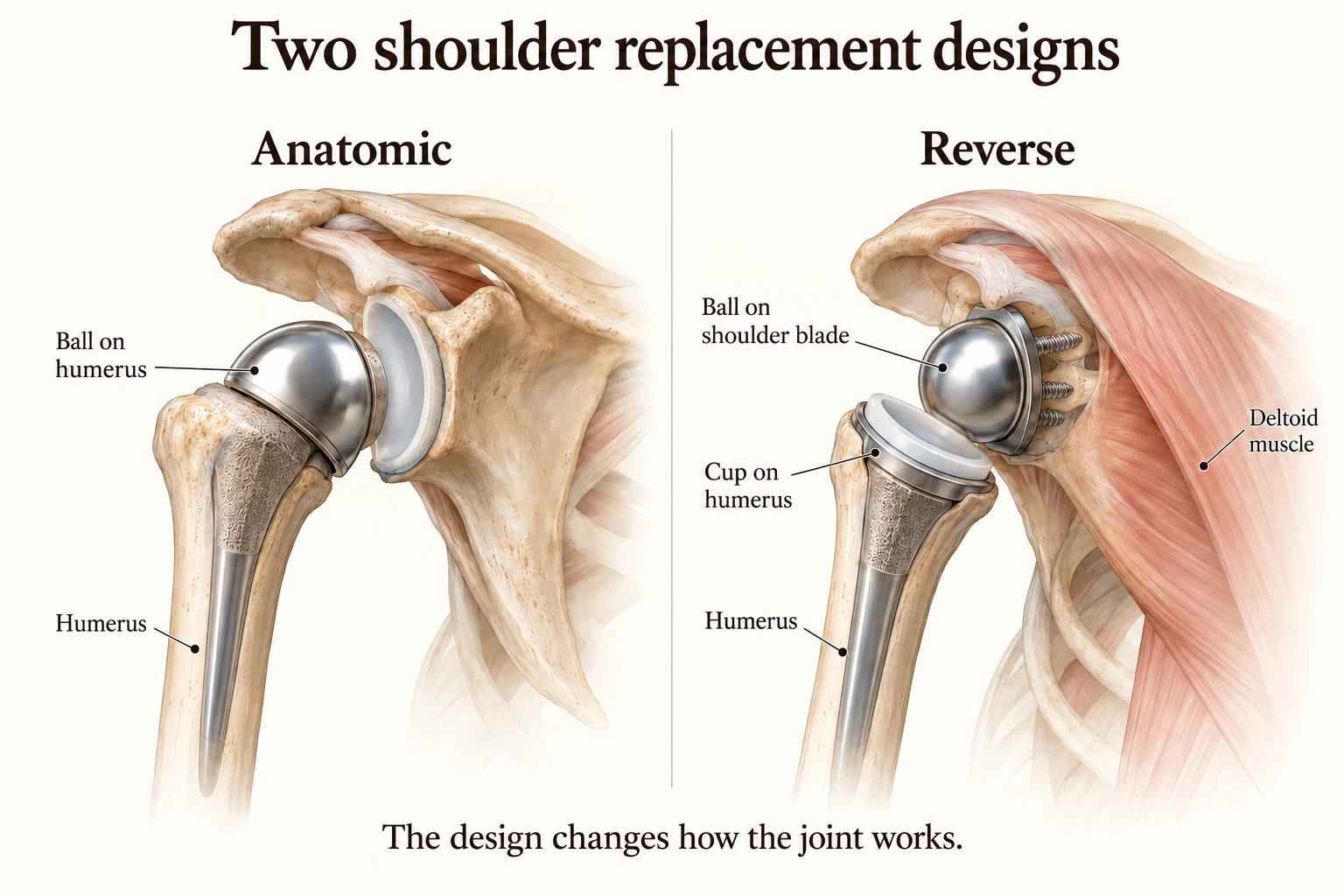
Original educational illustration. Anatomic replacement places the ball on the humerus; reverse replacement places the ball on the shoulder-blade side and the cup on the humerus.
The implant arrangement changes how the joint works. Discuss the rotator cuff, bone, deltoid function and goals that influence the choice; neither drawing identifies the right procedure for every patient.
Illustration references: Reference 1 · Reference 2
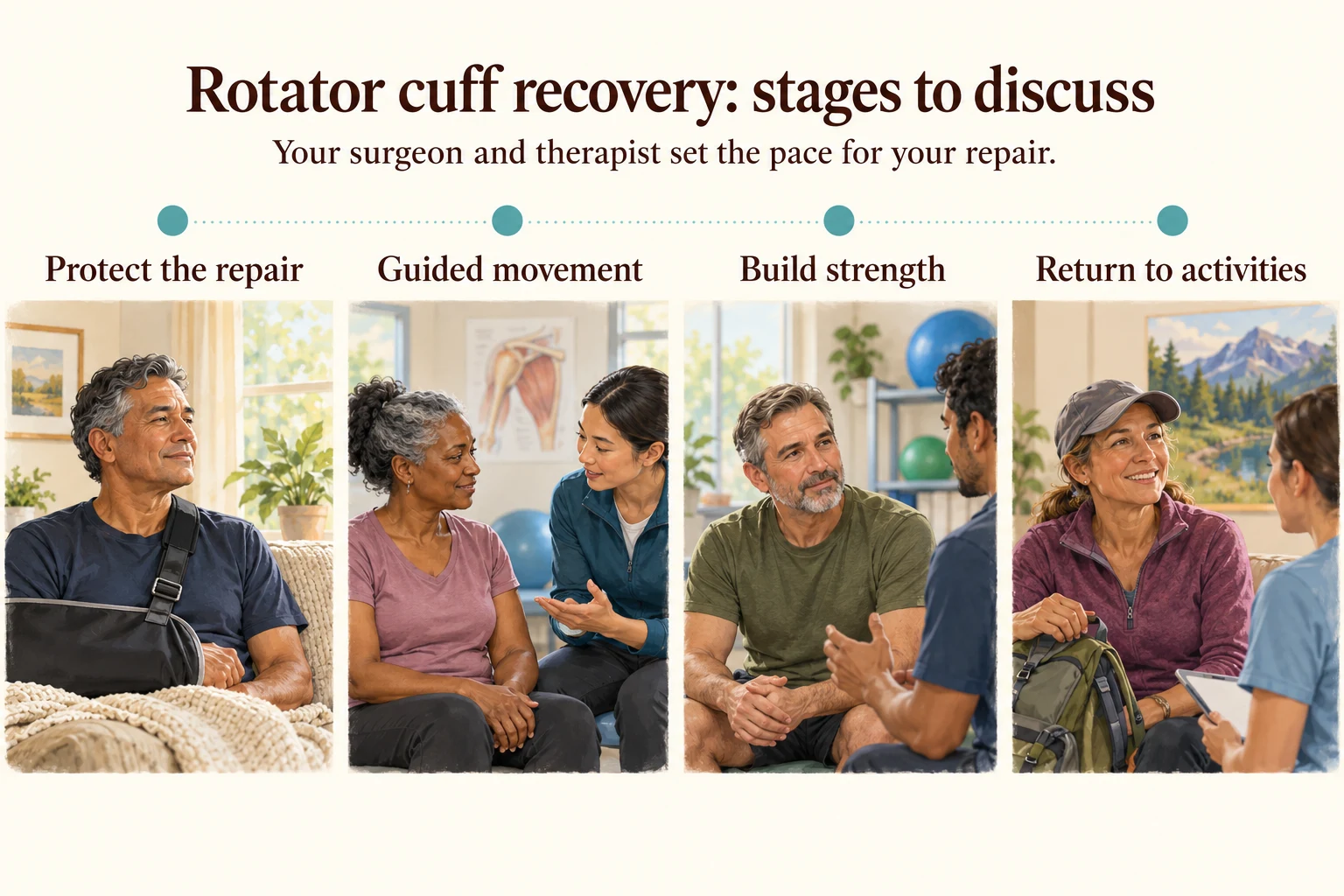
Original educational illustration. Illustrated scenes show protecting a repair, guided movement, strength planning and return-to-activity discussion.
Your surgeon and therapist set the pace for the particular repair. The sequence does not prescribe exercises, weights or dates. The people shown are fictional illustrations.
Illustration references: Reference 1 · Reference 2
1. Find out what the tear means for your shoulder
Rotator cuff tears vary in size, depth, cause and the quality of the surrounding tissue. An injury with new weakness can raise different questions from a tear that developed gradually. Tell the clinician when symptoms began and what changed after any specific event.
Ask the physician to connect the examination with the images. Which tendon is involved? Is the main limitation pain, stiffness or loss of strength? Bring examples such as lifting a pan, reaching a shelf or controlling a tennis serve. These details help clarify the treatment goal.
Sources: Rotator Cuff Tears
2. Compare symptom improvement with tendon repair
Rehabilitation can improve pain and function in selected patients even though it does not necessarily close a full-thickness tear. Surgery attempts to repair the tendon when the tissue and overall circumstances make that reasonable. These are different treatment goals.
The 2025 AAOS guideline supports meaningful improvement with either rehabilitation or repair in selected small-to-medium tears, while also recognizing that tear size and muscle changes can progress during longer-term nonsurgical care. Ask what that evidence means for your tear and how the shoulder would be monitored if you choose rehabilitation.
Sources: Management of Rotator Cuff Injuries: Evidence-Based Clinical Practice Guideline
3. Ask what makes repair possible and worthwhile
Tear size, tendon retraction, muscle condition and tissue quality can affect the discussion. Ask whether the proposed operation is a complete repair, partial repair or a different strategy, and why. If additional biceps or joint problems are present, ask whether they change the plan.
Discuss the possibility of incomplete healing or another tear, along with infection, stiffness and other surgical risks. Ask what outcome is realistic for pain and for strength separately. A reassuring explanation can acknowledge uncertainty without leaving you unsure about the purpose of the operation.
4. Plan for the protection phase
A small skin incision does not mean the tendon is ready for immediate use. Repair rehabilitation usually progresses through protection, assisted or permitted motion, active movement and later strengthening. The timing depends on the repair and your surgeon’s protocol.
Ask how you will dress, sleep, bathe and manage work while the arm is protected. If you care for someone, use a walking aid or rely heavily on that arm, raise it before scheduling. Make sure your therapist receives the actual operation details and restrictions.
5. Make the nonsurgical plan measurable too
If rehabilitation is the first step, ask what it will target and when the shoulder should be reassessed. Track a few relevant tasks, night symptoms and clinician-selected strength or motion measures. Ask what change would make surgery worth revisiting.
Bring prior therapy instructions, injection dates, medication information and any earlier shoulder images. If opinions differ, ask which feature of the tear or your goals explains the difference. You should understand both the recommendation and the alternative well enough to discuss the decision in your own words.
6. Ask what an injection changes about future options
Mayo Clinic describes corticosteroid injections as a possible source of temporary relief, while also raising concerns about tendon strength and later surgery. If an injection is offered, ask how its short-term purpose fits with the longer-term plan for the tear.
Bring the dates, location and response to previous shoulder injections. Ask whether another injection would affect the timing or choice of an operation, and which alternatives could help you participate in therapy. The answer should reflect the tendon being treated and your overall health; an injection that helps someone else may not answer the same question for you.
7. Know the contingency if the tendon cannot be repaired
Ask what the surgeon would do if the tissue proves less suitable than expected. A partial repair, a pain-relieving procedure and a shoulder replacement pursue different goals and have different consequences. Discuss which choices you consent to and whether any major alternative should wait for a separate conversation. An MRI estimate helps planning but cannot eliminate uncertainty about the tissue. Ask how the operative findings will be explained afterward and how the rehabilitation instructions will reflect them. You deserve a plan for this possibility before anesthesia, not an unfamiliar procedure name appearing for the first time in discharge paperwork.
Sources: Management of Rotator Cuff Injuries: Evidence-Based Clinical Practice Guideline
8. Define the result that matters to you
Separate comfortable sleep, overhead reach, sustained lifting and a return to sport. Improvement in one does not guarantee the others. Tell our team which limitation is driving the decision and which tradeoff would be hardest to accept. Patient reviews may offer useful context about communication and support, but an individual account cannot predict whether your tendon will heal or what strength you will regain. Ask for an explanation grounded in your tear, health, goals and ability to complete recovery.
Make the most of your visit
Questions to bring to your consultation
Choose the questions that matter most to you. Bring them along, and ask us to explain anything that is unclear.
- Which tendon is torn, and how does that fit my weakness or pain?
- What do retraction, muscle condition and tissue quality mean for repair?
- What could rehabilitation improve without repairing the tear?
- How would we monitor the shoulder if I wait?
- What operation are you proposing, including any biceps treatment?
- What could limit tendon healing or leave symptoms behind?
- How will protection, motion and strengthening be staged?
- What help will I need with daily tasks and return to work?
Sources & further reading
- Rotator Cuff TearsAmerican Academy of Orthopaedic Surgeons
- Management of Rotator Cuff Injuries: Evidence-Based Clinical Practice GuidelineAmerican Academy of Orthopaedic Surgeons · Published August 18, 2025
- Rotator Cuff Tears: Surgical Treatment OptionsAmerican Academy of Orthopaedic Surgeons
- Rotator cuff injury: Diagnosis and treatmentMayo Clinic
We use these medical sources to help explain your options and prepare you for a conversation with our team. Our guides feature our own clinicians; patient reviews describe individual experiences.








 (310) 595-1030