
At our Santa Monica clinic, you can see Brett Pugh, PT, DPT, our licensed physical therapist, for movement assessment and rehabilitation. Brett evaluates walking or running, strength and functional movement when those findings can help guide your plan. Tell us what you want to get back to, whether it’s taking the stairs, walking farther or returning to your sport. We’ll use your evaluation to decide what to work on first. [1]
Our Santa Monica clinic is at 2901 Wilshire Blvd, Suite 300, Santa Monica, CA 90403. The underground garage entrance is on Yale Street, and there is metered street parking. Request a visit with Brett online or call us at (310) 574-0367. If you are recovering from surgery, tell us which procedure you had and whether your surgeon gave you written restrictions. [1] [2]
See our physical therapy program for other locations and questions about getting started. If you’re looking for the physical therapy consult within our preventive health assessment, see how physical therapy fits into Wholebody.

What we look for at your first visit
We ask what brought you in, where you notice symptoms, when they started, and what happens later that day or the next morning. A symptom that appears after a twenty-minute walk tells us something different from one that starts with your first step. Bring the name and date of any procedure, the restrictions you were given, a medication list, and any brace or walking aid you currently use. It helps to write down one task that would make daily life easier if it improved. Our guide to preparing for your first orthopedic visit can help you organize your records. [3]
We choose an examination around your concern. We may measure how far a joint moves, assess strength, watch you walk, or observe a task such as getting out of a chair. If a movement is restricted after surgery, we work within those limits and contact your surgeon’s team when instructions need clarification. [3]
With Brett, we can assess how you walk or run, test your strength and look at how you move during tasks that matter to you. When it would help answer a question about your progress, we may use force-plate testing to measure how you load each leg during a specific movement. We use what we learn to build an exercise plan and decide when to progress it. If you are recovering from surgery, we coordinate with your care team so your plan follows your restrictions. [1] [3]
The same diagnosis can lead to different plans. If your immediate goal is standing long enough to prepare dinner, we may start with a task you can repeat and measure at home. If you want to return to recreational running, we may later look at walking tolerance, strength and how you respond to progressively more demanding activity. If returning to work means carrying tools, tell us how heavy they are and how far you need to carry them. Specifics help us make your rehabilitation relevant.
What types of exercises are used in physical therapy?
The examples below show how we think about exercise selection. Ask us which movements, amounts and limits fit your situation. An exercise that makes sense for one person may need to wait for another person who has a new injury, a healing repair, or a weight-bearing restriction. [3]
Range of motion and flexibility
Range of motion is how far a joint moves. A movement may be passive, with the therapist or another aid moving the joint, active-assisted, with your muscles doing part of the work, or active, with you moving by yourself. Each serves a different purpose. After a first total knee replacement for arthritis, we may check how far the knee bends and straightens, and explain which motion you can practice under your current plan. [4] Stretching addresses flexibility and is sometimes helpful when limited motion affects a task. Ask whether your plan calls for gently moving a joint, stretching, or protecting it from a particular motion for now. [3] [5]
Strength and muscle endurance
Strength exercises help your muscles produce force for activities like climbing steps, lifting a bag, or reaching to a shelf. A therapist might choose a muscle contraction without visible joint movement, a controlled movement against a light band, or a task using your body weight. Later, the plan might use weights or other resistance. Repeating a lighter task can also build the ability to do it for longer. We choose what to progress based on your goal, your movement and how your symptoms behave, including between visits. [3] [6]
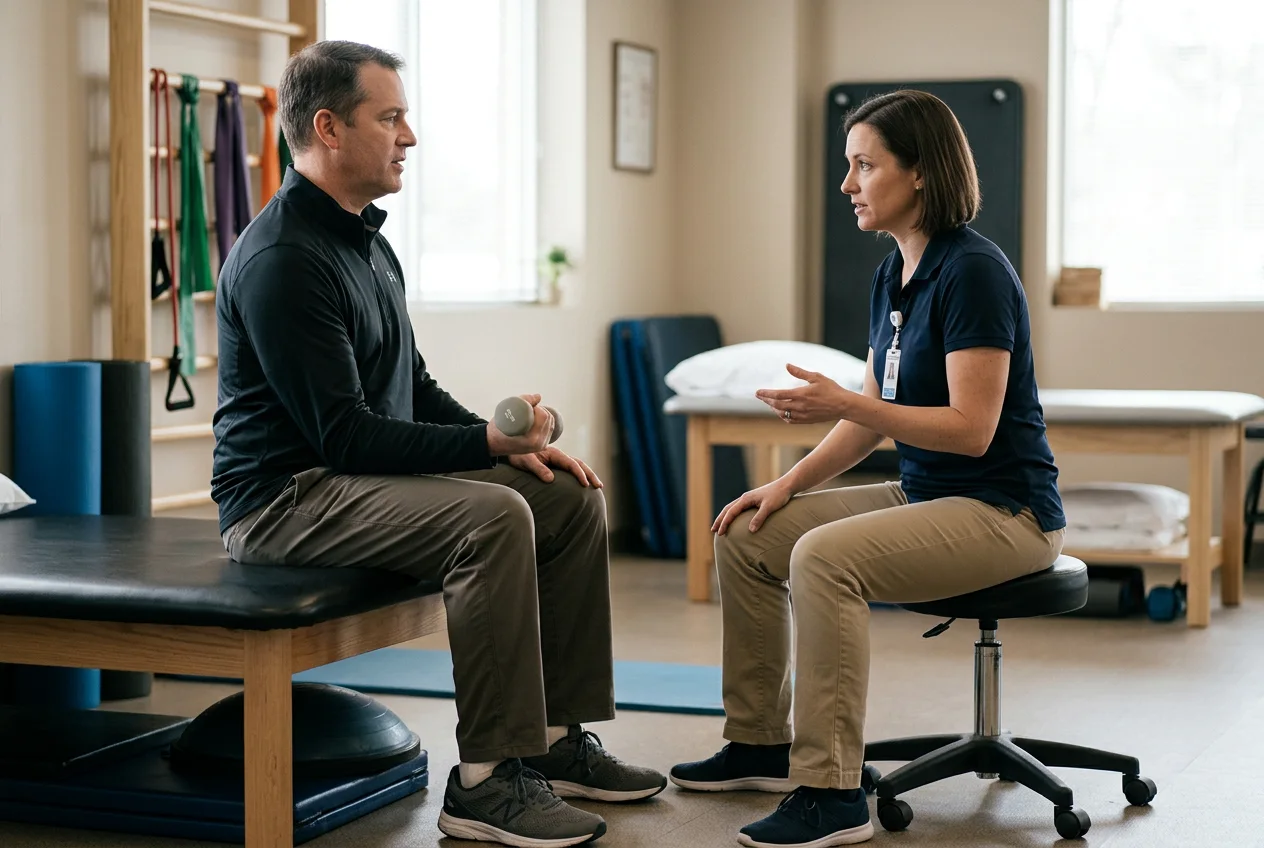
Balance, coordination and walking
Balance work can support ordinary tasks such as changing direction in a crowded room, stepping off a curb or carrying a bag while you walk. We may start near a stable support and adjust the challenge when appropriate. Coordination work can help you practice the order and timing of a movement. Gait training looks at how you walk, including how you use a cane, walker or crutches if one is part of your plan. We can help you practice using the device within your instructions and explain what we need to see before changing your level of support. [1] [3]
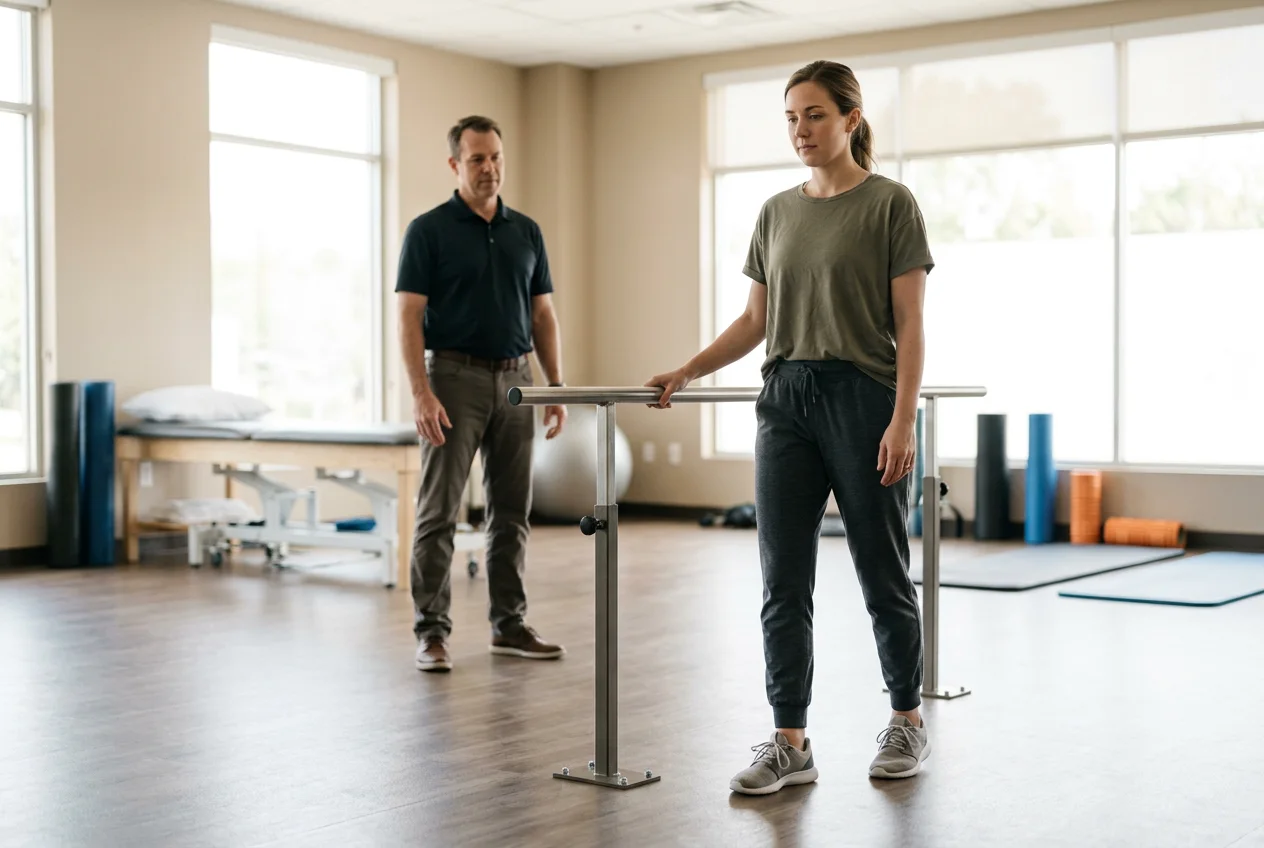
- A Hand near the support rail
- B Feet on the floor
Aerobic conditioning and everyday practice
Aerobic work builds tolerance for sustained activity. Depending on what you can safely do, a plan might involve walking, stationary cycling, or another option you can repeat comfortably. We can discuss how to build the duration or effort around your starting level and restrictions. If your main concern is making it through a work shift or a family outing, we can use a shorter version of that demand to see what you tolerate before we add more. [3] [6]
Functional training practices the movements you want in real life. An older adult who wants to rise from a low chair may work toward that task in stages. A parent who needs to lift a child may practice a version at a safe height and with an appropriate amount of load. For an athlete, later work may include changes in speed or direction after the care team clears that step. After an ACL injury, for example, readiness for sport involves a progression and can include strength, functional testing and psychological readiness. Time since the injury or surgery is one part of that decision. Ask what your team wants to see before you move from drills to practice or competition. [1] [7]
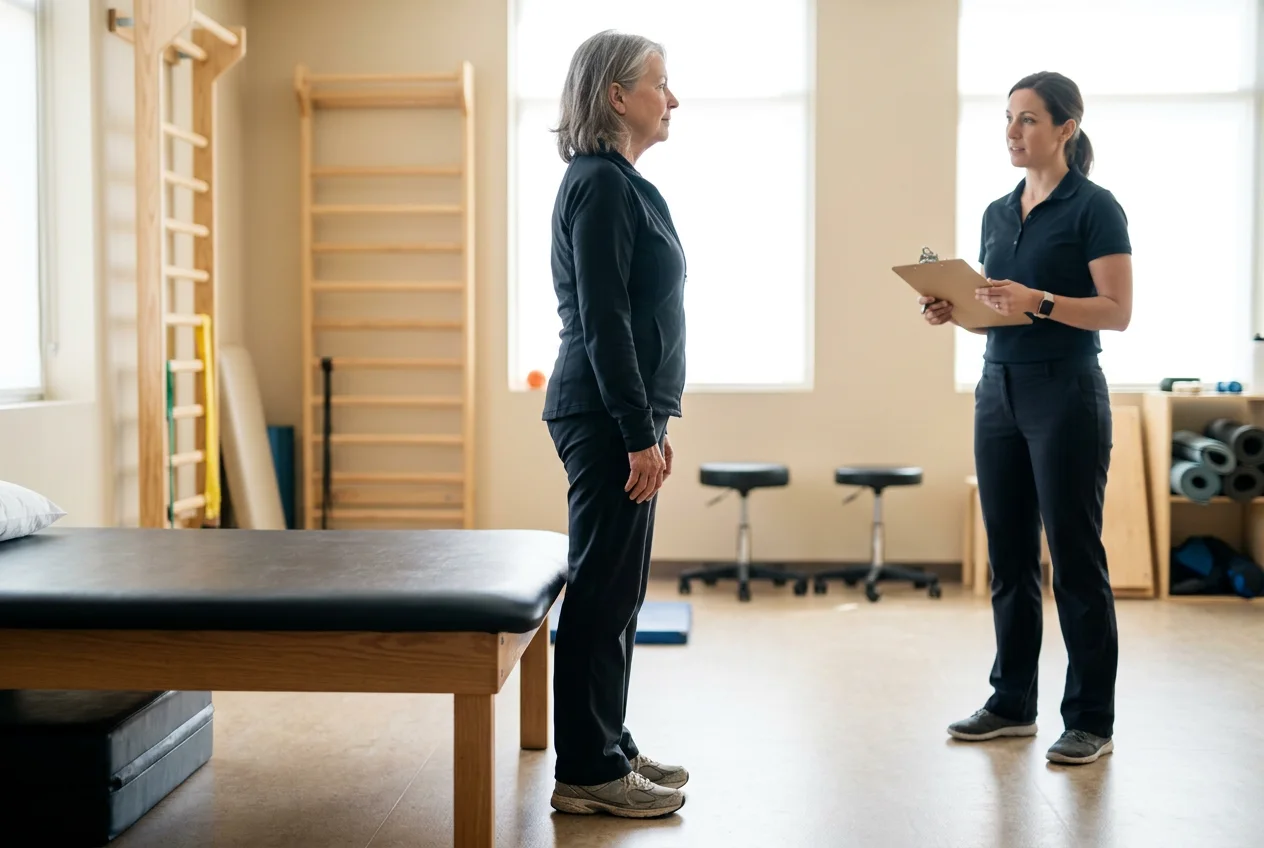
- A Hip region
- B Knee region
- C Foot contact with the floor
How we adapt therapy before and after surgery
If surgery is planned, ask your surgeon and physical therapist what you can work on now and what you will need at home. Depending on the procedure, your team may discuss keeping up permitted activity, practicing with a walking aid if one will be needed, or planning for stairs and transportation. Before you leave your surgical visit, ask who gives you the exercise and weight-bearing instructions, when to arrange your first therapy visit, and who to contact if you cannot follow the plan at home. Our care coordination guide has questions you can take to that visit. [3] [4]
After surgery, we use the details of the operation and the guidance from your surgical team. The surgeon may ask you to protect a repaired rotator cuff while the tendon heals. A person recovering from a first total knee replacement for arthritis may have a plan that includes knee motion, strengthening and walking practice. These examples show why a program labeled “post-op exercises” may be too general for your situation. Ask how your plan changes if another repair was done at the same time, and bring written instructions to your first appointment. Our guides to rotator cuff tears and total knee replacement recovery can help you prepare for the relevant discussion. [4] [5]
Plans may also include hands-on treatment or specialized assessment. Brett’s profile lists joint mobilization, force-plate and strength testing, and blood flow restriction training. Blood flow restriction uses a specialized cuff during selected exercises and requires screening. Tell us about your health history, including any circulation or clotting concerns. Ask how the technique would help your particular goal and what other options you have. [1] [8]
How to tell whether you are making progress
Pain relief can make sleep and movement easier. We also check what your body can do and what your injury or procedure still requires you to protect. Feeling comfortable during an exercise cannot confirm that a repaired tendon has healed or that you are ready to run. Your care team may use time since the procedure, the surgeon’s instructions, objective measures and your response to activity to decide when to progress. [3] [5] [7]
Give us details you can compare from visit to visit. For example, if walking is part of your prescribed plan, note how long you walked, whether you needed support, and how you felt later that day and the next morning. If a task becomes easier, ask us whether to practice the same amount a little longer or progress it. If you feel worse, tell us what you did and when symptoms changed. We can help you work out what needs adjusting. [3]
After surgery, follow your discharge instructions about when to call your surgical team. New unexplained swelling, pain, tenderness, warmth or redness in one leg or arm can be a sign of a blood clot and needs prompt medical assessment. Call 911 for possible emergency symptoms such as sudden shortness of breath, chest pain, a fast or irregular heartbeat, coughing up blood, severe lightheadedness or fainting. These can occur without arm or leg symptoms. [9]
Questions to ask about your physical therapy plan
| A question you might start with | A more specific question to bring us |
|---|---|
| What’s the best exercise? | Which movement targets the activity I’m trying to get back to, and what should I feel when I do it? |
| Should I exercise every day? | How often do you want me to do each movement, and when should I rest or call? |
| How long will this take? | What are our first two milestones, and what would make you change the plan? |
| Can I go back to running now? | What do you need to see in my movement, strength and response to activity before I try running again? |
| Can I stop using my walking aid? | Can you watch me walk and explain what I need to do safely before I change my level of support? |
| Why does this still feel hard? | Which part of the task is limiting me now, and is there a version I can practice safely at home? |
If you have space for just one more question, try: “What should I do if my symptoms change before our next visit?” Ask for an answer you can use at home. It also helps to agree on what you should continue after visits become less frequent, and when a new assessment makes sense. Read 8 things to compare when choosing your physical therapist for more questions about evaluations, communication and follow-up. [3]
Plan your visit with Brett Pugh
Our Santa Monica physical therapy practice is at 2901 Wilshire Blvd, Suite 300. If you are choosing care for a new injury, tell us how it happened and what you hope to do again. If you are preparing for or recovering from surgery, have your written instructions ready. Ask about insurance, referral requirements and where to check in before you come. Request an appointment with Brett online or call us at (310) 574-0367. [1] [2] [3]
This guide is general education. Your care team can advise you about exercises and restrictions for your own situation.
Learn More
- Commons Clinic — Brett Pugh, PT, DPT
- Commons Clinic — Santa Monica clinic and directions
- American Physical Therapy Association, ChoosePT — Preparing for Your Visit With a Physical Therapist
- American Physical Therapy Association — Physical Therapist Management of Total Knee Arthroplasty, 2026 Revision
- American Academy of Orthopaedic Surgeons, OrthoInfo — Rotator Cuff Tears: Surgical Treatment Options
- American Academy of Orthopaedic Surgeons, OrthoInfo — Starting an Exercise Program
- Panther Symposium Consensus Group — Return to Sport After Anterior Cruciate Ligament Injury
- Patterson and colleagues — Blood Flow Restriction Exercise: Considerations of Methodology, Application, and Safety
- U.S. Centers for Disease Control and Prevention — About Blood Clots






 (310) 595-1030