
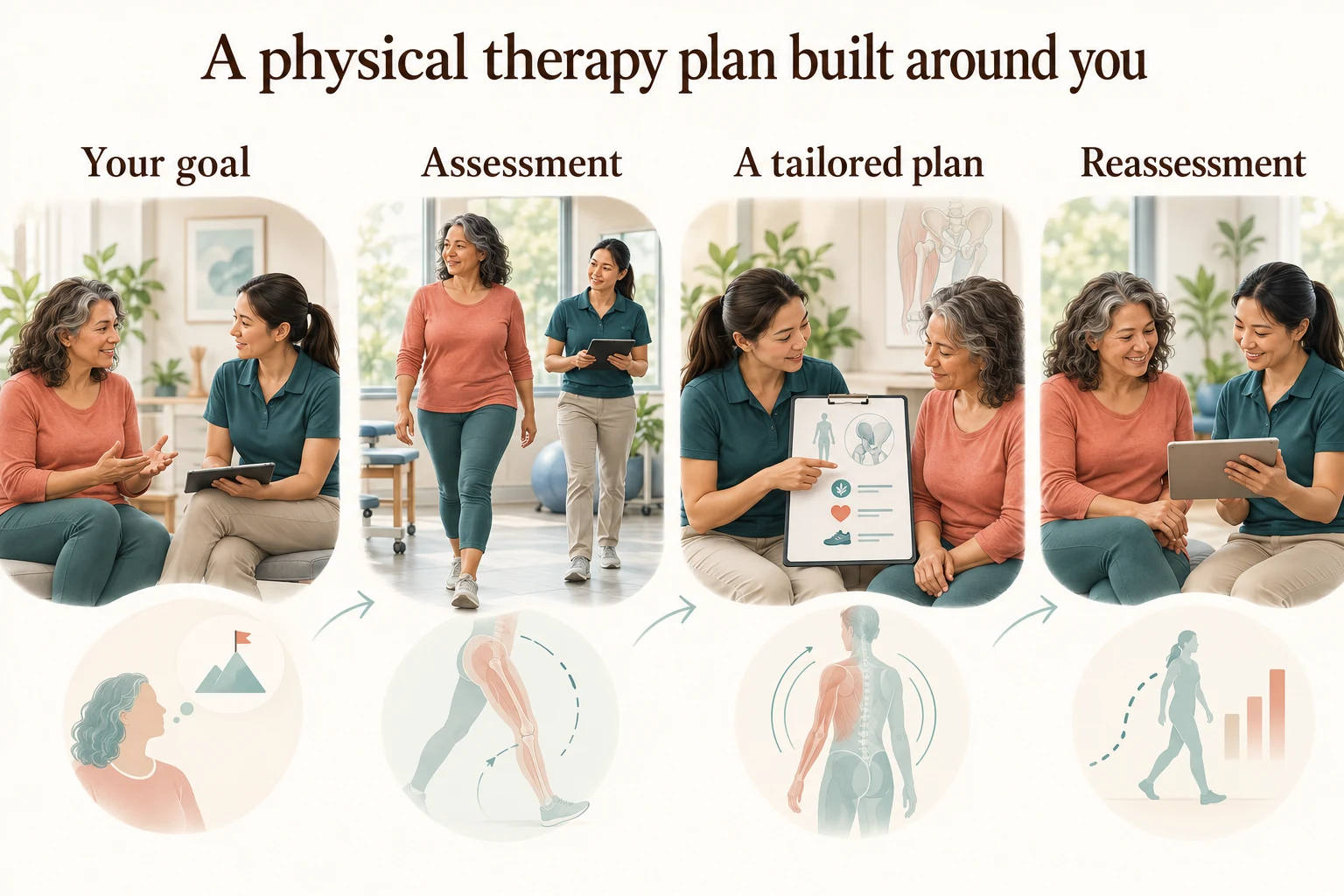
Original educational illustration. Illustrated patient and therapist scenes show goals, assessment, a selected plan and reassessment.
Start with an activity that matters to you. The therapist assesses your needs, selects an appropriate plan, checks your response and adjusts it. The people shown are fictional illustrations.
Illustration references: Reference 1 · Reference 2
1. What the assessment suggests about your symptoms
Start by describing the day your back is interrupting. Is the hard part getting out of a chair, standing through a shift, lifting a child, or sitting for the drive home? Include where symptoms travel and what has changed. ChoosePT explains that a low-back assessment considers symptoms, movement, health history, and everyday demands. Ask what the therapist learned from examining you and what remains uncertain.
A useful explanation can be specific without claiming to identify a single damaged structure. Try asking, 'Which finding are we working on first, and how does it relate to the task I find difficult?' If an image or a diagnosis from another visit is central to your concern, bring it into that conversation rather than assuming everyone has interpreted it the same way.
2. The goal that will make progress meaningful
'A stronger back' may be an aim, but it does not tell you what will change in your day. Choose one activity and describe your starting point: how far you walk before stopping, how long you can prepare a meal, or which part of dressing requires help. Ask which of those details should be tracked and how often.
Include the reason the activity matters. Walking farther might mean returning to a neighborhood routine or managing the distance between work sites. Those are different demands. If there are several goals, agree which comes first. APTA's examination guidance includes measuring function and setting a plan that can be revised as the person's needs evolve. Your own priorities belong beside the examination findings.
3. Why each part of treatment belongs in your plan
An appointment can include instruction, exercise, hands-on treatment, and discussion of daily movement. Ask what role each part plays and what you are expected to carry into the rest of the week. For example, is an exercise meant to practice a movement you avoid, build tolerance for a work task, or address a particular limitation found during assessment?
The APTA low-back guideline summary addresses several contexts, including leg-related symptoms and postoperative care. An exercise that sounds familiar may serve a different purpose in your situation. Tell the therapist what you tried previously and what happened. That history is more informative than simply saying you have 'already done PT.' Ask how this approach builds on, or changes, that earlier experience.
Sources: Interventions for the Management of Acute and Chronic Low Back Pain: Revision 2021
4. How the home plan fits your actual life
Ask to leave with instructions you can use without reconstructing the appointment from memory. Practice the movements while the therapist watches, confirm the starting amount, and say if the setup will not work at home. A floor exercise may be difficult if getting down and up is a problem; equipment may not fit your space. Those are reasons to adapt the instructions together.
The NHS describes home exercise as a possible part of physiotherapy between visits. Make that part realistic: what is essential on a busy day, what should wait until technique is reviewed, and what should you record? It is better to describe a manageable plan honestly than agree to a schedule you already know you cannot follow.
Sources: Physiotherapy
5. Which symptom changes need a different response
Before you exercise on your own, ask what response is acceptable for you, what should make you stop that activity, and how to reach the team. Avoid treating every uncomfortable sensation as either proof of harm or something you must push through. Get instructions that relate to your assessment and explain new symptoms promptly.
Back pain with new loss of bowel or bladder control or numbness around the groin calls for immediate emergency assessment, as ChoosePT advises. A routine appointment is not the place to wait out those symptoms. For less urgent changes, ask which details to report: where the symptom occurs, when it began, what activity preceded it, and whether it affects a task that was previously manageable.
6. How the plan connects with your other care
Tell the therapist about recent procedures, current restrictions, and the clinicians involved in your care. Bring the actual instructions when possible. If two sets of advice seem different, ask the treating professionals to clarify them before you choose between them yourself. A useful question is, 'Who needs to confirm this change before I make it?'
Ask which updates the therapist will send to your physician and when you should arrange a medical reassessment. You can also ask who handles a prescription question, a work form, or an appointment issue. Naming those roles early saves guesswork later. If you receive care outside Commons Clinic, tell us where the information should go and what permissions the offices need to share it.
7. When you will review progress and change direction
A plan should have a review point, not just another booking. Ask what you and the therapist expect to learn by then and which measures will be repeated. Bring a brief account of the task you chose, what you practiced, and anything that prevented you from following the instructions. A change in function deserves discussion even when the pain score has not changed much.
If the plan is not helping, ask what the reassessment suggests: a different exercise amount, clearer coaching, a revised goal, or input from another clinician. Ask what will be different in the next stage. Our Commons Clinic physical therapists, including Brett Pugh and Mina Sidarous, can discuss their assessment and approach with you; their profiles below introduce their backgrounds and practice focus.
Make the most of your visit
Questions to bring to your consultation
Choose the questions that matter most to you. Bring them along, and ask us to explain anything that is unclear.
- What did you learn from my examination that shapes this plan?
- Which everyday activity should we measure first?
- What is each treatment intended to help me do?
- Can you watch me perform the home exercises before I leave?
- What symptom response should make me pause and contact you?
- How will current restrictions from my physician reach you?
- When will we reassess, and what would make you change the plan?
- Who should I contact if a new problem develops between visits?
Sources & further reading
- Physical Therapy Guide to Low Back PainAmerican Physical Therapy Association / ChoosePT
- Documentation: Initial Examination and EvaluationAmerican Physical Therapy Association
- Interventions for the Management of Acute and Chronic Low Back Pain: Revision 2021American Physical Therapy Association / Academy of Orthopaedic Physical Therapy
- PhysiotherapyNHS
- Read our related clinical guide on Commons Clinic ↗
We use these medical sources to help explain your options and prepare you for a conversation with our team. Our guides feature our own clinicians; patient reviews describe individual experiences.







 (310) 595-1030