
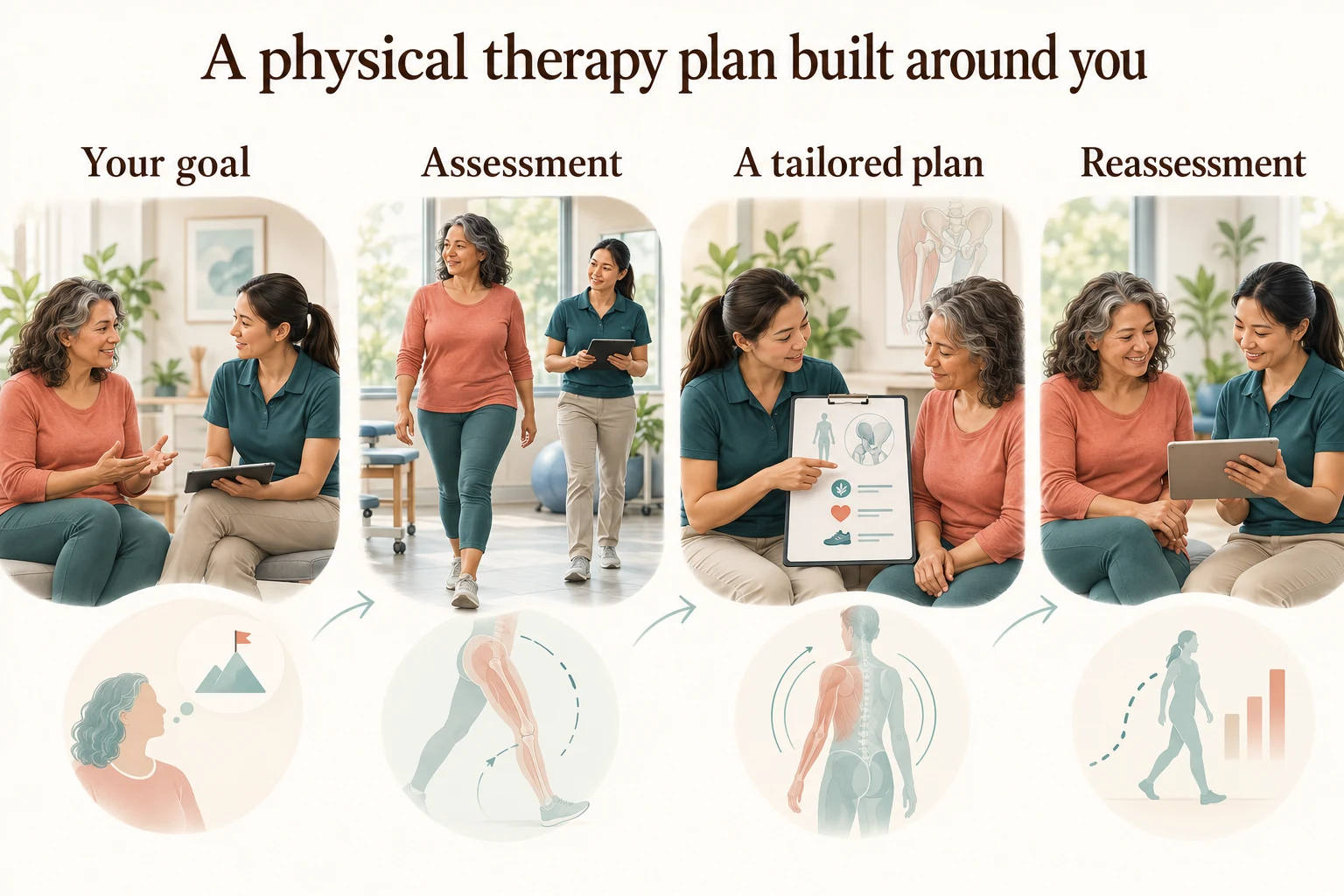
Original educational illustration. Illustrated patient and therapist scenes show goals, assessment, a selected plan and reassessment.
Start with an activity that matters to you. The therapist assesses your needs, selects an appropriate plan, checks your response and adjusts it. The people shown are fictional illustrations.
Illustration references: Reference 1 · Reference 2
1. Why is this exercise appropriate for my back problem?
Start with the purpose. Ask which finding or daily limitation the exercise is meant to address and how it fits the rest of the plan. A movement may look simple on a handout while requiring a particular starting position or level of control. Do not assume an exercise recommended to a friend belongs in your program.
NIAMS advises checking with a physician or physical therapist before starting a back exercise routine. Bring an online video or old handout if it has influenced what you are doing, and ask the therapist to review it in the context of your assessment. The useful question is why this movement belongs in your plan now.
2. Can you watch me do it without prompting?
Watching a demonstration and reproducing it are different tasks. After the therapist explains a movement, try it yourself and ask which detail matters most. You may need to adjust where you place your feet, the height of a support, or how far you move. Request a cue you can remember at home rather than a long list of corrections at once.
AHRQ's 'show-me' approach checks whether instructions were explained clearly by having a person demonstrate them. It gives you a useful way to start: 'Let me show you how I think this works.' If it still feels confusing, ask for another demonstration before adding repetitions.
Sources: Use the Teach-Back Method: Tool 5
3. What starting amount should I use?
Confirm the amount in terms you can follow: which exercises, how much of each, how often, and whether there are days or situations when the instructions change. Ask whether a short session and a longer session have different purposes. Written instructions should make clear which version is yours if the handout shows several levels.
Tell the therapist what your day allows. If you have ten minutes before work and more time on another day, ask how to arrange the prescribed plan rather than guessing how to compress it. If tiredness or another health condition limits practice, bring that up while the plan is being set.
4. What should I notice during and after practice?
Ask what the therapist wants you to observe and what information would be useful at the next visit. That may include whether a movement becomes easier or whether symptoms change location or interfere with an ordinary task afterward. Request instructions for a response that differs from what you discussed, including when to stop and call.
Avoid making up a personal rule that every exercise must feel painless or that discomfort always means you should continue. The next decision depends on the assessment and the symptom pattern. If you cannot describe what feels wrong, ask the therapist to watch you again and help identify what to report.
5. How can we make the setup work at home?
Describe the space and equipment you actually have. Mention if getting onto the floor, balancing beside a counter, or moving furniture is difficult. Ask for an appropriate alternative before substituting a chair, band, or weight on your own. Tell the therapist if someone will be helping you so that person's role can be explained too.
Johns Hopkins' virtual therapy guidance emphasizes a clear area with room to move and a device setup that allows coaching. Even when you attend in person, thinking through your home arrangement can uncover obstacles that are invisible in the clinic. A brief description or a photo of the setup can help the conversation.
Sources: Virtual Physical Therapy
6. What should change as I get more comfortable?
Ask how you will know when the starting version is no longer the right challenge and who should approve a progression. Clarify whether the next step changes resistance, movement, duration, or the task itself. Doing more of everything at once can make it difficult to explain which change helped or aggravated a problem.
Agree what stays the same until the next review. If an exercise feels easy, that is useful information to report; it is not automatically permission to add load. Ask what everyday activity the progression is preparing you for so the program remains connected to your goal, rather than becoming a collection of harder exercises.
7. What if I miss sessions or cannot manage part of the plan?
Say what happened without trying to make the record look perfect. You may have missed practice because the instructions were unclear, a movement worried you, equipment was unavailable, or the schedule did not fit. Each calls for a different adjustment. Ask what to prioritize if time is limited and whether a shorter version can be prescribed.
Separate a practical obstacle from a symptom change. 'I could not find a place to do it' needs a different discussion from 'I tried it and developed a new symptom.' A workable program leaves room for that conversation. You should know how to resume after a gap without doubling the amount to catch up.
8. When will you check the plan with me again?
Before leaving, decide what you will bring back: a question, a short practice record, or a description of a task that remains difficult. Ask how the therapist will review technique and whether an in-person or virtual check is appropriate. A recorded exercise demonstration can support instructions when the clinic provides one, but it does not replace reassessment when your circumstances change.
Our Commons Clinic therapists include Brett Pugh and Mina Sidarous. Ask our team how to get clarification between appointments and what should prompt an earlier review. The aim is to leave knowing the next manageable step and how you can ask for help when an instruction no longer fits.
Sources: Virtual Physical Therapy
Make the most of your visit
Questions to bring to your consultation
Choose the questions that matter most to you. Bring them along, and ask us to explain anything that is unclear.
- What finding or goal is this movement intended to address?
- Can you watch me perform it and correct the most important detail?
- What exact starting amount and frequency are you prescribing?
- What should I do if symptoms respond differently than expected?
- Can you adapt the setup to my home and available equipment?
- Who should approve a progression, and what changes first?
- What should I prioritize if I cannot complete the whole plan?
- When will we review technique and progress again?
Sources & further reading
- Back Pain: Diagnosis, Treatment, and Steps to TakeNIH / NIAMS
- Use the Teach-Back Method: Tool 5Agency for Healthcare Research and Quality
- Virtual Physical TherapyJohns Hopkins Medicine
- Read our related clinical guide on Commons Clinic ↗
We use these medical sources to help explain your options and prepare you for a conversation with our team. Our guides feature our own clinicians; patient reviews describe individual experiences.







 (310) 595-1030