
MCP joint replacement (metacarpophalangeal arthroplasty) replaces a damaged knuckle at the base of a finger with an implant. The main goal is less pain when you move the finger. Alignment may improve, and many people retain about the movement they had before [1]. It can help some adults with severe arthritis or damage from an old injury. It does not give you back a natural joint, though. Feeling less pain also does not mean your hand is ready for heavy gripping or lifting. We see it as one option among several, and we choose it together based on your hand, your goals and what your days ask of you.
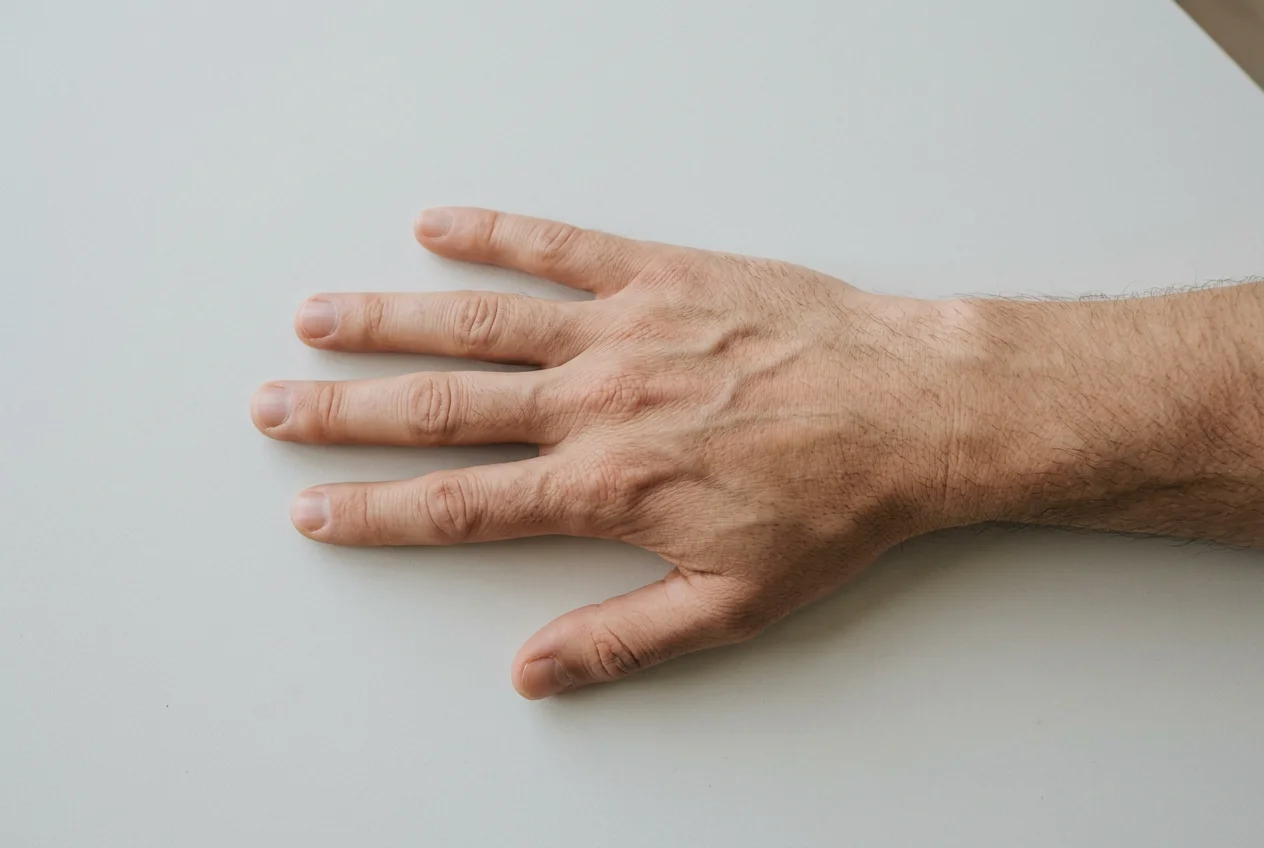
- A Finger knuckle region
- B Thumb base region
Which knuckle are we talking about?
Three joint areas often get mixed up:
- MCP joints are the large knuckles at the base of each finger.
- PIP joints are the middle joints of each finger.
- The thumb-base CMC joint sits near the wrist, where the thumb meets the hand.
Most finger implants are made for PIP or MCP joints, where motion matters most for finger function [1]. Implants, results and recovery differ from joint to joint. Advice about thumb-base or middle-joint surgery should not be applied to your knuckle. If your pain is at the base of the thumb, see our guide to thumb-base arthritis decisions.
Why knuckle joints wear out
Rheumatoid arthritis can destroy MCP joints and lead to deformity, pain and loss of function [2]. MCP joint damage is more often caused by rheumatoid arthritis than by osteoarthritis [3]. Osteoarthritis can also affect these joints [4]. An injury to the joint can raise your risk of arthritis later [5].
Care decisions: start with the least invasive options
Finger joint replacement is usually considered only after medicines, therapy, activity changes or injections have not helped enough [1]. For MCP arthritis, options without surgery include anti-inflammatory medicines, splinting, occupational therapy and corticosteroid injections. People with rheumatoid arthritis may also take disease-modifying drugs [4].
If surgery makes sense, the main choices are:
- Silicone implants. These are flexible spacers with some stability built in, and they have the longest track record [1].
- Pyrocarbon implants. These are durable and resist wear [1].
- Fusion. This permanently joins the bones. It ends motion at that joint but relieves pain and lasts well [1]. Fusion at the knuckle is generally harder to adapt to than fusion at other finger joints [3].
A 2026 systematic review found that silicone and pyrocarbon MCP implants gave similar improvements in pain, function and medium-term implant survival. The authors noted that the studies varied widely, so the results should be read with caution [6]. Your diagnosis, bone quality, ligament support and goals all shape which option fits you.
Tradeoffs with grip and loads
Implants can fail. Reported fracture rates for silicone implants vary widely, and some failures are linked to recurrent deformity or loss of motion [3]. In one series of pyrocarbon MCP replacements for osteoarthritis, 18% of joints needed another operation over an average of about six years [7]. A 2026 silicone study described revisions for returning deformity, infection and dislocation [8].
Pain relief versus progress
Adults with rheumatoid arthritis and severe knuckle deformity who chose silicone replacement reported better function, appearance and satisfaction at seven years than those who stayed on medical care alone [2]. That is real progress. In one small study of pyrocarbon implants for osteoarthritis, people reported less pain while grip strength changed little [9]. Comfort is one sign of recovery. Tissue healing, stability, alignment and strength each recover at their own pace. A knuckle that feels fine may still not be ready for a heavy pan or a full grocery bag. Ask us what signs besides comfort will tell us you are ready for more load.
Before surgery and reducing risk
- Tell us about every medicine you take. Drugs for rheumatoid arthritis need careful planning around surgery [4].
- Tell us about health conditions that affect healing.
- Plan for help at home while one hand is protected.
- Ask whether your wrist or elbow affects the plan. Our wrist and elbow arthritis guide may help.
Aftercare and hand therapy
Hand therapy is essential after finger joint replacement. It works on range of motion and tendon gliding, then strengthening within the safe limits of your surgery [1]. Your splint, therapy schedule and activity limits will come from your surgeon and therapist, based on your implant and your tissues. Read more in our guide to hand therapy after surgery.
When to seek urgent care
After hand surgery, call your surgical team right away if you have any of these [10]:
- A fever of 100.4°F (38°C) or higher, or shaking chills
- Heavy bleeding
- More swelling, pain, tingling or numbness
- Being unable to move your fingers
- Drainage, warmth or redness at the incision
Call us right away if your fingers turn pale, blue or cold [10]. If you cannot reach your surgical team, go to an emergency department.
Questions to ask us
For everyone
- Why replacement rather than fusion, or no surgery, for my finger?
- Which implant do you suggest for me, and why?
- What could make my joint drift, loosen or fail?
If your work or hobbies involve heavy gripping or tools
- Which loads could put my implant at risk?
- How will we judge when I'm ready for my job's specific tasks?
If you type, play music or do fine-detail work
- How much motion is realistic for my knuckle?
- Will working on my other joints matter?
If you use a cane, walker or wheelchair
- How do I protect the knuckle while still moving around safely?
- Can my mobility aid be adapted?
If your main goal is easier daily tasks
- Which tasks are most likely to get easier, and which may not change?
Returning to meaningful activities
Getting back to activities is gradual and personal. Bring us a list of what matters most to you, such as cooking, caring for others, gardening or your craft. Your surgeon and therapist can help you move toward those activities step by step, as your hand shows it is ready.
Talk with us
Richard Ahn, MD, an orthopedic surgeon specializing in the elbow, wrist and hand, practices at our Lakewood and Long Beach – Douglas Park offices. He can review your options with you.
Learn More
- American Academy of Orthopaedic Surgeons. Finger Joint Replacement. OrthoInfo. https://orthoinfo.aaos.org/en/treatment/finger-joint-replacement/
- Seven-Year Outcomes of the Silicone Arthroplasty in Rheumatoid Arthritis Prospective Cohort Study. Arthritis Care and Research. https://pubmed.ncbi.nlm.nih.gov/27696739/
- Implant Arthroplasty for Proximal Interphalangeal, Metacarpophalangeal, and Trapeziometacarpal Joint Degeneration. Journal of Hand Surgery, 2017. https://hande.assh.org/servlet/servlet.FileDownload?file=00P5b00000vYLbAEAW
- Management of Index Finger Metacarpophalangeal Joint Arthritis. Orthopedic Clinics of North America. https://sciencedirect.com/science/article/abs/pii/S0030589824000452
- Arthroplasty for Treating Traumatic Metacarpophalangeal Joint Defects: A Retrospective Study Over Three Years. https://pmc.ncbi.nlm.nih.gov/articles/PMC8168832/
- Outcomes and survival of pyrocarbon versus silicone metacarpophalangeal arthroplasty: a systematic review. Hand Surgery and Rehabilitation, 2026. https://www.sciencedirect.com/science/article/pii/S2468122926000186
- Metacarpophalangeal Joint Pyrocarbon Arthroplasty for Osteoarthritis: An Analysis of 44 Arthroplasties. Journal of Hand Surgery. https://www.sciencedirect.com/science/article/abs/pii/S0363502322004993
- Postal Z, Schluttenhofer A, Bankes A, Rizzo M. Silicone Metacarpophalangeal Arthroplasty: A Matched Cohort of Osteoarthritis and Rheumatoid Arthritis Patients. HAND, 2026. https://journals.sagepub.com/doi/10.1177/15589447261437819
- Functional Outcomes of Spherical Pyrocarbon HAPY Metacarpophalangeal Interposition Arthroplasty for Long Fingers: A Retrospective Study of 16 Cases. https://pmc.ncbi.nlm.nih.gov/articles/PMC12356446/
- UMass Memorial Health. After Hand Surgery. https://www.ummhealth.org/health-library/after-hand-surgery






 (310) 595-1030