
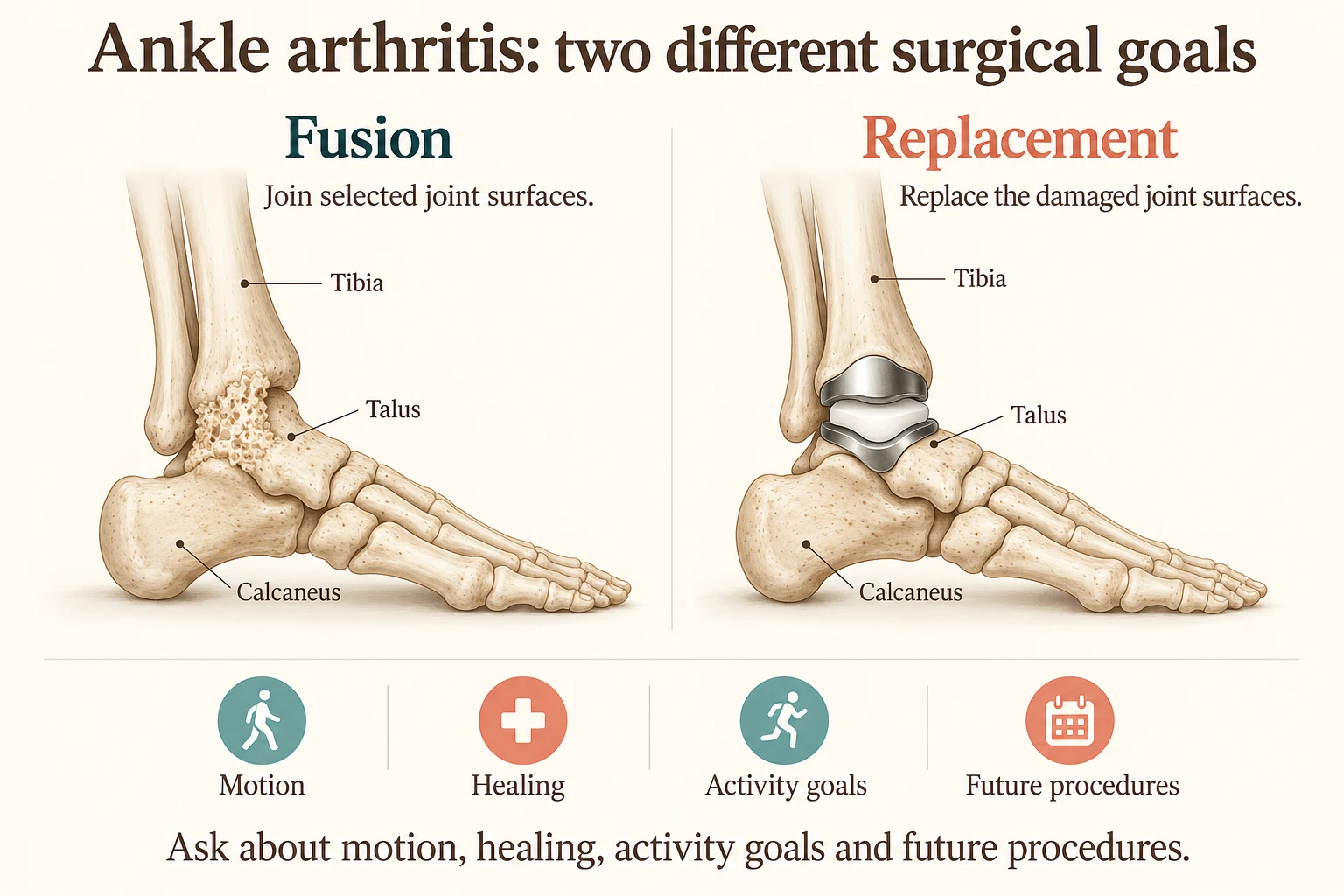
Original educational illustration. Ankle schematics contrast joining selected joint surfaces with replacing damaged joint surfaces.
Ask about motion, healing, activity goals and possible future procedures. The diagrams are conceptual and do not identify which operation is suitable for a particular patient.
Illustration references: Reference 1 · Reference 2
1. Find out which joint is causing the problem
Pain around the ankle may involve the ankle joint, nearby joints or surrounding tendons. Ask the clinician to identify the source and explain the role of old injuries, alignment and arthritis. Weightbearing X-rays can help show how the joint behaves under load.
Describe walking distance, uneven-ground tolerance, stairs and work demands. Bring earlier injury or operation records if available. Knowing where the pain comes from is essential before deciding which joint to fuse or replace.
2. Review what can help without an operation
Bracing, footwear changes, walking aids, activity adjustments and selected medication or injection options may help symptoms. Ask what each option is intended to do and whether it remains reasonable for the level of arthritis you have.
If these approaches have not helped enough, describe the actual benefit and duration. The question is whether the remaining pain and limitation justify an operation for you, rather than whether you have completed a fixed checklist of treatments.
Sources: AOFAS FootCareMD: Ankle Fusion
3. Understand what fusion trades for pain relief
Fusion aims to stop painful movement by joining the ankle bones together. Nearby joints still contribute to movement, but the ankle joint itself loses motion. Ask how this could affect the surfaces and activities you use most.
The bones must heal together, so nonunion is a specific concern. More stress can also pass to neighboring joints over time. Ask how alignment, bone quality, circulation and your health affect the plan and how the surgeon checks that healing is progressing.
Sources: AOFAS FootCareMD: Ankle Fusion
4. Understand what replacement requires
Ankle replacement uses an implant to preserve some movement while treating an arthritic joint. Candidacy depends on more than wanting motion: bone, deformity, circulation, nerve function and the surrounding soft tissues matter. Ask whether any additional correction would be needed.
An implant can loosen, wear or become infected and may need another operation. Ask what a later revision or conversion to fusion could involve. Compare this future uncertainty with the tradeoffs of fusion, rather than assuming either procedure is permanently problem-free.
5. Consider the rest of the foot when comparing motion
HSS describes fusion as sacrificing ankle motion and replacement as an option that aims to preserve it. That difference is important, but it should be considered alongside the condition of neighboring joints and the way your foot is aligned.
Ask the surgeon to show which joint is responsible for the pain and whether other joints would still limit walking after treatment. If more than one correction is proposed, clarify the purpose and recovery restrictions of each. Discuss uneven ground, stairs and the activities you value, so that the comparison includes how you want to use the foot afterward.
Sources: Foot and Ankle Arthritis
6. Ask what the 2026 guideline does and does not establish
The AAOS ankle osteoarthritis guideline adopted in June 2026 distinguishes stronger evidence from expert consensus. It advises against routine PRP and against hyaluronic acid alone for symptomatic ankle osteoarthritis. Many other options, including the choice of fusion or replacement after ineffective nonsurgical care, rely on much less certain evidence.
Ask your clinician to explain the strength of evidence behind the proposed treatment and how your anatomy and goals affect the choice. An honest discussion of uncertainty can be useful: it identifies which benefits are reasonably expected, which remain difficult to predict and what follow-up will show.
Sources: Management of Ankle Osteoarthritis: Evidence-Based Clinical Practice Guideline
7. Compare the recovery you can realistically manage
Ask for separate plans for protected mobility, wound checks, bone or implant assessment, therapy and return to shoes. Your own restrictions depend on the operation and any additional procedures. Ask who gives permission to increase weightbearing.
Discuss your home layout and ability to use an aid, along with work and driving needs. If you want to hike, golf or continue a physically demanding job, describe it precisely. Ask what the surgeon expects from each option for that activity and which limitations are likely to remain.
Sources: AAOS OrthoInfo: Arthritis of the Foot and Ankle · AOFAS FootCareMD: Total Ankle Replacement
8. Compare the choices against an ordinary day
Ask to compare the choices using one realistic day: getting out of bed, navigating stairs, traveling to work, and walking on the surfaces you encounter most. Include the recovery support each choice requires and how later problems would be evaluated. The most useful recommendation explains why the proposed tradeoff fits your ankle and your priorities. Bring your questions to a foot and ankle consultation; the operation's name alone does not tell you how the whole treatment pathway will fit your life.
Make the most of your visit
Questions to bring to your consultation
Choose the questions that matter most to you. Bring them along, and ask us to explain anything that is unclear.
- Which joint is the main pain source?
- What can bracing or footwear still offer?
- How would fusion change my walking and uneven-ground function?
- Am I a suitable replacement candidate, and what affects that assessment?
- Would alignment correction or another procedure be needed?
- How do nonunion and later implant revision compare as risks for me?
- What restrictions and home support will each recovery require?
- Which activities are realistic after healing?
Sources & further reading
- AAOS OrthoInfo: Arthritis of the Foot and AnkleAmerican Academy of Orthopaedic Surgeons
- AOFAS FootCareMD: Ankle FusionAmerican Orthopaedic Foot & Ankle Society (AOFAS / FootCareMD)
- AOFAS FootCareMD: Total Ankle ReplacementAmerican Orthopaedic Foot & Ankle Society (AOFAS / FootCareMD)
- Management of Ankle Osteoarthritis: Evidence-Based Clinical Practice GuidelineAmerican Academy of Orthopaedic Surgeons
- Foot and Ankle ArthritisHospital for Special Surgery
We use these medical sources to help explain your options and prepare you for a conversation with our team. Our guides feature our own clinicians; patient reviews describe individual experiences.







 (310) 595-1030