
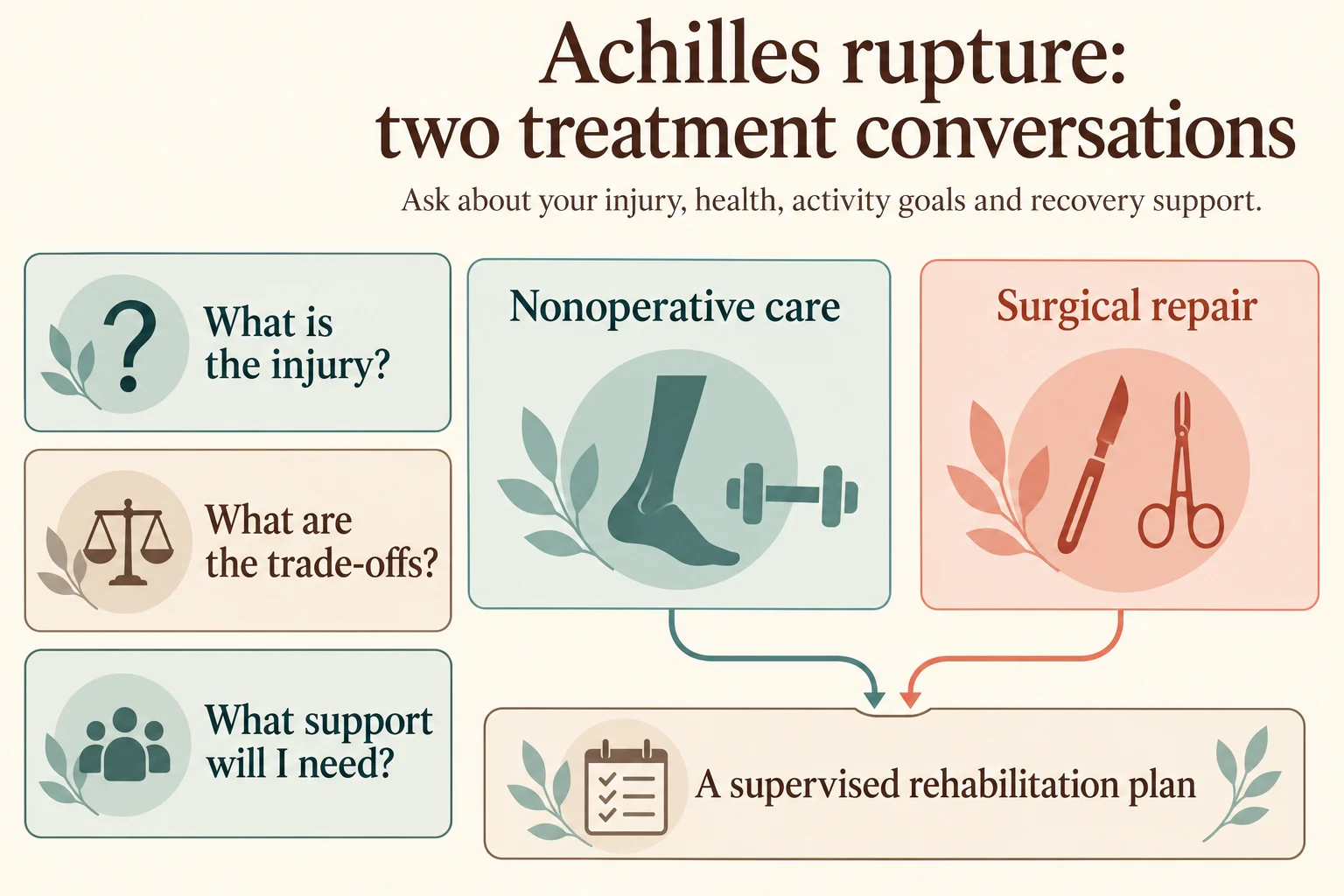
Original educational illustration. A decision graphic gives nonoperative care and surgical repair equal space and connects both to supervised rehabilitation.
Ask what the injury is, what the trade-offs are and what support you will need. Health, activity goals and the injury affect the choice. Neither pathway promises a particular recovery date or return to sport.
Illustration references: Reference 1 · Reference 2
1. Recognize why the first assessment matters
A sudden pop behind the ankle with loss of push-off strength can indicate an Achilles rupture. Some people describe feeling kicked even when nobody touched them. Seek prompt medical assessment rather than trying to test the tendon with repeated heel raises or continuing sport.
The examination often provides important diagnostic information. Ultrasound or MRI may be used when a specific uncertainty needs clarification. Tell the clinician when the event happened and whether you had tendon symptoms, previous surgery or relevant medication exposure beforehand.
2. Compare the whole treatment pathway
Both surgical and nonsurgical care may be reasonable for selected ruptures. The location and extent of the tear, timing, activity demands and general health influence the discussion. Ask how the physician weighs these factors for you.
Nonsurgical care still requires protection and a structured progression. Surgery joins or reattaches tendon tissue but also requires healing and rehabilitation. The useful comparison is between complete plans—including support, therapy and the consequences of a setback—rather than simply an operation versus a boot.
Mayo Clinic’s May 2026 review describes functional rehabilitation after surgical and nonsurgical treatment. The pathway matters because both choices require protection followed by progressive activity, and the ability to attend follow-up and therapy can affect how workable a plan is.
Ask to see the expected sequence for each option: immobilization, permitted movement, loading and later strength work. Clarify who adjusts it and how an unexpected setback will be assessed. Discuss your home layout, job demands and access to therapy before choosing a route. A plan is more useful when its demands are clear at the start.
Sources: AAOS OrthoInfo: Achilles Tendon Rupture · Achilles tendon rupture: Diagnosis and treatment
3. Ask about the risks on both sides
Surgical care introduces concerns such as wound healing, infection and nerve injury. Both pathways involve the possibility of rerupture and prolonged weakness, and reduced mobility raises other issues the team should assess. Ask which risks are most relevant to your health and the proposed technique.
If a small-incision repair is offered, ask what it changes and what it does not. If nonsurgical treatment is offered, ask how the tendon will be protected and how the team decides when to progress. You should understand the reason for either recommendation.
Sources: AAOS OrthoInfo: Achilles Tendon Rupture · AOFAS FootCareMD: Achilles Tendon Tear
4. Ask how the tendon and your health affect the repair
Johns Hopkins distinguishes repairing a newly torn tendon from removing or reconstructing extensively damaged tissue. It also describes wound, nerve and other surgical risks. Ask whether the injury pattern and time since rupture make the proposed operation straightforward or change what needs to be done.
Tell the surgeon about skin problems, diabetes, nerve symptoms and previous treatment around the tendon. Ask which personal factors influence the balance between surgery and nonsurgical care, and how those concerns would be managed. If reconstruction or another tendon is proposed, request an explanation of its purpose and the implications for rehabilitation.
Sources: Achilles Tendon Repair Surgery
5. Make the rehabilitation instructions unambiguous
Ask for written boot positioning, weightbearing, motion and therapy instructions from your own treating team. Protocols differ; mixing advice from several online recovery stories can create confusion. Confirm who changes the boot settings and which activities are restricted between visits.
Practice getting around before you leave. Discuss stairs, bathing, work, transport and whether your other leg or upper body can manage the proposed aid. If the plan is difficult to carry out at home, tell the team so the problem can be addressed rather than quietly improvising.
6. Separate walking from sport performance
Comfortable walking is an earlier goal than repeated jumping, sprinting or changing direction. Strength and confidence may continue to improve long after the first protection phase. Ask which measures the team will use to guide more demanding activity, without expecting a single date to answer every recovery question.
Bring the actual sport or job demands. Ask what improvement is realistic, what might remain different and what happens if progress is slower than expected. Keep the next milestone and contact plan clear, including when a new symptom needs earlier assessment.
7. Make protection work at home and work
Before choosing a pathway, describe the stairs, commute, work demands, and help available at home. Ask the treating team to separate the first protective phase from later strength and sport milestones. A plan that sounds manageable in the office may be difficult if your bathroom is upstairs or your job requires carrying equipment. Bring those details to the decision. Our foot and ankle profile can help you prepare a focused consultation about the injury and the recovery commitment.
Make the most of your visit
Questions to bring to your consultation
Choose the questions that matter most to you. Bring them along, and ask us to explain anything that is unclear.
- Where is the tear, and how does its pattern affect the choice?
- How soon do we need to make and begin the treatment plan?
- What benefit might surgery offer for my activities?
- How do wound, nerve and rerupture risks compare for me?
- What are my exact boot, motion and weightbearing instructions?
- Who will supervise each rehabilitation change?
- What practical support will I need at home and work?
- Which milestones will guide running, jumping and return to sport?
Sources & further reading
- AAOS OrthoInfo: Achilles Tendon RuptureAmerican Academy of Orthopaedic Surgeons (AAOS OrthoInfo)
- AOFAS FootCareMD: Achilles Tendon TearAmerican Orthopaedic Foot & Ankle Society
- Achilles tendon rupture: Diagnosis and treatmentMayo Clinic
- Achilles Tendon Repair SurgeryJohns Hopkins Medicine
We use these medical sources to help explain your options and prepare you for a conversation with our team. Our guides feature our own clinicians; patient reviews describe individual experiences.






 (310) 595-1030