
The Ultimate Guide to Plantar Fasciitis Treatment
Opening Hook
That stabbing pain in your heel when you first step out of bed in the morning—it's one of the most recognizable symptoms in orthopedics. Plantar fasciitis affects over 3 million Americans annually, making it one of the most common causes of heel pain. Whether you're a runner who pushed too hard, an office worker spending 8 hours on your feet, or someone in their 40s noticing sudden heel discomfort, plantar fasciitis can significantly impact your quality of life. The good news? Over 90% of cases resolve with conservative treatment, and when conservative approaches don't work, modern minimally invasive surgical techniques offer excellent outcomes. At Commons Clinic, we offer a comprehensive, evidence-based approach to treating plantar fasciitis—from initial conservative management through advanced surgical options when needed.
Understanding Plantar Fasciitis
Anatomy of the Plantar Fascia
The plantar fascia is a thick band of connective tissue that runs along the bottom of your foot, stretching from your heel bone to your toes. This tissue acts like a bowstring, supporting your arch and absorbing shock with each step. When you walk, run, or stand, the plantar fascia stretches and contracts thousands of times, playing a critical role in foot mechanics and energy return.
What is Plantar Fasciitis?
Plantar fasciitis is inflammation of the plantar fascia, typically where it attaches to the heel bone (calcaneus). Despite the term "inflammation," plantar fasciitis is actually a degenerative condition—it involves microscopic tears, degeneration of the fascia, and inflammation of surrounding tissues rather than acute inflammation. This distinction is important because it means:
- Rest alone doesn't cure it: The tissue requires specific rehabilitation to strengthen and remodel
- Chronic overuse is the cause: Not a one-time injury, but accumulated stress over time
- Conservative treatment targets tissue healing: Stretching, strengthening, and activity modification promote healing
- Early intervention prevents chronic disease: Addressing it quickly prevents long-term complications
The Typical Pattern
Most people experience plantar fasciitis as:
- Morning pain: Worst pain during first few steps after waking up or after sitting for extended periods
- Pain with activity: Discomfort increases with prolonged standing or walking
- Relief with warm-up: Pain typically improves as you move and warm up the tissue
- Evening pain: Pain often returns after prolonged standing/walking
This pattern reflects the biomechanics of the plantar fascia—the tissue tightens overnight and with immobility, causing pain with the initial stretch.
Risk Factors for Plantar Fasciitis
- Excessive pronation: Inward rolling of the foot during walking stresses the fascia
- High arches or flat feet: Both alter normal weight distribution
- Age 40-60: Most common in middle-aged adults
- Obesity: Increased weight stresses the plantar fascia
- Tight calves or hamstrings: Reduces ankle dorsiflexion, increasing plantar fascia stress
- Repetitive running or jumping: High-impact activities stress the fascia
- Prolonged standing: Occupational factors
- Sudden increase in activity: Beginning a new exercise program without gradual progression
- Poorly fitting shoes: Inadequate arch support
- Certain systemic conditions: Ankylosing spondylitis, reactive arthritis
The Conservative Treatment Approach: What Works
The overwhelming majority of plantar fasciitis cases (90%+) resolve with conservative treatment when properly implemented. Here's the evidence-based approach we recommend at Commons Clinic:
1. Stretching and Flexibility
Why it works: Tight calf muscles increase tension on the plantar fascia. Systematic stretching addresses this root cause.
Recommended stretches:
- Calf stretches (gastrocnemius and soleus): Hold each for 30 seconds, 3-4 times daily. Can be performed against a wall or with a strap around the foot.
- Plantar fascia self-massage: Use a golf ball or specialized massage tool under the arch, rolling from heel to toe
- Towel curls: Curl a towel with your toes to strengthen the intrinsic foot muscles
- Lumbar and hamstring stretches: Address proximal tightness that contributes to foot mechanics
Timeline: Consistency is more important than intensity. Most people see improvement with 6-8 weeks of daily stretching.
2. Physical Therapy
Why it works: PT addresses biomechanical deficits, strengthens stabilizing muscles, and improves movement patterns.
Components of effective PT:
- Intrinsic foot muscle strengthening: Exercises like short-foot exercises and toe abduction work
- Calf strengthening and eccentric loading: Eccentric calf lowering exercises (lowering slowly on one leg from a step) are particularly effective
- Proprioception and balance training: Improves foot stability
- Gait analysis and modification: Addresses compensatory movement patterns
- Activity pacing: Gradual return to activity without exacerbating symptoms
Recommended frequency: 2-3 sessions per week for 4-6 weeks initially, then maintenance exercises at home.
3. Orthotic Devices and Footwear
Why it works: Proper support redistributes pressure and reduces plantar fascia stress.
Options:
- Custom foot orthotics: Prescription inserts tailored to your arch type and biomechanics. These are significantly more effective than over-the-counter options.
- Over-the-counter arch supports: Effective for mild cases; good starting point while awaiting custom orthotics
- Night splints: Maintain plantarflexion during sleep, preventing fascia tightening overnight. Effective for morning pain symptoms.
- Proper footwear: Shoes with firm heel counters, good arch support, and appropriate cushioning. Avoid flip-flops and unsupportive shoes entirely during treatment.
Effectiveness: 60-70% of patients report significant improvement with orthotic treatment alone.
4. Rest and Activity Modification
Why it works: Reducing excessive loading allows tissue healing.
Recommended modifications:
- Avoid barefoot walking: Always wear supportive shoes with orthotics
- Limit high-impact activities: Reduce running, jumping, or prolonged standing temporarily
- Ice massage: Especially helpful after activity
- Elevation: Reduces swelling
- Modify work activities: If you stand all day, take frequent sitting breaks
Note: Complete rest is NOT recommended—gentle movement and activity at tolerable levels actually promotes healing and prevents stiffness.
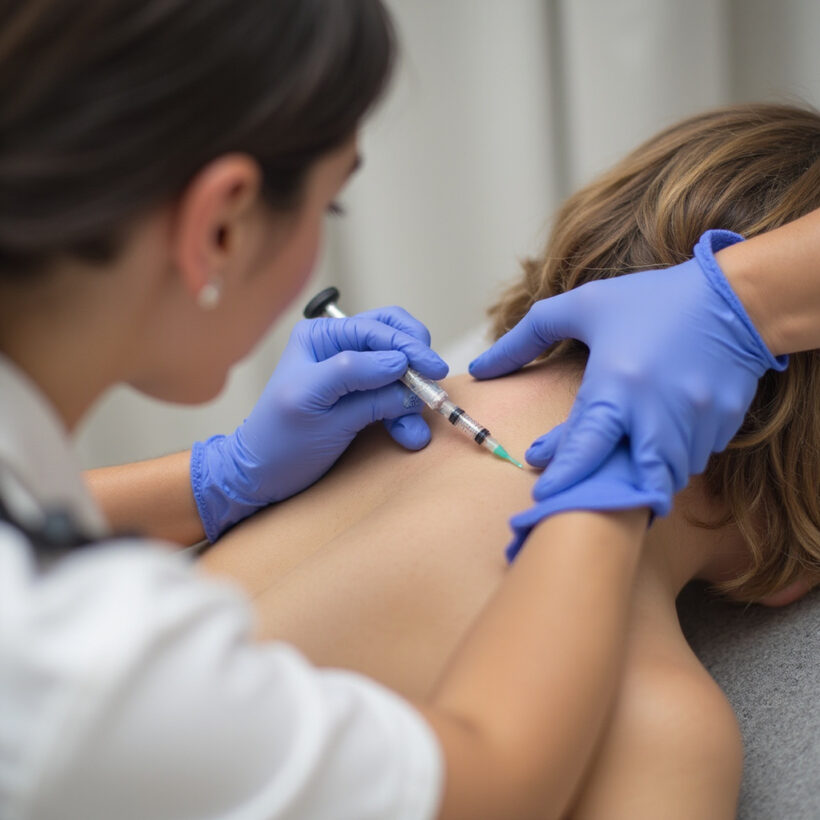
5. Cortisone Injections
When to use: After 4-6 weeks of conservative treatment when symptoms remain significant.
How it works: Corticosteroid medication injected into the area of plantar fascia inflammation provides rapid relief by reducing inflammation and pain.
Effectiveness: 70-80% of injections provide symptom improvement. Effect typically lasts 1-3 months.
Limitations:
- Temporary relief; doesn't permanently resolve the underlying degenerative process
- Maximum 3 injections per year (due to risk of tissue weakening with repeated injection)
- Works best when combined with ongoing conservative treatment (stretching, PT)
- Some patients experience recurrence after initial improvement
Risks: Minimal; very low infection risk when performed with ultrasound guidance. Rare fat pad atrophy.
Best approach at Commons Clinic: We use ultrasound-guided injection for maximum accuracy and safety. Injections are timed strategically to provide relief while ongoing conservative treatment addresses the underlying cause.
6. Shock Wave Therapy (ESWT)
When to use: For patients who've failed 6+ months of conservative treatment or prefer to avoid injections.
How it works: High-energy sound waves are directed at the plantar fascia attachment, creating a controlled inflammatory response that stimulates healing. This is a non-invasive outpatient procedure.
Effectiveness: 65-80% of patients experience significant improvement, with benefits appearing over 4-12 weeks as tissue heals.
Advantages:
- Non-invasive; no incisions
- No systemic medication side effects
- Can be repeated if needed
- Stimulates the body's natural healing response
Disadvantages:
- Not covered by many insurance plans (out-of-pocket cost typically $1,000-$2,500)
- Requires multiple sessions (typically 3-5)
- Results develop gradually; not immediate relief
- Variable effectiveness; best results in specific patient populations
Success factors: Best results in patients with failed conservative treatment for 6+ months, symptom duration less than 2 years, and good overall health.
7. Platelet-Rich Plasma (PRP) Therapy
When to use: For chronic cases or patients seeking to avoid surgery; increasingly used in sports medicine.
How it works: Blood is drawn, concentrated for platelets (which contain growth factors), and injected into the plantar fascia. These growth factors stimulate healing and tissue remodeling.
Effectiveness: Emerging research suggests 70-85% effectiveness, with improvements continuing over 3-6 months as tissue heals. May provide better long-term outcomes than cortisone alone.
Advantages:
- Stimulates tissue healing rather than just reducing inflammation
- May provide longer-lasting relief than cortisone
- Autologous (using your own blood) means no foreign substances
- Increasingly covered by insurance
Disadvantages:
- Requires drawn blood and processing time
- More expensive than cortisone injection ($800-$1,500)
- Results develop slowly (weeks to months)
- Requires appropriate candidate selection
Best used: In combination with continued conservative treatment and rehabilitation.
When Conservative Treatment Isn't Enough: Surgical Options
Despite best efforts, 5-10% of plantar fasciitis cases resist conservative treatment. If symptoms persist despite 6-12 months of appropriate conservative care, surgery becomes an option.
Surgical Criteria
Before considering surgery, ensure you've completed:
- Minimum 6-12 months of conservative treatment
- At least 2-3 cortisone injections spaced 6+ weeks apart (if tolerated)
- Consistent physical therapy (minimum 3 months)
- Proper orthotic use and footwear modification
- Imaging studies (ultrasound/MRI) confirming diagnosis and ruling out other pathology
Endoscopic Plantar Fascia Release (EPFR)
How it works: The surgeon makes 2-3 small keyhole incisions in the heel area. Using specialized instruments and visualization, the plantar fascia is carefully released/cut to reduce tension on the inflamed attachment site.
Advantages:
- Minimally invasive; only small incisions
- Rapid recovery compared to open surgery
- Excellent pain relief (85-90% success rate)
- Low infection risk
- Outpatient procedure
Disadvantages:
- Requires specialized equipment and surgeon training
- Risk of injuring nearby structures (nerve, blood vessels)
- May have minor sensory changes in heel area
- Doesn't address underlying biomechanical issues—ongoing conservative care still needed
Recovery timeline:
- Week 1-2: Non-weight-bearing, elevation, pain control
- Week 3-4: Gradual weight-bearing
- Week 4-8: Progressive return to normal activities
- Full recovery: 6-8 weeks typically; can return to walking 2-3 weeks post-op
Results: 85-90% of patients report significant pain relief; 80-85% report satisfaction with outcomes.
Open Plantar Fascia Release
How it works: A larger incision (1.5-2 inches) is made on the heel, providing direct visualization of the plantar fascia. A portion of the fascia is released to reduce tension.
Advantages:
- Direct visualization
- Slightly lower risk of nerve injury
- May address associated heel pad syndrome or bony spurs
Disadvantages:
- Larger incision; more visible scar
- Longer recovery time
- Higher infection risk than endoscopic approach
- More post-operative pain
Recovery timeline:
- Week 1-2: Non-weight-bearing
- Week 3-6: Gradual weight-bearing
- Week 6-12: Progressive return to activities
- Full recovery: 3-4 months typically
Results: Similar to endoscopic release (85-90% success rate), but longer recovery.
At Commons Clinic: Dr. David Lee prefers the endoscopic approach when appropriate candidate, reserving open release for complex cases or when additional pathology requires direct visualization.
Comparison Table: Treatment Options
| Feature | Conservative (Stretching/PT) | Cortisone Injection | Shock Wave Therapy | PRP Injection | Surgery (EPFR) |
|---|---|---|---|---|---|
| Success rate | 90% | 70-80% | 65-80% | 70-85% | 85-90% |
| Time to improvement | 4-12 weeks | 1-2 weeks | 4-12 weeks | 4-12 weeks | 2-6 weeks |
| Cost | $2,000-$5,000 | $200-$500 per injection | $1,000-$2,500 | $800-$1,500 | $8,000-$15,000 |
| Invasiveness | Non-invasive | Minimally invasive | Non-invasive | Minimally invasive | Minimally invasive |
| Risk of re-rupture | N/A | Rare | Very rare | Very rare | 5-10% |
| Permanence | Lasting if maintenance continues | Temporary (1-3 months) | Usually permanent | Usually permanent | Usually permanent |
| Number of treatments | Ongoing exercises | 1 injection; max 3/year | 3-5 sessions | 1-3 injections | Single procedure |
| Recovery time | Ongoing | Same day | Same day | Same day | 2-3 weeks return to walking |
| Best for | First-line; most patients | Failed conservative after 4-6 weeks | Failed conservative 6+ months | Failed conservative; prefers tissue healing | Failed conservative 6-12 months |
| Insurance coverage | Covered | Usually covered | Variable; often not | Increasingly covered | Covered |
Benefits and Risks
Benefits of Comprehensive Conservative Treatment
High success rate: 90% of cases resolve with appropriate conservative treatment.
Low risk: Conservative approaches are safe with minimal side effects.
Long-term solution: Addresses underlying biomechanical issues rather than just treating symptoms.
Improved overall foot function: Strengthening and stretching provide lasting benefits.
Cost-effective: Initial investment in orthotics and PT typically costs less than surgery.
Preventive: Strong, well-conditioned feet are less prone to future injury.
Risks of Conservative Treatment (Minimal)
Time requirement: Takes consistent effort over several months; requires patient commitment.
Temporary flare-ups: Symptoms may worsen transiently with activity increases.
Cost of orthotics and PT: Variable out-of-pocket depending on insurance.
Benefits of Surgical Treatment
Rapid symptom resolution: 85-90% of patients experience dramatic pain improvement.
Permanent relief: Unlike injections, relief typically lasts years or indefinitely.
Improved function: Enables return to activity level not possible with conservative treatment.
Minimally invasive: Endoscopic approach involves only small incisions.
Quick return to activity: Can return to walking within 2-3 weeks.
Risks of Surgical Treatment (Uncommon)
Nerve injury: 2-5% risk of injuring the lateral plantar nerve, causing heel numbness or tingling. Usually resolves spontaneously; rarely permanent.
Infection: <1% risk; managed with antibiotics.
Insufficient relief: 5-10% of patients don't achieve expected improvement.
Heel pain persistence: Some patients experience residual pain; may relate to other causes (nerve pain, fat pad atrophy).
Arch flattening: Rare; loss of plantar fascia support can theoretically affect arch. Preventable with proper post-operative activity progression.
Re-rupture/recurrence: 5-10% recurrence rate; usually responds to conservative treatment.
Why Patients Choose Commons Clinic for Plantar Fasciitis Treatment
At Commons Clinic, we believe in the hierarchical approach: first, we invest in conservative treatment with the resources and expertise to make it work. Only when conservative approaches have genuinely failed do we recommend surgery.
Evidence-Based Protocol: We follow the latest research on plantar fasciitis management. Our protocol emphasizes proper stretching, PT, orthotic prescription, and strategic injection timing.
Extended Consultation Time: We spend 45-60 minutes (3x national average) fully understanding your symptoms, examining your biomechanics, and creating a personalized treatment plan.
Comprehensive Imaging: Ultrasound assessment guides injection placement, confirms diagnosis, and excludes mimics like nerve pain or insertional pain.
Custom Orthotics In-House: We don't refer you elsewhere for orthotics—our specialists fabricate custom devices tailored to your specific biomechanics.
Vertically Integrated Care: Physical therapy, injections, imaging, and surgical care are all coordinated under one roof at our MOSI surgery center. No referrals between offices.
Minimally Invasive Surgery: When conservative treatment fails, Dr. Lee performs endoscopic plantar fascia release—a gold-standard, minimally invasive approach with rapid recovery.
Care Guarantee: We stand behind outcomes with a 2-year Care Guarantee. If complications arise, we manage them.
Accessible Pricing: Through surgery benefit plan partnerships (Carrum, Transcarent, LanternCare), many patients achieve $0 out-of-pocket surgical care.
Frequently Asked Questions
Q: How long should I try conservative treatment before considering surgery?
A: The standard recommendation is 6-12 months of appropriate conservative treatment. This should include consistent stretching/PT, proper orthotics, at least 2-3 cortisone injections, and possibly shock wave therapy. Only after this comprehensive approach hasn't resolved symptoms should surgery be considered.
Q: Will shock wave therapy cure my plantar fasciitis?
A: Shock wave therapy has 65-80% effectiveness in carefully selected patients (typically 6+ months of failed conservative care). It doesn't "cure" in the sense of restoring normal tissue, but it stimulates healing and provides lasting relief in most successful cases. It's best used as part of comprehensive care, not as standalone treatment.
Q: Can I avoid surgery if I'm willing to change my lifestyle?
A: Yes—in fact, lifestyle modification is the cornerstone of conservative treatment. Proper footwear, consistent stretching, activity pacing, and orthotics work for 90% of patients. Surgery is truly a last resort for the small percentage who fail comprehensive conservative care.
Q: Is PRP therapy worth the cost?
A: PRP is increasingly used and shows promising results (70-85% effectiveness) in research studies. It may provide better long-term outcomes than cortisone alone, and insurance coverage is improving. If you've failed cortisone injections and are exploring non-surgical options, PRP is worth discussing with your surgeon.
Q: What happens if surgery doesn't relieve my pain?
A: 85-90% of endoscopic releases are successful, but 5-10% of patients experience inadequate relief. This may reflect inadequate surgical release, fascia reformation, or alternative pain sources (nerve irritation, fat pad syndrome). These cases typically require further evaluation and possibly revision surgery or additional interventions.
Q: Can I return to running after treatment?
A: Yes—most patients return to running successfully with appropriate conservative or surgical treatment. However, return-to-running requires graduated progression. Start with walk/jog intervals 4-6 weeks after symptoms resolve, then gradually increase running duration. Proper orthotics and footwear remain essential.
Q: How much does plantar fasciitis treatment cost at Commons Clinic?
A: Conservative treatment typically costs $2,000-$5,000 (including orthotics and PT). Cortisone injections cost $200-$500 per injection. Shock wave therapy typically costs $1,000-$2,500 for 3-5 sessions. Endoscopic surgery ranges $8,000-$15,000. We accept Aetna, Cigna, Anthem Blue Cross, Blue Shield of California, and United Healthcare. Many patients qualify for $0 out-of-pocket surgery through our benefit plan partnerships.
Q: What's the most important thing I can do to recover?
A: Consistency. Plantar fasciitis requires daily stretching, proper footwear/orthotics, and activity pacing. Missing stretches, wearing unsupportive shoes, or pushing too hard resets your progress. The patients who recover fastest are those who commit to conservative management as a lifestyle change, not a temporary inconvenience.
Key Takeaways
Plantar fasciitis is degenerative, not inflammatory: Proper treatment targets tissue healing and remodeling, not just inflammation.
Conservative treatment works 90% of the time: Stretching, PT, orthotics, and proper activity pacing resolve most cases.
Consistency matters more than intensity: Daily stretching and proper footwear are more effective than occasional therapy sessions.
Cortisone injections are strategic, not primary: Best used after initial conservative care, not as first-line treatment. Limit to 3 per year.
Custom orthotics outperform over-the-counter: Proper arch support tailored to your biomechanics is more effective than generic inserts.
Night splints help morning pain: These simple devices prevent overnight fascia tightening, reducing dawn pain.
Newer options exist: Shock wave therapy and PRP offer non-surgical alternatives for failed conservative care before resorting to surgery.
Surgery has 85-90% success rate: Endoscopic plantar fascia release is highly effective for truly refractory cases, with rapid recovery.
Maintenance is ongoing: Even after successful treatment, you'll need to maintain proper footwear and stretching to prevent recurrence.
Early intervention prevents chronic disease: Treating plantar fasciitis early prevents it from becoming a chronic pain condition.
Call to Action
If plantar fasciitis is limiting your activities or if you've been struggling with heel pain despite various treatments, Commons Clinic offers a comprehensive, evidence-based approach that has helped hundreds of patients.
Take the first step toward pain-free feet.
- Schedule your consultation with Dr. David Lee: Call (310) 437-7921 or email hello@commonsclinic.com
- Prefer virtual? Initial consultations available nationwide via secure video
- Immediate care available: Custom orthotics, ultrasound-guided injections, and physical therapy scheduling available within days
- Concerned about cost? Ask about our $0 out-of-pocket options through Carrum, Transcarent, and LanternCare
- Visit us: Santa Monica, Marina del Rey, Beverly Hills, or Long Beach clinics
Commons Clinic: Healing feet. Restoring lives.
Sources and References
- American Academy of Orthopaedic Surgeons (AAOS). "Plantar Fasciitis." OrthoInfo.org
- Lemont, H., et al. (2014). "Plantar fasciitis: a degenerative process (fasciosis) without inflammation." Journal of the American Podiatric Medical Association, 93(3), 234-237.
- Goff, J. D., et al. (2012). "Plantar fasciitis: diagnosis and management." American Family Physician, 84(6), 676-682.
- Abi-Raad, R., et al. (2016). "Extracorporeal shock wave therapy for chronic plantar fasciitis: systematic review." Foot and Ankle Surgery, 22(4), 220-227.
- Peerbooms, J. C., et al. (2019). "Platelet-rich plasma for plantar fasciitis." American Journal of Sports Medicine, 47(7), 1694-1701.



 (562) 348-4588